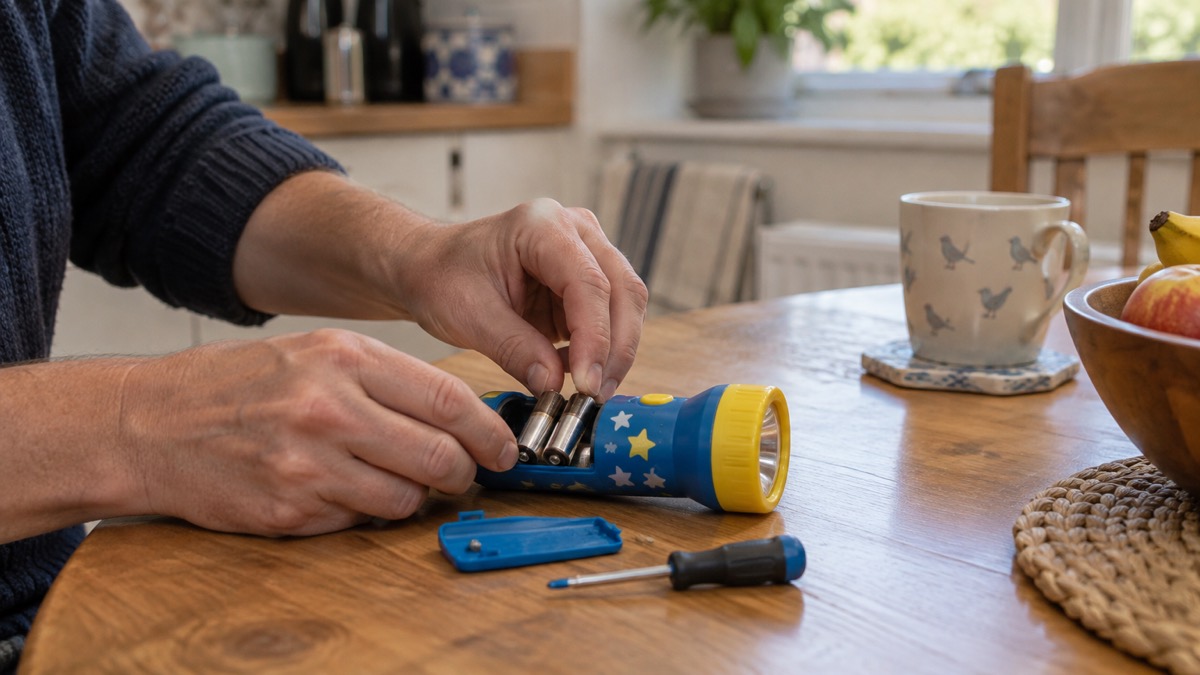
The Ledlenser KidBEAM4 is a handheld torch made for children aged 3 and over, sold as a robust first torch. It puts out 70 lumens on full power, reaching 12 metres, and drops to 10 lumens on low power, where the maker quotes an 18-hour runtime and a 5-metre beam1. It runs on two AAA batteries, and the battery compartment is screw-secured so a young child cannot open it unsupervised1.
For a household, that combination is the point. A child who has their own torch is less likely to reach for a candle or an adult's tool in a power cut, and a torch that survives being dropped and cannot be taken apart by small hands removes the two things that most often go wrong. The maker rates it to survive a drop of 1.5 metres and fits reduced-glare optics for sensitive eyes1.
This page sets out what the torch does, how long it runs, how to fit rechargeable batteries, and how to use and store it safely. It does not compare it with other torches, and it gives no prices.
What the KidBEAM4 is and who it suits
Ledlenser describes the KidBEAM4 as "a robust, fun first torch for children aged 3 and over"1. It is a handheld torch, held in the hand and pointed where the child wants, with an integrated clip for a jacket, school bag or belt loop3. That makes it a torch a child carries and uses themselves, rather than one an adult holds for them.
It sits alongside the maker's KidLED head torches, and the difference matters when you choose. The KidLED2 and KidLED4R are head torches worn on a headband for hands-free light; the KidBEAM4 is held in the hand. Both ranges share the automatic switch-off, the reduced-glare optics and the coloured light modes3. If your child wants light while using both hands, a head torch suits better; if they want a torch to carry, point and clip on, this is the handheld option. Our page on torches for children covers the wider question of what is safe for young children to use.
The torch is built from ABS plastic and carries an IP44 rating, which the maker describes as splash resistant1. That is protection against splashes, not immersion, so it should not go in water. It is rated to work between -20°C and +40°C1, which covers a cold night in a power cut and a hot car in summer.
Light modes and brightness: 70 lumens down to 10
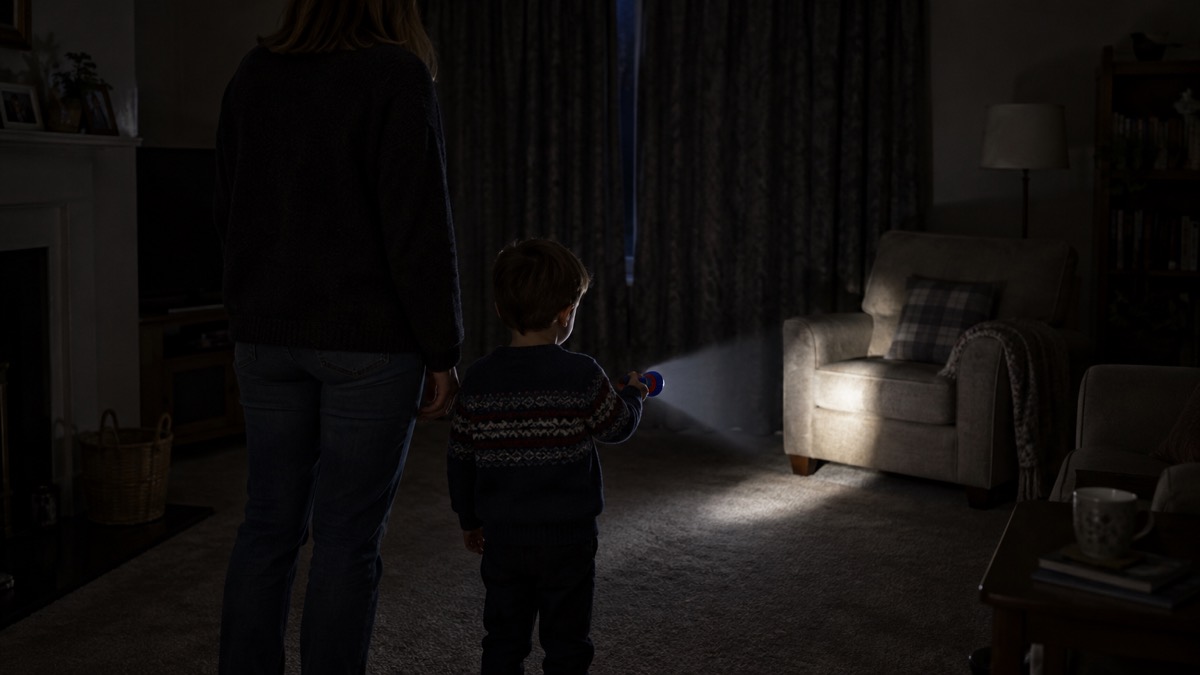
The KidBEAM4 has white, red, green and blue light, and the maker lists power, low power and blink settings across those colours2. In practice a child will use two of them: white power at 70 lumens for seeing across a room or garden, and white low power at 10 lumens for close work, reading or moving around without dazzling anyone2.
The gap between those two figures is the useful part. Seventy lumens is bright enough to light a path or search a cupboard, and the maker quotes a 12-metre beam for it1. Ten lumens is dim enough to use in a tent, a bedroom or a car without ruining night vision, and it is the setting that gives the long runtime2. Teach a child which is which: the bright setting for finding things, the dim setting for being close to people.
The coloured modes have their own uses. Red light is easier on dark-adapted eyes and less disruptive at night, which is why it appears on torches generally; our page on red light mode explains when it helps. The blink settings are for being seen rather than seeing, and a child should be told not to shine any mode into anyone's eyes. Our page on looking into a torch beam covers why that matters and what to do.
The maker gives a colour rendering index of 70 and a colour temperature of 6,000K to 6,500K1. That is a cool white light, typical of an LED torch, which shows shapes and edges clearly but renders colours less faithfully than daylight. For a child's torch that is a sensible trade: the priority is seeing where you are going, not matching paint colours.
| Mode | Brightness | Beam distance | Run time |
|---|---|---|---|
| White power | 70 lumens | 12 metres | 4 hours |
| White low power | 10 lumens | 5 metres | 18 hours |
Figures as given by the maker1.
Run time: up to 18 hours on low power
The headline figure is 18 hours on white low power, at 10 lumens with a 5-metre beam2. That is a long time for a small torch, and it is the setting to leave a child's torch on overnight or during a long power cut. On white power the maker quotes 4 hours at 70 lumens with a 12-metre beam2. The two figures describe different modes, not a disagreement: the torch runs four times longer when it is four times dimmer, which is how LED torches behave.
For a household, the practical lesson is to set expectations. A child who leaves the torch on full power will flatten the batteries in an evening; one who uses low power will still have light the next morning. Show them the switch positions and explain that the dim setting is the one for sitting and waiting. Our page on how long a torch battery lasts on low explains the general principle.
The optional automatic switch-off helps here. The maker says the torch can switch itself off after 20 minutes, a mode activated through the front switch, which prevents battery drain when a child forgets to switch it off4. It is optional, so you can leave it off when the torch needs to stay on, and turn it on for everyday use. For a child who regularly leaves a torch face down on a bedroom floor, it is the single most useful setting on the light.
Battery life also depends on the cells. Alkaline AAA batteries are included with the torch1. Rechargeable NiMH cells work but run at a lower voltage, which the maker says may slightly affect maximum output2. Either way, keep a spare pair of AAA cells with the household's other spares; our checklist of spare batteries to keep sets out what is worth holding.
Built for small hands: lockable battery compartment, drop testing and reduced glare
Three design choices decide whether a children's torch is safe and whether it lasts, and the maker addresses all three.
The battery compartment is lockable and screw-secured, and the maker states it "requires a screwdriver to open"1. That is a deliberate barrier: small button and AAA batteries are a swallowing hazard for young children, and a compartment a child cannot open removes the risk of them getting at the cells. Keep the screwdriver somewhere your child cannot reach, and change the batteries yourself rather than letting an older sibling do it. Our page on torches, candles and children covers the wider safety picture, and our page on storing spare coin cells safely explains why small batteries need care even when they are not in a torch.
The torch is drop tested to 1.5 metres1. That is roughly the height of a child's hand or a kitchen worktop, so a dropped torch should keep working. It is a test figure, not a guarantee, and a torch that has been dropped hard should be checked for cracks before a child uses it again.
The optics are reduced-glare, which the maker says are "designed specifically for sensitive children's eyes" for comfortable illumination without harsh dazzle2. That matters because children hold torches close to their faces and point them at each other. It does not make the torch safe to shine in someone's eyes, and the usual rule applies: point it at the floor or the wall, not at people.
Charging, batteries and storage
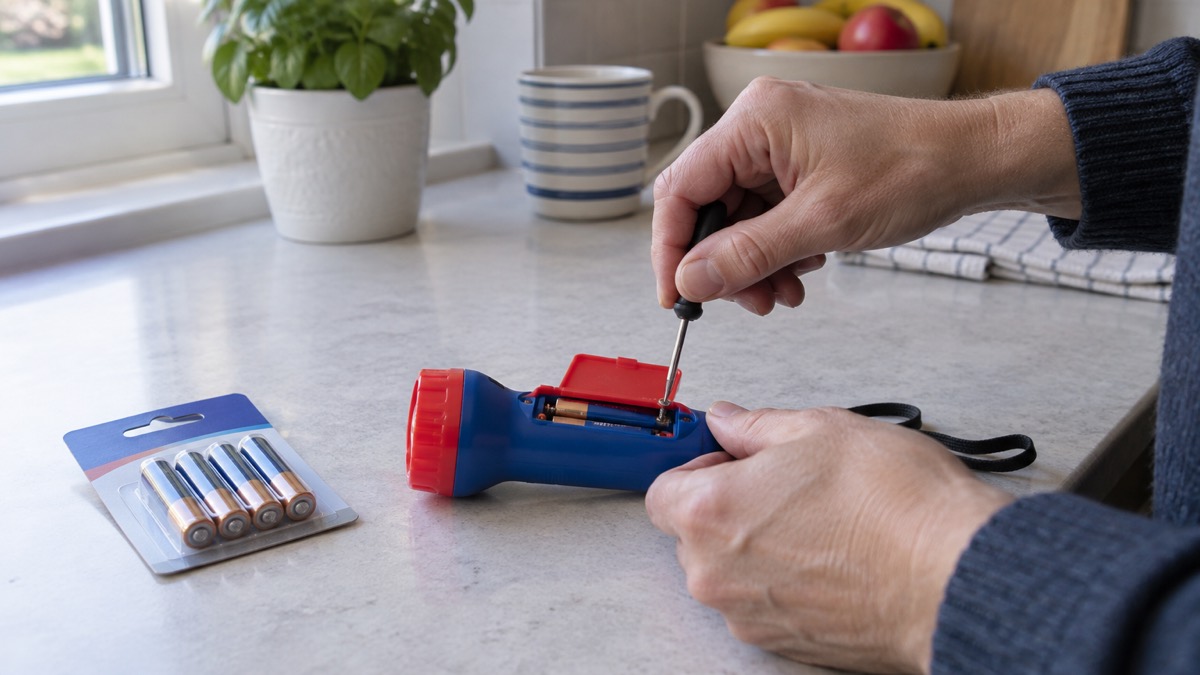
The KidBEAM4 does not have a built-in rechargeable battery. It takes two AAA cells: alkaline 1.5V as supplied, or AAA NiMH 1.2V rechargeables1. The maker says NiMH cells are charged in a separate external AAA charger, and that their lower voltage may slightly affect maximum output2. So the routine is simple: keep a set of charged NiMH cells ready, swap them in when the torch dims, and put the flat ones on charge.
Follow the maker's instructions for the torch and for the charger you use. Use a charger designed for AAA NiMH cells, charge them where you can see them and not overnight on a soft surface, and do not mix cells of different types or ages in the torch. Our page on charging and storing rechargeable torches safely sets out the general rules, and our page on torch batteries explains the difference between AAA, AA and built-in packs.
For storage, take the batteries out if the torch will not be used for a long period, and keep it somewhere dry and within reach. A torch kept in a drawer with no batteries is no use in a power cut. Our page on where to keep torches so you can find them in the dark has suggestions that work for a child's torch too.
Support, warranty and returns
Ledlenser gives the KidBEAM4 a 2-year standard warranty1. The maker also invites owners to register their light online for extended cover, describing registration as a way to add "extended peace of mind and long-term reliability"5. Registration is worth doing when the torch arrives, because it is easier to find the details later if something goes wrong.
The UK site advertises "Fast Delivery & Free UK Returns"5, and the maker points owners to "friendly, knowledgeable support from our UK team" for assistance5. Check the returns terms on the site at the time you buy, since the conditions in force then are the ones that apply. A fault with the torch itself is a warranty matter rather than a return, so keep the order details and contact the UK team first.
The torch is engineered in Germany5. None of this changes how you use it, but it tells you where to go for help: the UK team for delivery, returns and warranty questions, and the registration page for extending cover.
Sources (5)
- KidBEAM4 Green Dinos children's torch, Ledlenser, 2026-10-26
- KidBEAM4 Blue Police children's torch, Ledlenser, 2026-10-26
- Kids' torch range, Ledlenser, 2026-10-25
- KidBEAM4 Purple Rainbows children's torch, Ledlenser, 2026-10-26
- HF Series, Ledlenser, 2026-10-25

 NEBO Einstein 250
 Fenix HP16R Head Torch