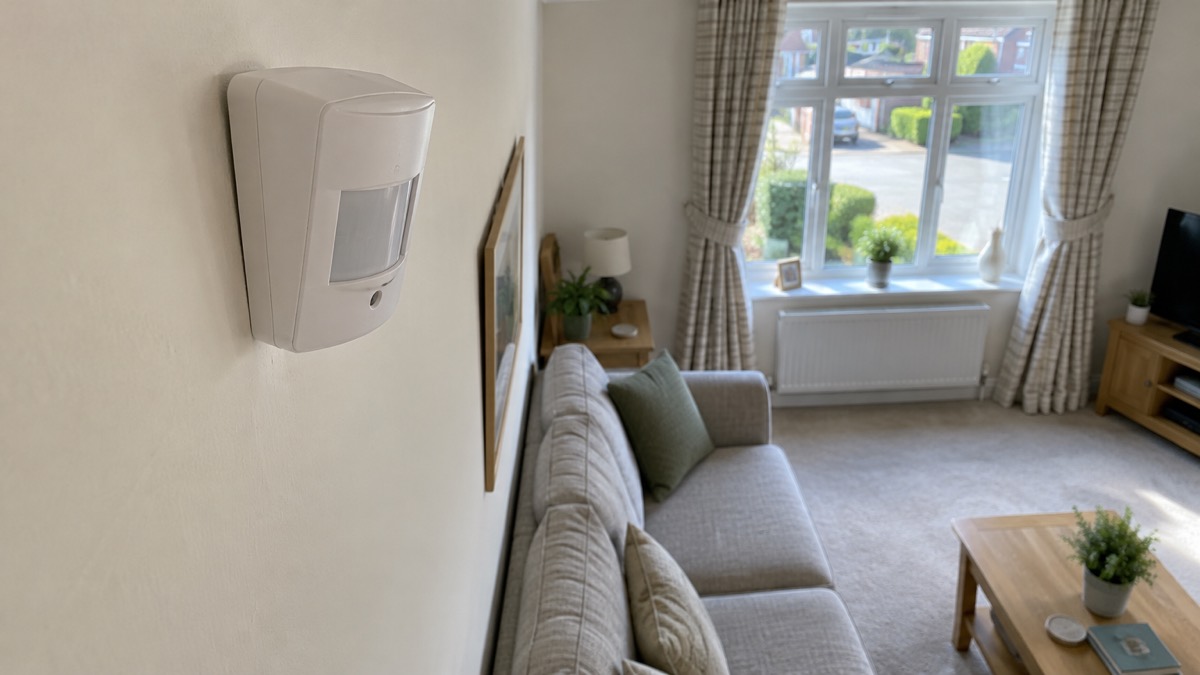
The Ajax CombiProtect is a wireless indoor detector that watches for two things at once: someone moving through a room, and the sound of glass breaking. It is one unit rather than two, which makes it a practical choice for a living room, hallway or landing where you want both kinds of cover without doubling up on sensors. Ajax describes it as a "Wireless IR motion and glass break detector with microphone"1.
If you are deciding whether it suits your home, the headline figures are these. Motion detection reaches up to 13.7 × 16.0 m at the High sensitivity setting1. Glass break detection reaches from 1 to 30 ft, again at High sensitivity1. It runs on a single CR123A battery, pre-installed, with a calculated battery life of up to 5 years1. Pets up to 44 lb and 1.6 ft tall should not trigger it1.
It is an indoor device only, and it is not a standalone alarm. It reports to an Ajax hub, and you need the hub and the app to receive alerts. This page sets out what it detects, how to fit it, how to change the battery safely, and where its limits lie.
What the CombiProtect does, and where it fits
The unit combines a passive infrared motion sensor with an electret microphone for glass break1. The motion side is a standard PIR: it notices the movement of a warm body across its field of view. The glass break side listens for the sound signature of shattering glass, and Ajax uses a "DualTone" two-factor software algorithm that verifies a break by both low and high sound frequencies1. That two-stage check is what stops a dropped plate or a slammed door being mistaken for a window going through.
The practical effect is that one device covers a room's two most common points of entry: the door or hallway someone walks through, and the window they break to get in. If you are working out where sensors belong across a whole house, the wider guide to burglar alarms sets out the types and how they compare, and the page on which alarm sensors are safe to use with pets covers the pet question in more depth.
It is part of the Ajax ecosystem, so it needs a hub. The Ajax Hub (2 Plus, 2, Plus) is the control unit it reports to. If you want a single-purpose glass detector instead, the Ajax GlassProtect covers that ground on its own, and the Ajax MotionProtect (standard, Plus) does motion only.
Motion detection range and sensitivity settings
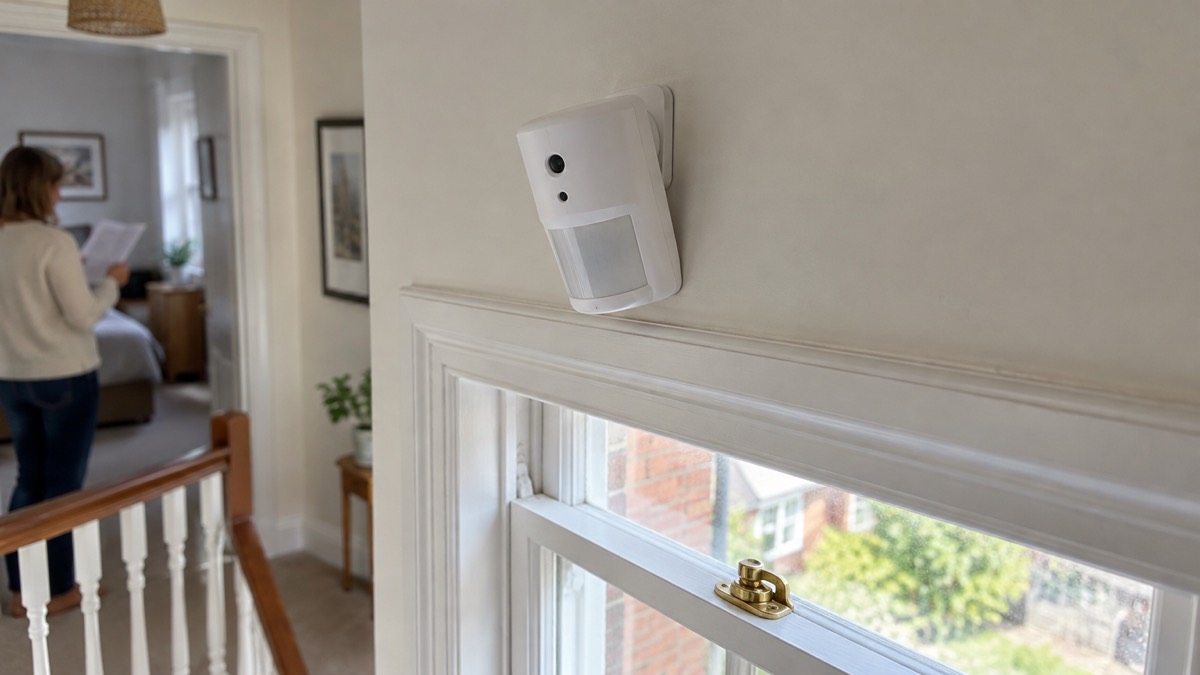
The motion range depends on the sensitivity level you choose, and Ajax gives three. At High the detector covers 13.7 × 16.0 m (44.9 × 52.4 ft); at Normal, 8.6 × 7.6 m (28.2 × 24.9 ft); at Low, 7.5 × 4.8 m (24.8 × 15.7 ft)1. The horizontal detection angle is 88.5°1, and it picks up movement at speeds from 1 to 6.6 ft/s1.
That spread matters more than it first appears. A large open-plan room may need High to cover the far corner, but High also reaches further into a hallway and may pick up movement through a doorway you would rather it ignored. A small box room on High will trigger constantly. Start at Normal, walk-test the room, and move up or down from there.
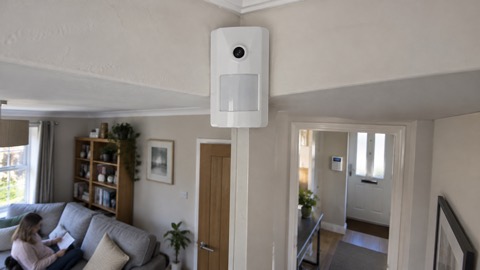
Ajax recommends mounting the detector at a height of 7.9 ft1. Height is not a detail: a PIR looks down and out across its field, and fitting it too low narrows the coverage and makes it more likely to catch a pet at floor level. The CombiProtect U Jeweller states its motion detection distance of up to 12 m applies when installed at a height of 2.4 m2, which is close to the same figure.
Pets, false alarms and getting the settings right
Ajax states pet immunity for animals weighing up to 44 lb and standing up to 1.6 ft tall1. The CombiProtect U Jeweller gives the same height limit as up to 50 cm2. The principle is that a small animal moving across the floor stays below the beam pattern, while a person walking upright crosses it.
Two things undercut that in practice. A cat on a sofa back or a shelf is at person height, and will trigger the detector whatever the pet immunity figure says. And a large dog close to the 44 lb limit may still register depending on how it moves. Pet immunity is a design tolerance, not a switch.
The detector also carries Ajax's SmartDetect false alarm prevention software1, which is intended to filter out signals that do not look like a person. That helps with curtains moving and sunlight shifting across the room, but it is not a substitute for sensible siting: keep the unit away from radiators, windows that catch direct sun, and anything that moves in a draught.
If you have a dog and are weighing up how much deterrent value it adds alongside sensors, the page on dogs as a burglar deterrent covers the law and the practicalities.
Glass break detection: what it hears and what blocks it
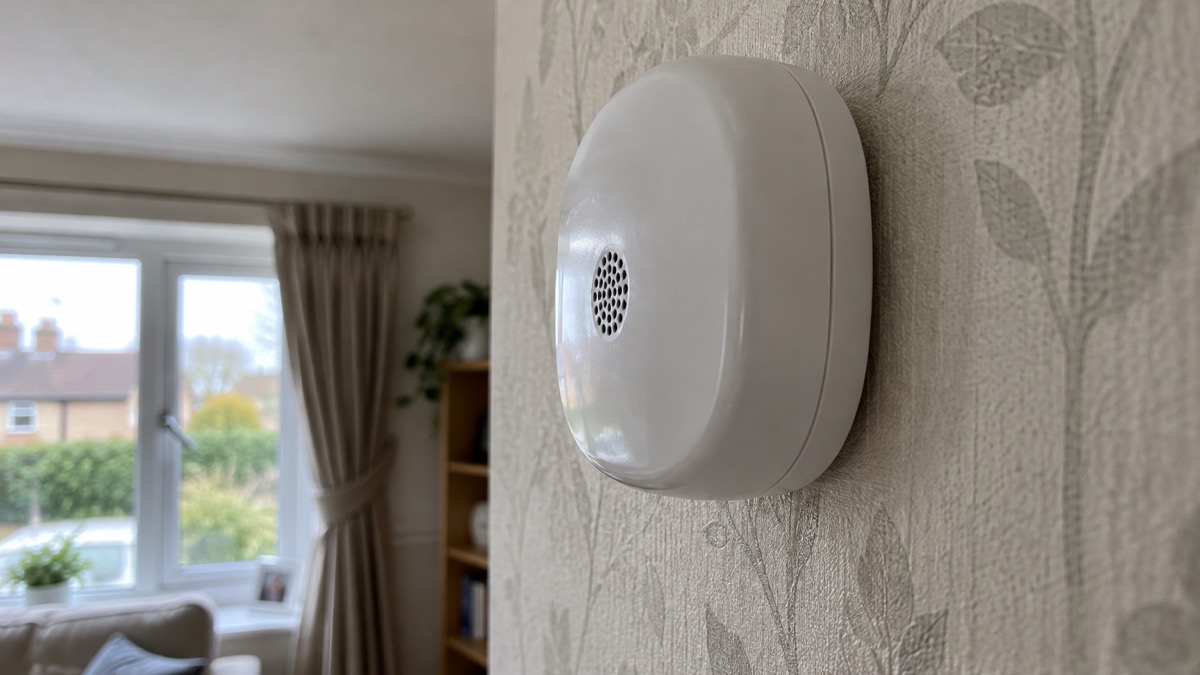
At High sensitivity the detector hears breaking glass from 1 to 30 ft, across a horizontal angle of 180°1. Ajax states that the 30 ft distance applies to all glass types at that setting1. The minimum glass size it will register is 11″ × 11″1.
It is tuned to particular glass constructions, and the thicknesses Ajax lists are worth checking against your windows:
| Glass type | Thickness the detector is rated for |
|---|---|
| Standard pane | ⅛" and ⅜"1 |
| Tempered | ⅛" and ⅜"1 |
| Laminated | ⅛" and ½"1 |
| Wired | ¼"1 |
| Insulated | ⅛" and ¼"1 |
| Annealed | ¹⁄16"1 |
That warning collides with common summer advice. Official heatwave guidance suggests sticking up removable window films or whitewash paint, or installing permanent reflective solar films on the glass, to keep heat out3. Both are reasonable for comfort, but a film on a watched window defeats the detector. If you need to cut glare or heat on a window the CombiProtect covers, consider shading from outside or a blind instead, and rely on the motion side of the detector for that room.
The same logic applies to replacement glazing. The page on what PAS 24 means for your doors and windows explains what that standard covers. A properly accredited window is harder to break in the first place, which reduces reliance on hearing it happen.
Battery life and how to change the CR123A safely
The CombiProtect takes one CR123A battery, pre-installed, and Ajax calculates up to 5 years of life from it1. The full battery capacity is 1,600 mAh, and the device switches off at an end-of-life voltage of 2.1 V, by which point capacity has fallen to 300 mAh1. The nominal operating voltage is 3 V, with an operating range of 2.1 to 3.3 V1.
The low battery warning is reported at 2.5 V, and it clears once the voltage recovers to 2.7 V1. Ajax notes that battery status does not update instantly but within a ping period, every 36 seconds by default4. So a warning in the app reflects the state within the last minute or so, not the instant you look.
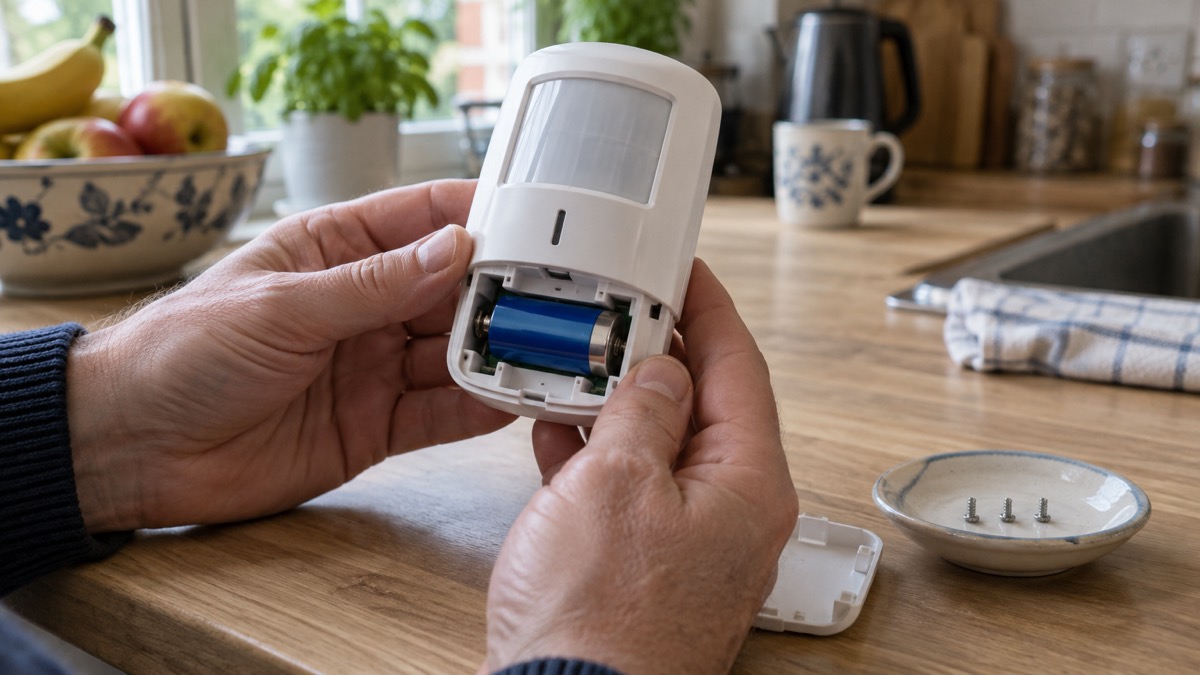
Ajax's own instructions for changing the battery are as follows4:
- Remove the detector from the SmartBracket attachment panel.
- Switch off the device.
- Loosen the three screws and remove the front and back of the detector.
- Change the battery, observing the polarity.
- Reattach the back panel and tighten the three screws.
- Turn the detector on and check the battery status in the mobile application.
Ajax adds a clear instruction: "Do not install already used or damaged batteries"4. It also notes that if other batteries are installed, the operating time may differ from the calculated time4. The datasheet lists Huiderui or Duracell, UL listed, as the battery manufacturers1.
Tamper alerts, encryption and UK security standards
The detector reports a tamper alarm on attempts to detach it from the surface or remove it from the mounting panel1. That is the difference between a sensor that can be quietly disabled and one that tells you it is being interfered with.
On the radio side, Ajax states the detector uses frequency hopping to prevent radio interference and jamming1, and that all stored and transmitted data is protected by block encryption featuring a dynamic key1. It also lists protection against spoofing by device authentication1. The CombiProtect U Jeweller carries the same encryption and frequency hopping, plus device authentication and communication loss detection after 36 seconds2.
The standards it is tested against are the part an insurer or installer will look for. Both models are Security Grade 21. The Jeweller lists EN 50131-1:2006 / A1:2009 / A3:2020, EN 50131-2-2:2017, EN 50131-6:2017, EN 50131-5-3:2017, EN 50131-2-7-1:2012 and PD 6662:20171. It also lists UL 639 and ULC S306 (Canada) for intrusion detection1, and PSTI UK Schedule 1 compliance1, which is the UK's product security regime for connected devices.
If you are checking whether a product's approvals are what they claim, the page on how to tell if a security product is police approved explains the difference between a standard and an approval scheme.
CombiProtect and CombiProtect U: what differs
There are two versions, and the differences are worth knowing before you buy. Both are wireless indoor motion and glass break detectors with a microphone, both take one CR123A battery with a calculated life of up to 5 years, both are Security Grade 2 and both carry a 24 month warranty1.
| Feature | CombiProtect Jeweller | CombiProtect U Jeweller |
|---|---|---|
| Motion detection | 13.7 × 16.0 m at High1 | up to 12 m at 2.4 m height2 |
| Glass break distance | 1 to 30 ft1 | 0.3 to 9 m2 |
| Sensitivity levels | three1 | three2 |
| Radio range | not stated on datasheet | up to 1,200 m2 |
| Communication loss detection | not stated on datasheet | after 36 s2 |
| Operating temperature | 14 °F to 104 °F1 | −10 °C to +40 °C2 |
| Colours | Black, White1 | Black, White2 |
| Warranty | 24 months1 | 24 months2 |
The U version's stated radio range of up to 1,200 m and its communication loss detection make it the more informative of the two on link quality, which matters in a large or thick-walled house. The Jeweller datasheet gives its frequency bands as 866.0 to 866.5 MHz, 868.0 to 868.6 MHz, 868.7 to 869.2 MHz, 905.0 to 926.5 MHz, 915.85 to 926.5 MHz and 921.0 to 922.0 MHz depending on the sales region1, while the U version lists 868.0 to 868.6 MHz2. Both use GFSK modulation1.
Installation, environment and where it should not go
Ajax is explicit: "The device is designed for indoor use only"1. The IP50 rating on both models confirms it is not weatherproof1. That rules out a garage, shed, porch or any unheated outbuilding, and it rules out fitting one under a leaking gutter or beside a window you leave open in the rain.
The operating range is 14 °F to 104 °F for the Jeweller1 and −10 °C to +40 °C for the U2, with humidity up to 75%1. Ajax states motion detection is effective across that range1. The UL/ULC certified range for the Jeweller is wider, 32 °F (0 °C) to 120 °F (+49 °C), with humidity up to 93%1, but that is a certification figure rather than the everyday operating range.
For an outbuilding, look at sensors built for the job rather than pushing an indoor unit past its rating. The Ajax DoorProtect Plus and the Ajax MotionCam Outdoor are the outdoor-rated options in the range, and the Ajax DoorProtect Outdoor Jeweller datasheet sets out the outdoor specification. If your concern is a garage that floods, the page on how to stop a garage from flooding covers making a damaged home safe afterwards.
Support, warranty and what comes in the box
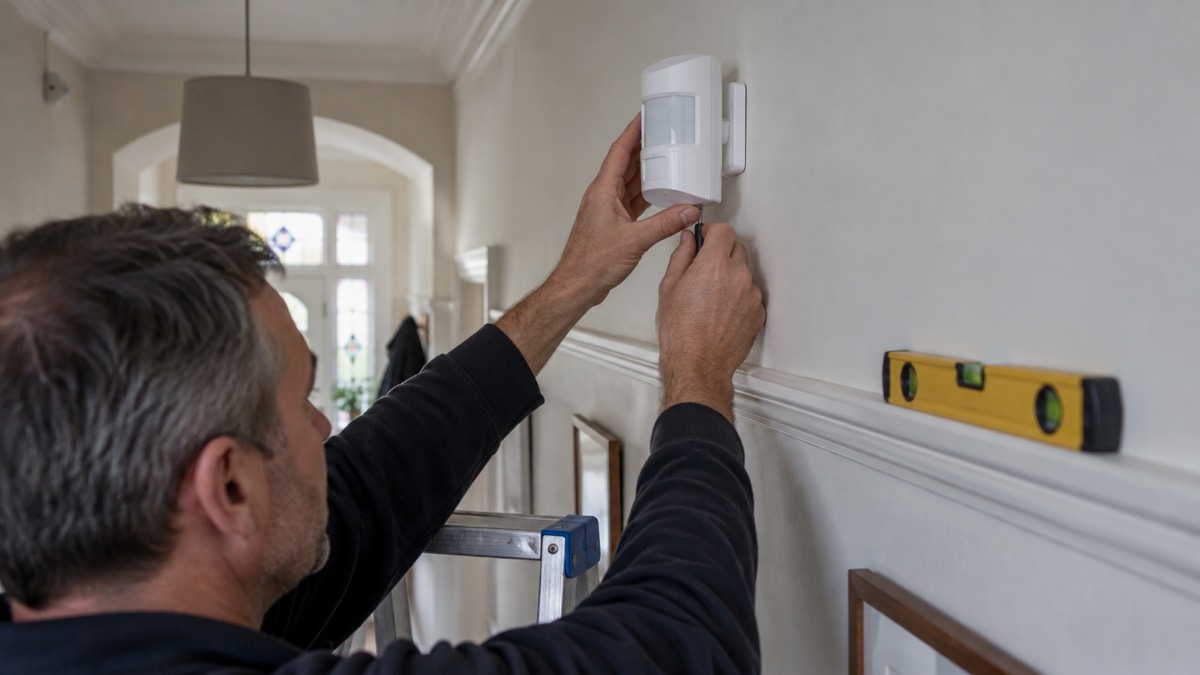
The complete set is the SmartBracket mounting panel, a CR123A battery (pre-installed), an installation kit and a quick start guide1. You will need the hub and the app to receive alerts, and the detector is designed to work as part of an Ajax system.
The warranty is 24 months on both models1. The wider Ajax Systems Manufacturing warranty runs for 2 years after purchase and does not cover the pre-installed battery6. That distinction matters: a battery that fails early is a consumable, not a warranty claim.
Ajax publishes support material for the range, including manuals for the Ajax Hub (2 Plus, 2, Plus), the Ajax FireProtect Plus and the Ajax FireProtect 2 SB (Smoke, Heat, CO), which show how devices are added and configured in the app. If you are building out a system, the home security section sets out the wider picture, and the page on alarms and cameras on a weak mobile signal or slow broadband covers what happens when the link to the hub is poor.
Sources (7)
- CombiProtect Jeweller specifications, Ajax Systems, 2026-11-02
- CombiProtect U Jeweller specifications, Ajax Systems, 2026-11-02
- Beat_the_Heat_A4_V02_1, Oxfordshire County Council
- How to replace batteries in CombiProtect, Ajax Systems, 2024-05-10
- Child safety hub: poisoning, RoSPA, 2026-10-26
- Hub Plus user manual, Ajax Systems, 2026-09-25
- FireProtect Plus user manual, Ajax Systems, 2026-07-30

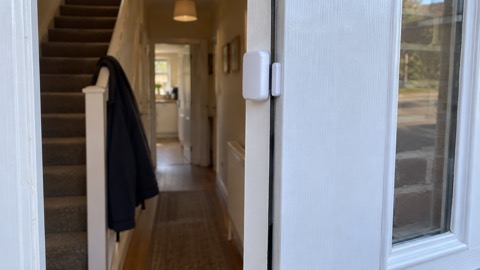 Ajax DoorProtect Plus
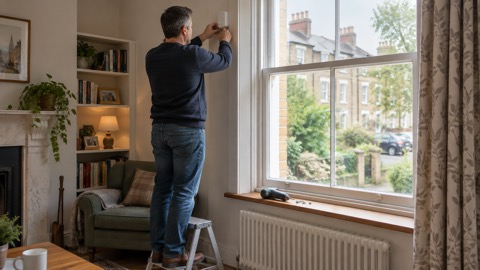 Ajax GlassProtect
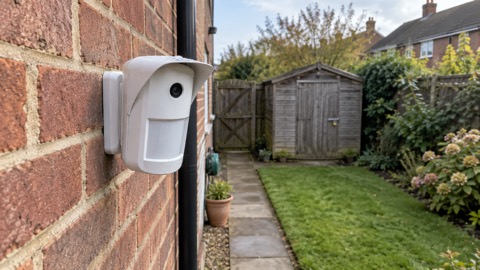 Ajax MotionCam Outdoor
 Ajax MotionCam
 Ajax MotionProtect