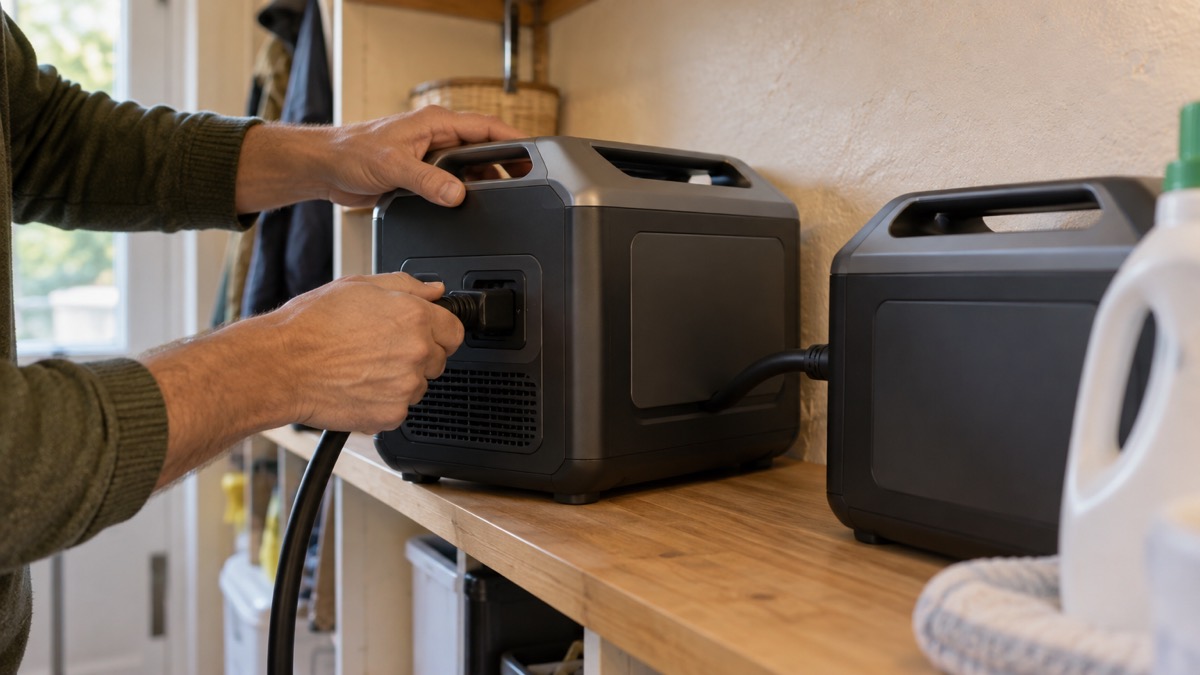
The Anker SOLIX BP2000 Expansion Battery (Gen 2) is not a power station. It is a second battery that plugs into an Anker SOLIX C2000 Gen 2 and doubles the amount of stored energy that power station has to give. On its own it does nothing: Anker states plainly that the expansion battery cannot be used separately, and that it must be connected to the power station to charge or discharge and to monitor its status through the Anker app1. If you do not already own the C2000 Gen 2, this is not the product to start with.
What it adds is capacity. The BP2000 holds 2,048Wh on its own, and Anker describes the pairing as doubling the C2000 Gen 2's capacity to 4,096Wh2. It uses lithium iron phosphate (LFP) cells rated for up to 4,000 cycles at 80% capacity, and Anker says the battery is designed for daily use for up to 10 years2. It weighs 18.9 kg, so it is a two-handed lift rather than something you carry up a ladder, and it comes with a 5-year full-device warranty2.
The practical question for a household is whether the extra capacity is worth having. The answer depends on what you want to keep running and for how long, and on where you will store it: Anker gives a charging range of 0°C to 40°C, so a freezing garage is not a place to charge it2. The sections below set out the specifications that decide it, how long it keeps things going, and how to connect, charge and store it safely.
What the BP2000 is, and what it is not
The BP2000 Gen 2 is an expansion battery, and Anker's own product page describes it as exclusively designed for the Anker SOLIX C2000 Gen 23. The C2000 Gen 2's specification page carries the matching note that the power station is for use with the BP2000 Expansion Battery4. The two are meant to be bought and used as a pair: the power station provides the sockets, the display and the app connection, and the expansion battery provides more stored energy behind it.
That design has consequences worth understanding before you buy. The expansion battery has no mains socket of its own that you can use independently. Anker's instruction is that it cannot be used separately, and that it must be connected to the power station to charge or discharge and to monitor its status via the Anker app1. So the battery is only as useful as the power station it is attached to. If the C2000 Gen 2 is damaged, lost or out of action, the BP2000 has nothing to do.
The pairing is also the reason the capacity figures are usually quoted together. Anker lists the BP2000 Gen 2 at 2,048Wh, made up of 40,000mAh cells2. When it is connected to the C2000 Gen 2, Anker describes the combined capacity as 4,096Wh2. That combined figure is the one that matters for run time, because it is the total energy available to your appliances.
If you are still deciding what kind of backup power suits your home, the portable power stations guide explains the difference between a power station, an expansion battery and a generator, and the Anker brand page lists the maker's other products.
Capacity: 2,048Wh alone, 4,096Wh with the C2000 Gen 2
Capacity is the headline number, and it is worth being clear about what it means. A watt-hour is a unit of energy: 1,000Wh is one kilowatt-hour, the unit on your electricity bill. The BP2000 Gen 2 stores 2,048Wh, and adding it to a C2000 Gen 2 gives a combined 4,096Wh2. That is the total amount of energy the pair can deliver before they need recharging, before any losses in the conversion from battery to mains.
The table below sets out the capacity figures as Anker publishes them.
| Measure | Figure | Source |
|---|---|---|
| BP2000 Gen 2 capacity | 2,048Wh | 2 |
| Cell capacity | 40,000mAh / 2,048Wh | 2 |
| Combined capacity with C2000 Gen 2 | 4,096Wh | 2 |
| Peak power | 4,000W | 2 |
The peak power figure of 4,000W is the surge the pair can handle briefly, which matters for appliances with motors that draw a burst of current at start-up2. It is not the same as the continuous output, and it is not a promise that every appliance will run: a device that draws more than the inverter can supply continuously will trip the output even if the surge figure looks generous. The watts and watt-hours guide explains how to work out what your own appliances draw.
The combined 4,096Wh is a substantial amount of stored energy for a household. It is the kind of capacity that lets you ride out a multi-hour outage while keeping a fridge, a router and some lighting going, rather than the smaller capacity of a unit meant only for phones and a torch. Whether that is enough for your household depends on what you choose to run, which is the subject of the next section.
Specifications that decide it: LFP cells, weight and size
The chemistry inside the battery is the first specification that decides whether it suits you. Anker uses LFP cells in the BP2000 Gen 23. LFP, or lithium iron phosphate, is a battery chemistry that Anker rates for up to 4,000 cycles at 80% capacity in this product2. A cycle is a full charge and discharge, so the figure describes how many times the battery can be used before its usable capacity falls to 80% of new. Anker also says the battery is designed for daily use for up to 10 years2.
The second specification is weight. Anker lists the BP2000 Gen 2 at 18.9 kg (41.7 lb)2. That is heavy enough that you should plan where it will live before it arrives: a shelf above head height is not sensible, and carrying it up and down stairs during an outage is not something to leave until the lights go out. The dimensions are 459 × 250 × 257 mm (18.1 × 9.8 × 10.1 in)2, so it needs a footprint roughly the size of a small suitcase.
| Specification | Figure | Source |
|---|---|---|
| Battery type | LFP | 3 |
| Cycle life | 4,000 cycles at 80% capacity | 2 |
| Expected lifespan | Up to 10 years of daily use | 2 |
| Net weight | 18.9 kg (41.7 lb) | 2 |
| Dimensions | 459 × 250 × 257 mm (18.1 × 9.8 × 10.1 in) | 2 |
| Charging temperature | 0°C to 40°C | 2 |
| Discharging temperature | -20°C to 40°C | 2 |
| Noise | 30 dB | 3 |
The temperature range is the specification most likely to catch a household out. Anker gives the charging range as 0°C to 40°C and the discharging range as -20°C to 40°C2. In plain terms, the battery can give power in a cold garage but should not be charged there in freezing weather. If you plan to keep it in a shed or an unheated outbuilding, that is the limit to design around. The battery storage temperature guide covers the general principles.
How long it keeps going in a power cut
There is no single run-time figure, because run time depends entirely on what you plug in. Anker states that the BP2000 Gen 2 draws 9W when idle, measured at 25°C, fully charged, with "Never Turn Off" mode enabled, within the first 9 hours2. That is a laboratory figure under controlled conditions, and it matters because a battery left permanently on will slowly drain itself even when nothing is plugged in.
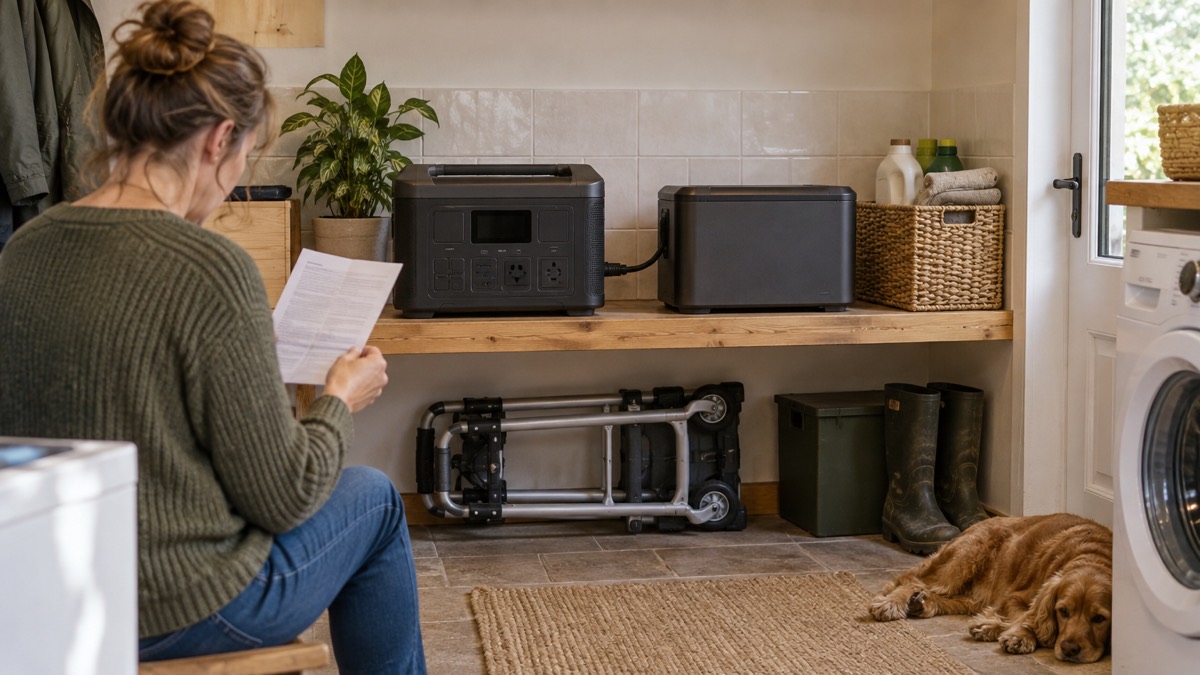
To work out how long the pair will last, divide the usable energy by the load. The combined 4,096Wh is the starting point2. Those are arithmetic from the stated capacity, not maker claims, and real run time will be shorter. The power station run time guide walks through the calculation for a fridge or a laptop.
The practical approach for a household is to decide in advance what matters. A router, a phone charger and a couple of lamps draw very little and will last a long time on 4,096Wh. A fridge cycles on and off and draws more when the compressor runs. An electric heater or a kettle will flatten the battery quickly. The guide to deciding what to keep running helps you rank those choices before an outage rather than during one.
The bars are arithmetic from the combined capacity Anker states2; real run time is shorter once conversion losses and the 9W idle draw are counted.
Anker also publishes a short course on saving lives during outages with a doctor, estimated at 30 minutes5. It is a general piece of guidance rather than a specification of this battery, but it is a reminder that the planning, not the kit, is what makes an outage manageable.
LFP lifespan: 4,000 cycles at 80% capacity
The cycle figure is the one that decides the long-term value of the battery. Anker rates the BP2000 Gen 2 at up to 4,000 cycles at 80% capacity2. That means the battery is expected to keep 80% of its original capacity after 4,000 full charge and discharge cycles. Anker also says it is designed for daily use for up to 10 years2.
For a household, the cycle rating is mostly about how the battery is used over years rather than during a single outage. A battery that sits charged and is used a few times a year will age slowly. A battery that is discharged deeply and recharged every day will reach its cycle limit sooner. Anker's own comparison pages for its other ranges quote 3,000 cycles for the camping series6 and for the Flex series7, so the 4,000-cycle figure for the BP2000 Gen 2 is the maker's higher rating for this product.
The lifespan claim should be read as a maker's expectation, not a guarantee. Anker's wording is that the battery is "designed for daily use for up to 10 years"2, which is a design statement. The warranty is the enforceable promise, and it runs for 5 years2. Keeping the battery within its temperature range and avoiding deep discharges in storage will help it last, and the guide to storing a power station sets out the general approach.
Charging, connecting and storing it safely
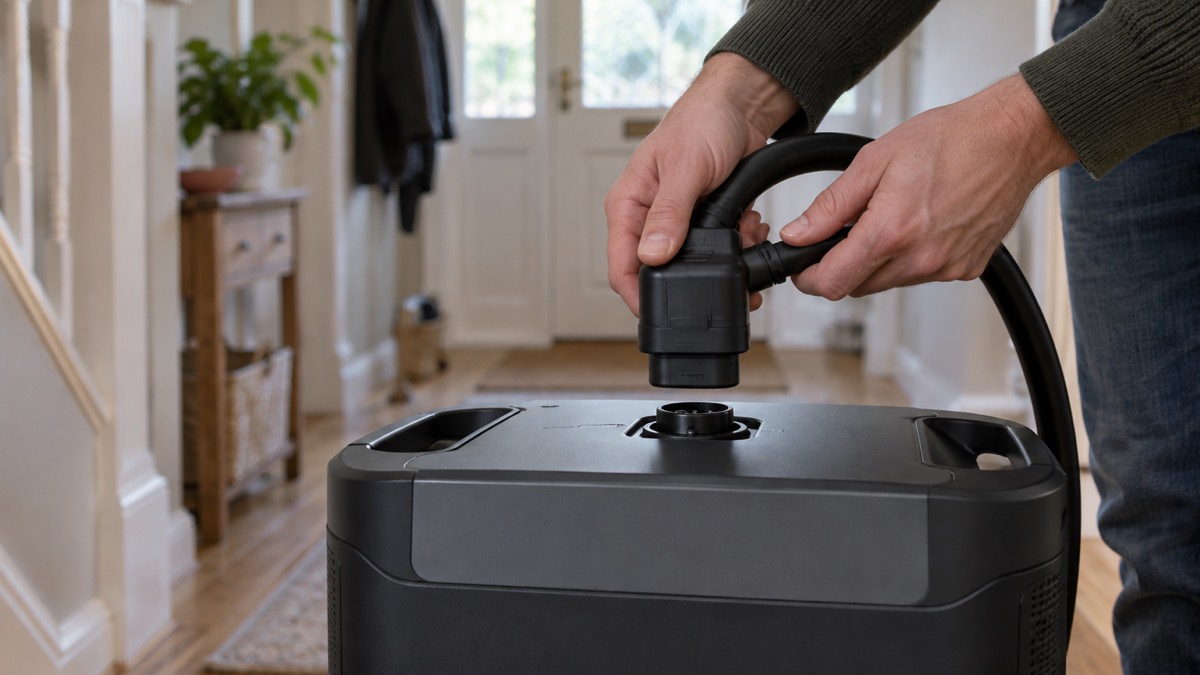
The maker's instructions for this battery are specific, and they are worth following exactly. Anker's connection instruction is to align the cable with the Anker logo in the centre and insert it directly1. To disconnect, push the knob in the centre and turn the cable slightly to the left, 12.5 degrees, before pulling it out1. Do not twist it further or pull it out without turning the knob.
"To connect, align the cable with the Anker logo in the center and insert it directly."
The charging limits are the other instruction to keep in mind. Anker gives the charging temperature range as 0°C to 40°C2. Charging a lithium battery below freezing is outside the maker's specification, and the guide to charging in freezing weather explains why cold charging is a problem for this chemistry. If the battery has been stored somewhere cold, let it come up to temperature indoors before charging.
For the app, Anker's guidance for its camping series is to connect to a network before using the app for the first time, and then to connect the power station to off-grid devices via Wi-Fi or Bluetooth6. The same approach applies here: get the power station on a network before you need to check the battery's status in a hurry.
Storage follows from the temperature limits. Keep the battery somewhere dry and within the charging range if you intend to top it up, and within the discharging range at all times. The safe charging checklist covers the general setup, and the lithium battery safety guide explains the warning signs to watch for. Anker also states that a secure 3-point protective clasp safeguards the battery and ensures no leakage current occurs while charging1.
Warranty, support and what comes in the box
Anker offers a 5-year full-device warranty on the BP2000 Gen 22. The box contains the Anker SOLIX BP2000 Expansion Battery (Gen 2), the battery-to-host cable, a user manual, the 5-year warranty and access to Anker's customer service3. The cable is the part to keep track of: without it the battery cannot be connected to the power station, and it is not a standard mains lead you can replace from a drawer.
| In the box | Detail | Source |
|---|---|---|
| Expansion battery | Anker SOLIX BP2000 Expansion Battery (Gen 2) | 3 |
| Cable | Battery-to-host cable | 3 |
| Documentation | User manual | 3 |
| Warranty | 5-year full-device warranty | 2 |
| Support | Anker customer service | 3 |
Anker lists the product as in stock and shipping within 1 to 2 business days on its UK site2. That is a stock statement rather than a delivery promise, and it can change. If you are buying ahead of winter, the winter readiness checklist sets out the checks to do once the kit arrives.
Anker published a recall advertisement for the A1647 dated 2 October 2024, and in June 2025 launched an additional recall covering both models, asking customers who had received 2024 recall information to re-check all their power banks using the 2025 submission form8. If you own one of those power banks, check it against Anker's notice. The BP2000 Gen 2 is a different product and is not named in those recalls.
Sources (8)
- Anker SOLIX BP2000 Expansion Battery product page, Anker SOLIX, 2026-10-25
- Anker SOLIX BP2000 Expansion Battery (Gen 2) product page, Anker SOLIX, 2026-10-25
- Anker SOLIX C2000 Gen 2 Expansion Battery product page, Anker SOLIX, 2026-10-25
- Anker SOLIX C2000 Gen 2 product page, Anker SOLIX, 2026-10-25
- Anker SOLIX C2000 Gen 2 with Expansion Battery product page, Anker SOLIX, 2026-10-25
- Anker SOLIX Camping Power Station range, Anker SOLIX, 2026-10-25
- Anker SOLIX Flex Power Station range, Anker SOLIX, 2026-10-25
- Anker power bank recall notice, Anker SOLIX, 2026-10-25

 BLUETTI B500K Expansion Battery