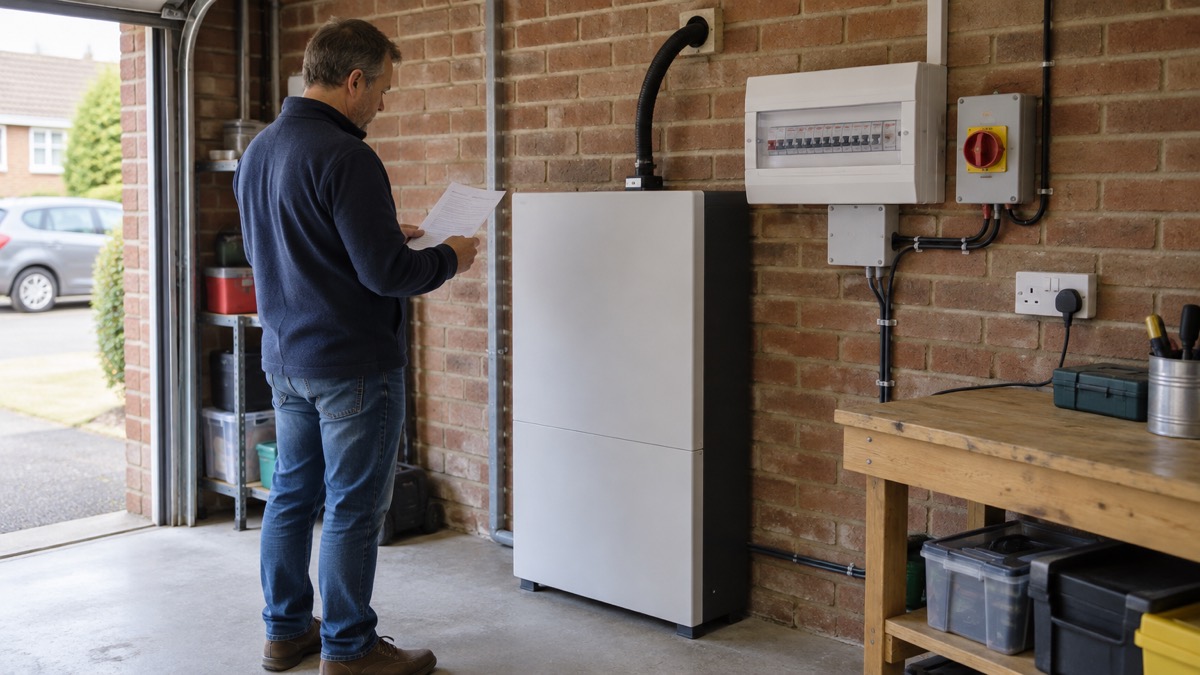
The Anker SOLIX Solarbank 4 E5000 Pro is a floor-standing home battery with a rated energy of 5,024Wh and a 2,500W AC output, designed to store solar power and keep a few essential circuits running when the mains fails1. It is not a whole-house backup system: Anker states that backup power is delivered through the off-grid port, not to the whole home, and that whole-house three-phase backup and backup through the on-grid port are not supported1.
For a household, the practical points are these. In a power cut the system switches to Off-Grid Mode within 10 ms, so equipment on that port sees almost no interruption1. In the UK it must be installed by an electrician holding Part P registration, and the electrician submits G98 documentation to the local distribution network operator within 28 days3. It takes 1 to 12 solar panels, wired in parallel only, and can be expanded with up to five BP5000 batteries to a total of 30kWh1.
This page sets out what the maker says the unit can do, how it is installed and wired, how to add panels and batteries safely, and what to check before you rely on it in an outage.
What the Solarbank 4 E5000 Pro is, and who it suits
The Solarbank 4 E5000 Pro is a home battery that sits on the floor and works alongside solar panels and the mains supply. Anker describes it as part of its plug-in solar battery storage range, with a 5,000Wh capacity and 2,500W AC output3. The battery chemistry is LiFePO4, and the cells are described as automotive-grade 314Ah LFP cells with a 10,000-cycle lifespan1.
It suits a household that wants to store surplus solar generation for evening use, shift cheap off-peak electricity to peak hours on a time-of-use tariff, and keep a small number of essential appliances running through a short outage. It does not suit a household expecting the lights to stay on throughout the house: Anker is explicit that backup is provided through the off-grid connection and not for the whole home2.
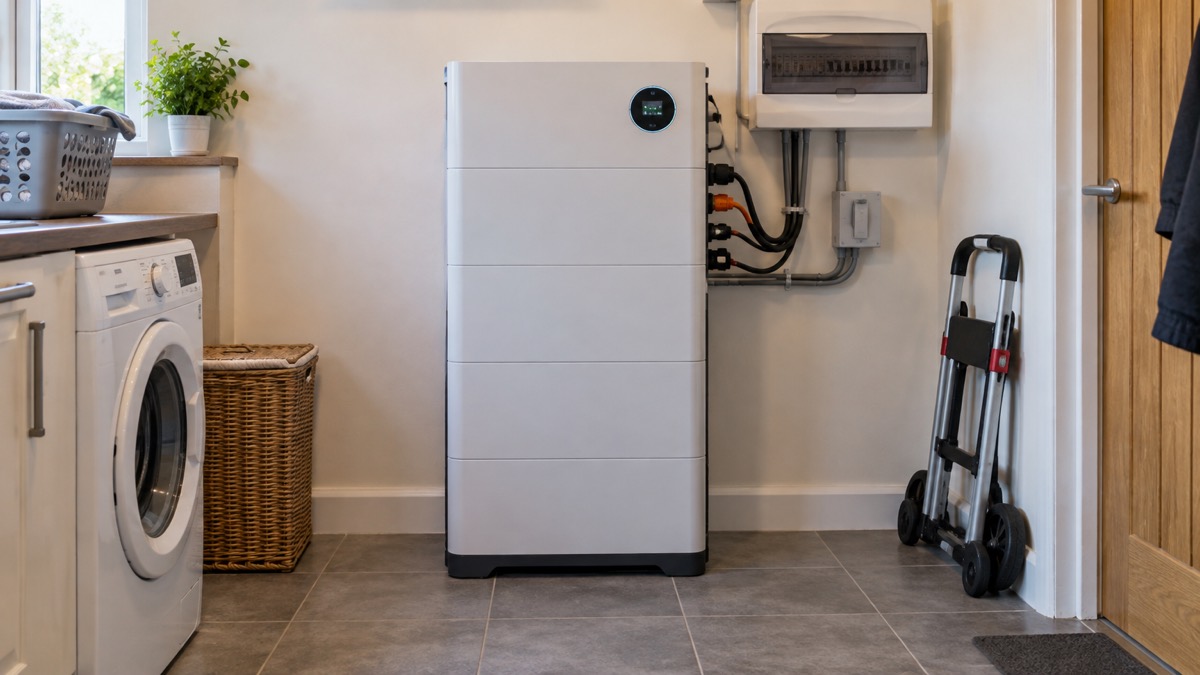
The unit is a substantial piece of kit. The main unit measures 460 × 305 × 355 mm and weighs 50 kg net, 54 kg gross including packaging1. It is floor-standing and does not support wall mounting1. Anker states that a single unit can support up to five BP5000 expansion batteries, each with a capacity of 5kWh, bringing total system capacity to 30kWh1.
Specifications
Anker's own figures for the main unit are set out below. Where the maker's UK and European product pages give different values for the same attribute, both are shown and the difference noted.
| Specification | Figure | Source |
|---|---|---|
| Rated energy | 5,024Wh | 1 |
| Capacity (marketing figure) | 5,000Wh | 3 |
| Battery chemistry | LiFePO4, automotive-grade 314Ah LFP cells | 1 |
| AC output | 2,500W | 3 |
| Maximum AC charging power | 2,500W | 1 |
| Maximum PV input power | 5,000W | 1 |
| Maximum input power per PV port | 1,250W | 1 |
| MPPT voltage range | 16 to 50V DC | 1 |
| Open-circuit voltage per panel | 16 to 60V | 1 |
| Maximum PV input voltage | 60V DC | 1 |
| Maximum PV input current | 36 × 4A DC | 1 |
| MPPT count | 4 | 2 |
| Ingress protection | IP66 | 1 |
| Operating temperature | -20°C to 55°C | 1 |
| Dimensions (main unit) | 460 × 305 × 355 mm | 1 |
| Weight (main unit) | 50 kg net, 54 kg gross | 1 |
| Connectivity | Bluetooth, Wi-Fi (2.4 GHz) | 1 |
| Warranty | 10 years | 3 |
| Cycle life | 10,000 cycles | 3 |
Two figures need a note. Anker's UK page gives the capacity as 5,000Wh3, while its product page gives rated energy as 5,024Wh1; the documents give both and this page reports both. The European product page lists a maximum AC bypass output of 3,600W2, while the UK product page gives 2,990W1; the maker's figures differ between the two pages, so check the current UK specification before relying on the bypass rating.
Backup in a power cut: 10 ms switchover to the off-grid port
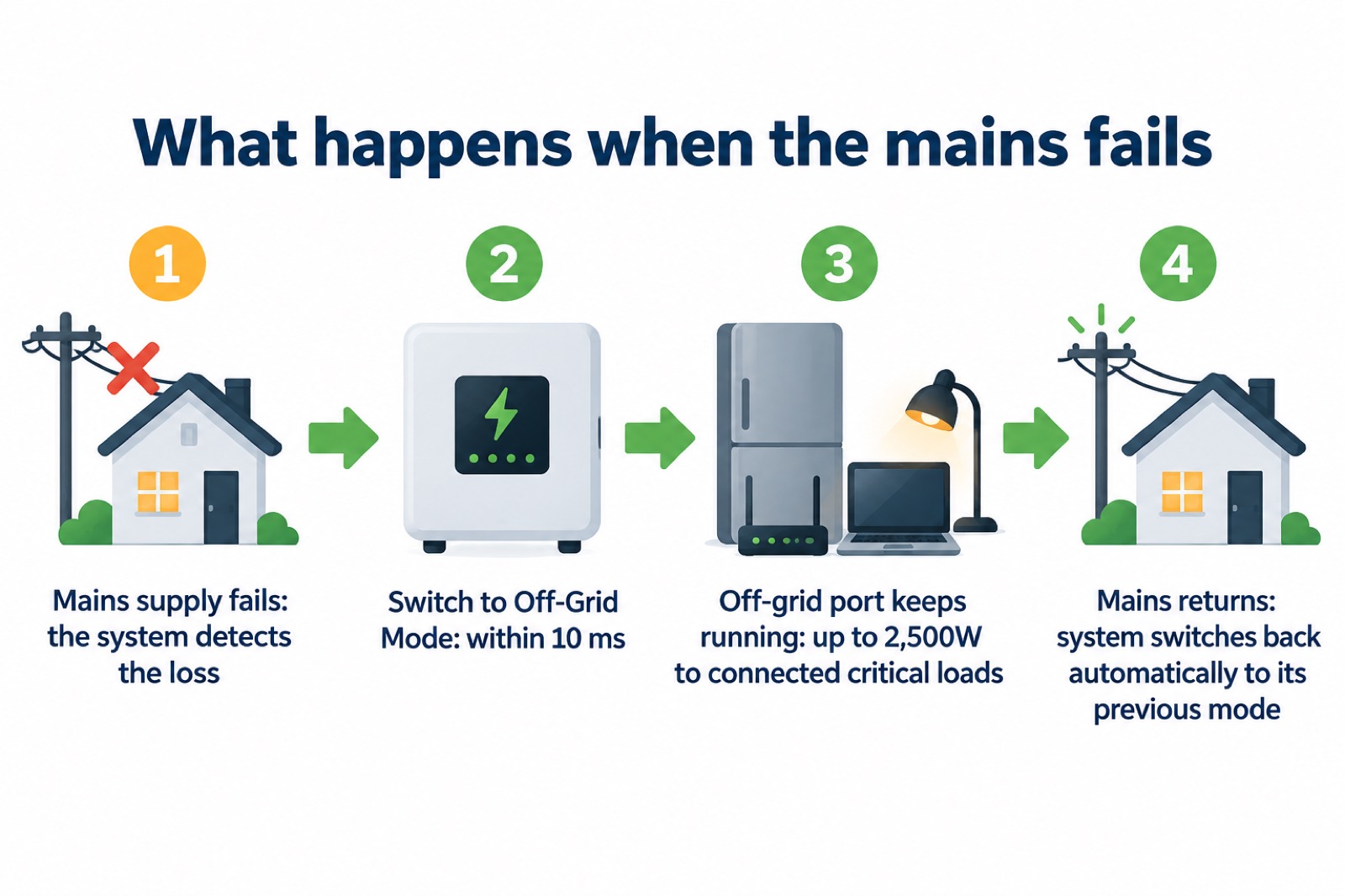
When the mains fails, Anker states that the system automatically switches to Off-Grid Mode within 10 ms1. That is fast enough that most connected equipment will not notice the interruption. The backup output is up to 2,500W to critical loads connected to the dedicated off-grid port3.
The scope matters more than the speed. Anker states that the function provides backup power through the off-grid connection and not for the whole home2. The maker lists as not supported: whole-house three-phase backup, backup power through the on-grid port, and supplying power to the entire house through a Wieland socket during an outage1. In practice, plan which appliances you will plug into the off-grid port and check their running and surge demands against the 2,500W figure. The guide to watts, watt-hours and surge explains how to do that.
You can reserve capacity for an outage. Anker states that you can set a minimum state of charge, for example 15%, so the battery keeps a reserve rather than emptying into the house1. When mains power returns, the system switches back automatically to the operating mode that was active before the outage, with no manual intervention2.
Anker also offers Storm Guard Mode, which monitors weather alerts and proactively charges the battery ahead of potential outages caused by severe weather1. If you are weighing this kind of battery against a portable power station, the guide to home battery storage sets out what each can and cannot do in an outage.
Installation must be done by a Part P registered electrician
In the UK, Anker states that installation must be carried out by an electrician holding Part P registration, and that the product is fitted with hard-wiring terminals as standard3. The maker cites Part P of the UK Building Regulations 2010 and the G98 standard (connect and notify) as the basis1. The unit is G98 certified and officially listed3, and the electrician must submit the relevant G98 documentation to the local distribution network operator within 28 days of installation1.
Anker recommends a 16A to 20A circuit breaker1. The maker also advises strongly that a qualified electrician check the dedicated circuit and assess the condition of the equipment, and states that Anker is not responsible for problems caused by outdated wiring, shared circuits or poor socket contact2.
This is not a DIY installation, and the independent safety guidance points the same way. Electrical Safety First recommends that households have their electrical installation assessed by a competent electrician registered with a competent persons scheme before purchasing or using a plug-in solar system, particularly in older properties or where the condition of the installation and the type of protective devices is unknown5. Its guidance on solar panels more broadly says it is vitally important to use a skilled, trained and qualified solar PV installer who is registered with a competent person scheme6.
Anker states that the grid-connected generation and solar self-consumption features are not bound to any specific electricity supplier, and that the device can connect to any distribution network operator in the UK for normal use3. The guide to connecting a generator or battery to your home's wiring explains why hard-wired battery systems sit in a different category from plug-in kit.
Connecting solar panels: 4 to 12 panels in parallel, never in series
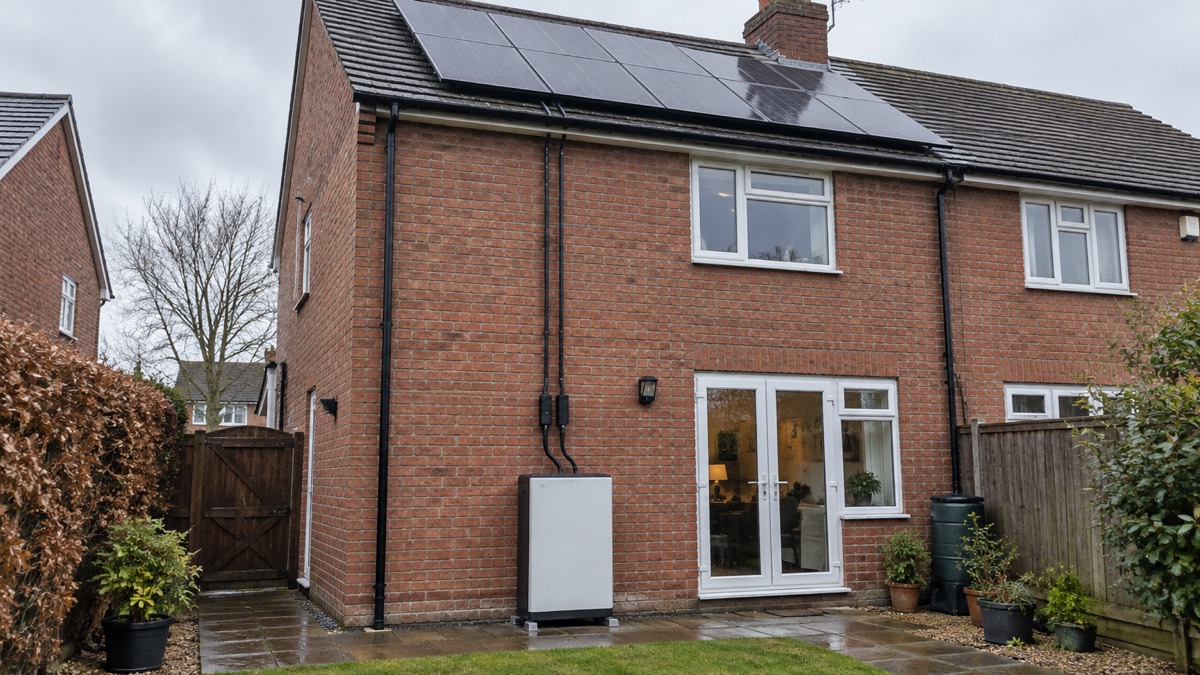
Anker's UK page states a maximum of 12 panels3, while its product page states support for 1 to 12 solar panels1. The European product page describes 4 to 12 panels, with 4 connected directly and 8 through Y-branch connectors at two per port2. The maker's wiring rule is unambiguous: parallel connection only, and series connection is strictly prohibited1.
The electrical limits decide what you can connect. Each panel's open-circuit voltage must be between 16V and 60V1. The maximum input power per PV port is 1,250W1, and the total current from all panels connected to one MPPT must not exceed 36A2. The unit has four MPPTs2, and the maximum PV input power overall is 5,000W1.
Anker states that with 4 to 12 panels the system can generate up to 5,586kWh annually1. It also states that surplus third-party PV can be stored at a maximum charging power of 2,500W1.
"Wiring Method: Parallel connection only; series connection is strictly prohibited."
If you are new to panel sizing, the guide to portable solar panels for charging in a power cut covers the basics of matching panels to a battery.
Adding expansion batteries safely: up to 30kWh
Anker states that the Solarbank 4 E5000 Pro supports up to five BP5000 expansion batteries, each with a capacity of 5kWh, bringing the total system capacity to 30kWh1. The European product page confirms the same limit of five BP5000 units2. The main unit is also described as backwards compatible with the Anker SOLIX BP1600 and BP2700 expansion batteries, though charging power can be affected by the installation or stacking order when models are combined2.
The maker's safety instruction is direct: always power off the system before installing or removing any expansion battery1. Because of the weight, Anker says two people should lift the device together1. When stacking, the order runs from bottom to top as BP1600, then BP2700, then BP5000, then the host, and the host unit must always be placed on top4. Fully expanded with five BP5000 batteries, the stack is approximately 1,855 mm tall1.
Anker notes that the host unit's charging power may vary slightly depending on the installation order of the expansion batteries4.
Smart meters, tariffs and getting the most from the battery
The battery works without a smart meter, but with reduced function. Anker states that without a smart meter, household load monitoring is unavailable, only Custom Mode is available for charge and discharge control, and anti-backflow (zero-export) is not supported1.
With a smart meter, more is possible. Anker states that in the UK the unit is compatible with the Anker SOLIX Smart Meter (A17X7), the Anker SOLIX Smart Meter Gen 2 and the Everhome Meter (Eco Tracker IR)3. For single-phase households the single-phase smart meter comes standard with two independent CTs3. For three-phase households the three-phase smart meter comes standard with a 3-in-1 CT bundle designed exclusively for monitoring the grid supply phases, and additional sub-circuit CTs must be purchased separately to monitor third-party PV generation accurately3.
On tariffs, Anker states that under time-of-use or dynamic tariffs, when solar generation is insufficient, Smart Mode can charge the battery during low-rate off-peak periods and discharge it during peak high-rate periods3. The maker says the 5kWh battery fully charges in under 2 hours at off-peak rates3. Anker states the unit is widely compatible with over 870 UK electricity suppliers, including British Gas, E.ON Next, OVO Energy, EDF Energy and ScottishPower3.
The energy management modes are Smart Mode, Custom Mode, Dynamic Tariff Mode, Time-of-Use Mode, Rapid Charging Mode and Storm Guard Mode1. On fixed-rate tariffs, Anker states that during periods of surplus solar generation or negative electricity prices, Smart Mode can automatically turn on controllable loads through the Smart Load Port to maximise solar self-consumption3.
Output limits, the 800W default and unlocking more
Out of the box, Anker states that the system's default AC output power is set to 800W1. The hardware is rated at 2,500W AC output3, so the 800W setting is a factory default rather than the limit of the unit.
To enable output above 800W, Anker states that you email proof of installation to support@ankersolix.com, and once verified the maker sends you the unlock password to enable the feature1. The maker's European page notes that in the Netherlands the requirements of the local network operator apply, and advises checking current regulations when using more than 800W of output power2. In the UK, the installation route through a Part P registered electrician and the G98 notification is the framework that applies3.
The bypass figures also matter if you plan to run loads through the unit while the mains is present. Anker's UK product page gives a maximum AC bypass output of 2,990W1, while the European product page gives 3,600W2; the maker's figures differ between the two pages, so check the current UK specification. The UK page also gives a maximum off-grid port bypass output of 2,990W3.
Where to put it, and how to look after it
The unit is floor-standing and does not support wall mounting1. Anker gives an operating temperature range of -20°C to 55°C1. The IP66 rating means it is protected against dust and powerful water jets, but the maker states it is not suitable for use under water and advises avoiding prolonged exposure to standing water, heavy rainfall or maritime and corrosive environments; it requires sufficient ventilation, water protection and raised installation2.
For a UK household, that points to a sheltered, ventilated position rather than an exposed wall or a spot where water pools. If you are storing or charging batteries in a cold spell, the guide to charging lithium batteries below freezing covers the general principles, and the safe battery charging at home checklist sets out a safe charging set-up.
Anker states that the system supports dual-cycle operation, delivering two charge-discharge cycles daily1. The maker lists a 15-year lifespan alongside the 10-year warranty3. Warranty terms are set by Anker, so check the current terms with the maker.
Warranty, support and what to check before you buy
Anker lists a 10-year warranty3 and a 15-year lifespan, with 10,000 battery cycles3. The maker also states a 15-year product lifespan alongside the 10-year warranty on its product page1. The documents give both figures and this page reports both; confirm the current warranty terms with Anker before purchase.
On availability, Anker states that orders are usually dispatched within 1 to 2 working days, with delivery in 3 to 7 working days after dispatch1. The maker's UK site lists the product as in stock with fast dispatch1.
Before buying, check three things against your own home. First, whether your consumer unit and wiring can take the installation, which the electrician will assess2. Second, whether your smart meter is on Anker's compatible list, because without one you lose load monitoring and anti-backflow3. Third, whether the off-grid port's 2,500W is enough for the appliances you want to keep running, since whole-house backup is not supported1.
For the wider picture on what a home battery can and cannot do in an outage, start with the backup power at home guide and the guide to deciding what to keep running when the mains fails. Anker's own product range is covered on the Anker brand page.
Sources (6)
- Anker SOLIX Solarbank 4 E5000 Pro product page, Anker SOLIX, 2026-10-25
- Anker SOLIX Solarbank 4 Pro 5kWh product page (Belgium), Anker SOLIX, 2026-10-25
- Anker SOLIX Solarbank 4 plug-in solar battery storage, Anker SOLIX, 2026-10-25
- Anker SOLIX portable power station range, Anker SOLIX, 2026-10-25
- Plug-in solar panels safety advice, Electrical Safety First, 2026-10-25
- Solar panels safety advice, Electrical Safety First, 2026-10-25