
Energizer makes the small, ordinary batteries that most of a household's emergency kit runs on: AA alkaline cells for torches, radios and lanterns, 9V alkaline batteries for smoke alarms and some radios, and 9V lithium batteries for devices that need to work in the cold or sit unused for a long time. None of them will heat a room or run a fridge. What they do is keep the small things working when the mains goes off, and that is often what decides whether a power cut is an inconvenience or a bad night.
The first thing to do is not to buy anything. Walk round the house and write down every torch, radio, lantern, smoke alarm and clock that takes a battery, and the size and number each one needs. Then buy for that list, store the cells properly, and check them once a year. A drawer full of the wrong sizes is no help in the dark.
This page covers what Energizer's household batteries are, what each type is for in an emergency, how to store and check them, and the safety rules that apply to anything that runs on cells or is charged from the mains. It does not rank batteries against other makers, and it gives no prices.
The short answer: what Energizer kit does in an emergency
Energizer's role in a household plan is narrow and useful. Its AA alkaline batteries, 9V alkaline batteries and 9V lithium batteries are the consumables that keep small devices alive: a torch to move round a dark house, a radio to hear warnings, a lantern for a child's bedroom, a smoke alarm that still works when the mains is off. That last point matters more than it sounds. Energizer Ultimate Lithium 9V is recommended by the maker for toys, smoke detectors and clocks1, and the maker's Change Your Clock, Change Your Battery programme ties battery changing to the clock change for fire-safety awareness2.
What the batteries cannot do is carry the heavy loads. A freezer draws 200 watts1, and no household battery will run one for long. Heating, cooking and refrigeration need the backup power and heating guidance elsewhere on this site, not a pack of AA cells. The honest way to plan is to decide which small jobs matter most to your household, buy the cells those jobs need, and treat everything else as a separate problem.
There is also a money side that bears on preparedness. Age UK's guidance notes that your energy supplier may offer energy efficiency products like insulation free of charge, and that if you are on a low income you may be eligible for a discounted social tariff from your energy supplier6. A warmer, better-insulated home is itself a form of emergency preparation, and it costs nothing to ask.
What to do now: build a battery plan round your own devices
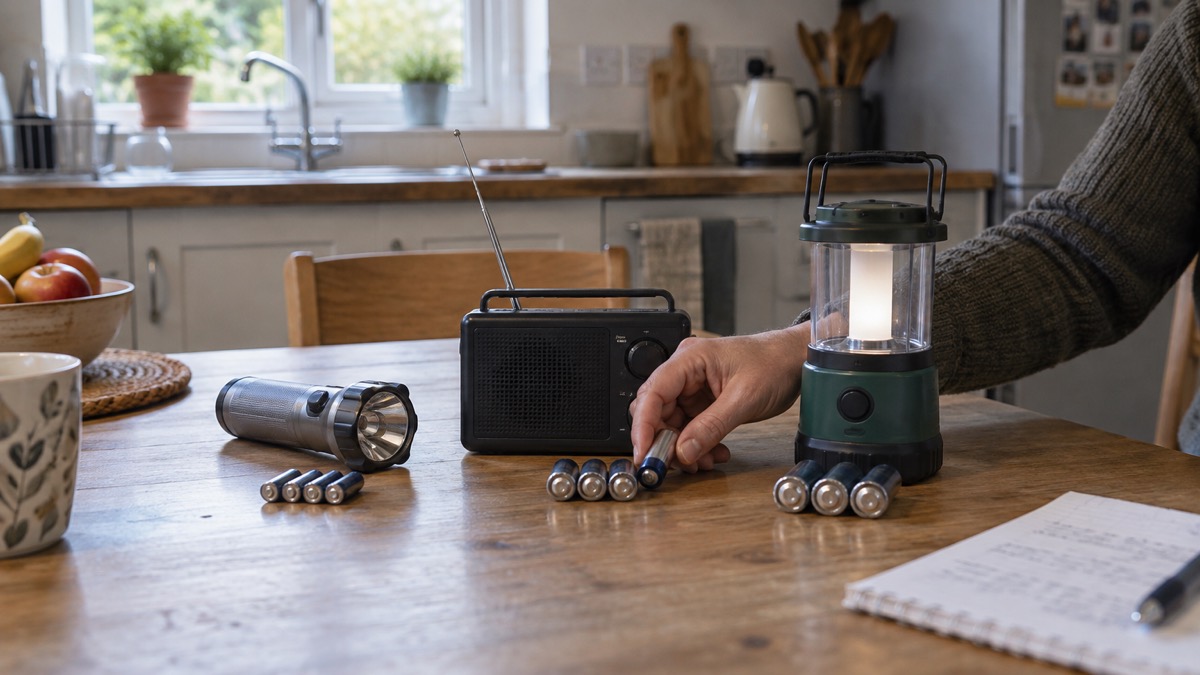
Start with an inventory, not a shopping list. Go room by room and note every battery-powered device you would want in a power cut, plus every smoke alarm. Record the size, the number of cells and whether the maker specifies alkaline, lithium or something else. Keep that list with your emergency kit so anyone in the household can restock it.
Then work through the house with the fire service's electrical checks in mind. Fire and rescue services advise you to check all appliances, plugs, sockets and leads for damage such as scorch marks or exposed wiring, to always use the correct fuse, to buy approved chargers, to switch off appliances at night or when leaving the home unless they are designed to be left on, such as fridges and freezers, and not to charge devices on flammable surfaces such as bedding1. A battery plan is only as good as the devices it feeds.
A simple routine keeps the kit ready:
- Write down every device that takes a battery, the size it takes and how many spares you want.
- Buy only those sizes, in sealed packs, and keep the packaging.
- Store cells out of reach of children: Energizer produces child-resistant packaging for lithium coin cell batteries, designed to help keep kids safe1.
- Test every torch and radio now, and again each year.
- Change smoke alarm batteries at the clock change, as Energizer's Change Your Clock, Change Your Battery programme for Daylight Savings Time fire-safety awareness suggests2.
- Note the date you restocked, so rotation is easy.
What you need: the three Energizer battery types
Energizer's household range for emergency use comes down to three products on this site, and each suits a different job. The table sets them side by side by what they do and who they suit, not by which is better.
| Battery | Typical emergency job | Suits a household that | Watch for |
|---|---|---|---|
| AA Alkaline Batteries | Torches, radios, lanterns, clocks | Wants one common size for most small devices | Devices that need several cells; keep spares in the same size |
| 9V Alkaline Battery | Smoke alarms, some radios and testers | Has 9V smoke alarms or older radios | Fit only the type the alarm maker specifies |
| 9V Lithium Battery | Smoke alarms and devices left unused for long periods, or used in the cold | Wants a battery that sits ready without attention | Never mix chemistries in one device |
AA alkaline batteries: the everyday workhorse
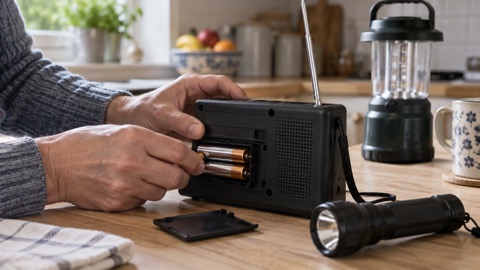
AA cells are the size most torches, portable radios and lanterns take, which makes them the backbone of a small emergency kit. Their job in a power cut is to keep light and information flowing: a torch for stairs and fuse boxes, a radio for local warnings, a lantern so a child can sleep. Buy enough for each device plus a spare set, keep them in their packaging, and check them each year. If a device takes several cells, replace them all at once and never mix old and new. The full guide to choosing and storing cells is in Emergency Lighting at Home and the wider Emergency Kit section.
9V alkaline batteries: smoke alarms and radios
The 9V battery is the one many UK households meet first, because a lot of smoke alarms take it. Energizer Ultimate Lithium 9V is recommended by the maker for toys, smoke detectors and clocks1, and the maker's Change Your Clock, Change Your Battery programme ties battery changing to the clock change for fire-safety awareness2. Fit the battery type the alarm's own instructions specify, test the alarm with its test button, and replace the cell when the alarm chirps or at the maker's interval. A 9V battery also suits some portable radios, which is worth knowing if your radio is the older type. Keep one spare per alarm in the kit, labelled with the date you bought it.
9V lithium batteries: for cold and long storage
Lithium cells are the choice where a device must sit unused for a long stretch and still work, or where it will be used in the cold, such as a smoke alarm in an unheated hallway or a torch kept in a car or shed. They cost more than alkaline cells, so use them where the job justifies it rather than throughout the kit. The same rules apply: fit what the device maker specifies, never mix chemistries, and dispose of spent cells properly. For the wider question of what backup power can and cannot do in a home, see Backup Power at Home.
Staying safe: charging, heat and flames
Batteries are safe when used as instructed and dangerous when abused. The Health and Safety Executive's advice is that you can be reasonably sure equipment is safe to work on if all sources of energy have been securely isolated and any stored energy released, and that you should follow the manufacturer's instructions and any local safety rules8. In household terms: read the device instructions, use the charger that came with it or an approved one, and unplug before you fiddle with anything.
Heat is the main risk. Fire and rescue services advise against overloading sockets, and recommend surge protectors where needed1. They also warn against charging devices on flammable surfaces such as bedding2, and advise keeping electrical appliances clean and in good working order to prevent them triggering a fire3. If a charger or cell becomes hot, smells strange or changes shape, stop using it, unplug it and take the battery to a recycling centre rather than the bin.
Warmth brings its own rules. NHS guidance notes that electric blankets and portable heaters can be a great way to stay warm, but it is important that they are used safely9. Fire and rescue services advise that portable heaters have a permanent safety guard fitted10, and that anyone using emollients sits a safe distance away from fires or heaters and takes extra care when cooking or using candles11. If you use a generator after a flood, fire and rescue services advise refuelling only when it has cooled down completely, and storing fuel safely in properly labelled approved containers outside living spaces and away from ignition sources12. Keep a battery torch, not a candle, for moving round a dark house.
Keeping the kit ready through the year
A battery kit decays quietly. Cells left in a hot cupboard, a cold shed or a device that is never used will let you down at the worst moment. The routine that works is dull and quick: once a year, open the kit, test every torch and radio, check the date on each pack, and replace anything that has leaked, corroded or lost its shape. Keep the inventory with the kit so the check takes minutes.
Think about where the kit lives. It should be somewhere you can reach in the dark without a torch, and somewhere cool and dry rather than above a radiator or in a damp outbuilding. Keep cells in their packaging so the terminals cannot touch loose metal such as keys or coins. If you have children, store the kit out of reach and teach them what it is for.
Finally, tie the battery plan to the rest of your household preparations. A power cut plan that covers food, warmth and light is set out in Power Cuts: A Household Guide, and the wider list of what to keep ready is in Emergency Kit. If someone in the household is older, disabled or medically dependent, the Extra Help in an Emergency guide explains the Priority Services Register and other support. During a cut, official advice is to notify a friend or neighbour if you are anxious, check on vulnerable neighbours, keep fridge and freezer doors closed, keep blankets and thick jumpers available, switch off appliances like straighteners and stoves, and keep a light on in one room so you know when power returns2.
Where Scotland, Wales and Northern Ireland differ
The batteries themselves are the same across the UK, but the help around them is not. Flood warnings are a good example: the government's checking service covers England, with separate services to check flooding in Wales, Scotland and Northern Ireland13, and there are different ways to get flooding information if you live in Scotland, Wales or Northern Ireland14. If your emergency plan depends on warnings arriving, find your nation's service before you need it.
Power arrangements differ too. The Low Frequency Demand Disconnection scheme, which protects the network by disconnecting demand in stages, sets different figures for each area: 60% of total demand in England and Wales, 40% in Southern Scotland and 40% in Northern Scotland15. At Stage 8 the scheme disconnects 5% of demand in England and Wales, 10% in Southern Scotland and 10% in Northern Scotland15. The documents also give a second set of figures for Stage 4 and Stage 6 that do not agree with each other, so treat the exact percentages as indicative rather than fixed. What matters for a household is the same everywhere: know where your torches are and keep the cells fresh.
Other differences are practical. Building regulations for storing oil at home differ in Wales, Scotland and Northern Ireland16. Winter travel advice points to Traffic Scotland for Scotland, with similar information for England, Wales and Northern Ireland available through their own websites17. And the weather itself varies: the Met Office has noted that parts of western Scotland and Northern Ireland often stay cooler and cloudier when England heats up18, which affects how much you rely on a fan or a torch versus a blanket. For the network behind all this, see How the Power System Works in the UK.
Sources (18)
- Ratings of electrical appliances, Electrical Safety First, 2026
- Power cuts, Wigan Council, 2026
- Home fire safety, Northern Ireland Fire and Rescue Service, 2026
- Escape plan, Devon and Somerset Fire and Rescue Service, 2026
- Domestic fire, UK Government Prepare campaign, 2026
- Tragedy of excess winter deaths makes emergency plan imperative, Age UK, 2010
- What are electricity rota loads, Wiltshire and Swindon Prepared, 2026
- Electricity safety FAQs, Health and Safety Executive, 2026
- Stay warm and nourished, NHS Norfolk and Suffolk ICB, 2026
- Heating and gas, Scottish Fire and Rescue Service, 2024
- Stay warm safely in winter, Devon and Somerset Fire and Rescue Service, 2026
- Safe use of heaters and generators, Armagh City, Banbridge and Craigavon Borough Council, 2026
- Check for flooding, UK Government, 2026
- Request flooding history, UK Government, 2026
- GB power disruption 9 August 2019 final report, Ofgem and National Grid ESO, 2020
- Oil storage regulations and safety, UK Government, 2026
- Drive safely in winter weather, Met Office, 2026
- Highs of 33C forecast this weekend, Met Office, 2026
 9V Alkaline Battery
 9V Lithium Battery
 AA Alkaline Batteries