UltraFire makes fire extinguishers, fire blankets and domestic smoke and heat alarms for homes, businesses and marine use1. For a household getting ready for a power cut, a flood, a storm or a cold spell, that kit matters because the risk of fire does not pause when the power goes or the heating fails: candles, portable heaters, extra cooking and overloaded sockets all raise it. The maker's extinguishers are Kitemarked to BS EN3, CE marked and MED approved, and come with a wall bracket and a 5 year warranty1. Its fire blankets are tested and kitemarked to BS EN 18691. Its smoke and heat alarms are tested to the British Standards and are suitable for BS 5839-6 Grade F1 and F2 domestic installation, backed by a lifetime warranty2.
The practical points for a household are simple. Order before 4:30pm for Next Working Day Delivery2. Fit alarms where they will wake you, keep an extinguisher and a blanket where a fire is most likely to start, and check both before the season when you will rely on them.
What UltraFire makes for a UK household
UltraFire's range covers three jobs a household plan needs to answer: detecting a fire early, putting out a small fire before it spreads, and smothering a fire on a hob or a person. The extinguishers come in water, wet chemical and powder types, each aimed at a different kind of fire, and the blankets are a separate line for the kitchen1. The smoke and heat alarms are the detection side of the same plan2.
Where this fits a household preparing for disruption is straightforward. A power cut moves cooking onto a camping stove or a barbecue, brings candles out of the drawer and may bring a portable heater into a bedroom. A flood or storm can leave a household without mains services for days. Each of those raises the chance of a fire starting in a home that is already under strain, and each is the moment when a working alarm, a blanket within reach and the right extinguisher for the fire in front of you make the difference between a scare and a serious incident.
Fire and rescue services treat detection as the first line. A home fire safety visit gives personalised advice about fire safety and, in some services, free fitting of smoke alarms3. The national Fire Kills campaign aims to raise awareness among the public, and especially vulnerable groups, of the potential fire risks and everyday accidents that are the primary causes of domestic fire in the UK4. Buying an alarm or an extinguisher is one part of that; knowing what to do when it sounds is the other.
For the wider picture of fire, carbon monoxide, gas leaks and burst pipes in the home, see Home Emergencies: Fire, Carbon Monoxide, Gas Leaks and Burst Pipes. For the kit a household should hold overall, see Emergency Kit: What a UK Household Should Keep Ready.
Fire extinguishers: matching the type to the fire
The single most important thing about an extinguisher is that it must suit the fire. Using the wrong type can spread a fire or put you at risk. UltraFire's own descriptions set out what each of its types is for1.
| Type | What the maker says it is for | Where it suits a household |
|---|---|---|
| Water | An economical solution for Class A fires1 | Fires involving solid materials such as wood, paper and textiles |
| Wet chemical | Low-pressure discharge specifically designed for fat, oil and grease fires in kitchens1 | The kitchen, where cooking oil and fat are the fuel |
| Powder | Usable on electrical equipment and in low temperatures1 | Areas with electrical equipment, and outbuildings or unheated spaces in cold weather |
All UltraFire extinguishers are supplied with a wall bracket for easy installation, and all carry a 5 year warranty1. The bracket matters more than it looks: an extinguisher that has fallen behind a cupboard or is buried under coats is not available in the seconds you have. Mount it on the escape route side of the risk, so you are moving towards the door as you reach for it, not past the fire.
Fire and rescue services are clear that speed decides the outcome. At the Exeter Cathedral Yard fire, the first appliance was ordered at 5.12am and arrived at the scene six minutes later, at 5.18am5. Six minutes is fast, and a small fire can still double in that time. That is the case for having the right extinguisher mounted and ready rather than relying on the brigade alone.
For the full household guide to fire in the home, see Home Emergencies: Fire, Carbon Monoxide, Gas Leaks and Burst Pipes.
Fire blankets: the kitchen's first response
A fire blanket is the simplest piece of fire kit in the house and the one most likely to be used. UltraFire's blankets are made from high-performance materials and are tested and kitemarked in accordance with BS EN 18691. That standard is the mark to look for: it tells you the blanket has been tested to do the job it claims.
The job is smothering. A pan of oil that catches light is put out by cutting off the air, not by throwing water on it, and a blanket does that in one movement. Keep it within reach of the hob but away from the heat itself, mounted on a wall or inside a cupboard door that opens away from the cooker. Practise the movement once, with the blanket still folded, so that in the moment you are pulling the tapes and covering the pan rather than reading the label.
Burns are the other kitchen risk. Cheshire Fire and Rescue Service advises storing matches, lighters and chemicals safely, which removes the easy sources of ignition that a blanket then has to deal with6. A first aid kit with burns dressings belongs in the same cupboard as the blanket: the NHS lists a first aid kit as a basic item, and fire services advise keeping your first aid kit up to date so you can respond quickly and confidently7.
For the household guide to first aid at home, see First Aid at Home: A Household Guide.
Smoke and heat alarms: early warning when the power is off
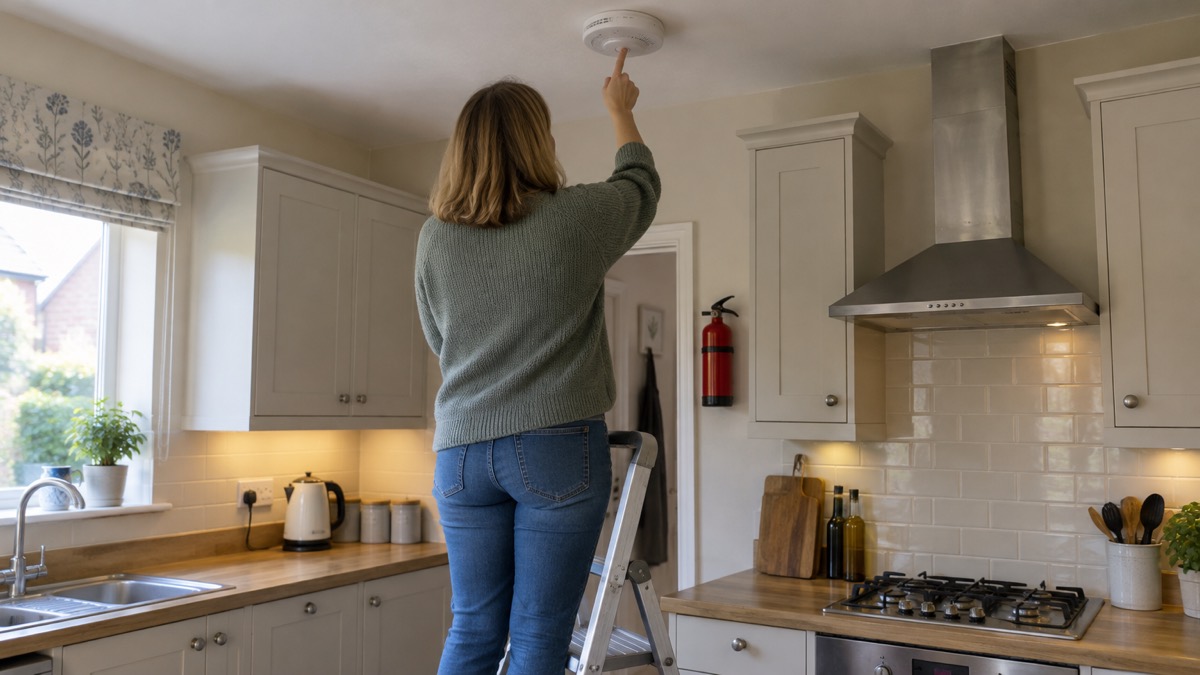
UltraFire's domestic smoke and heat alarms are quality assured and tested to the British Standards, and are suitable for BS 5839-6 Grade F1 and F2 domestic installation2. They are backed by a lifetime warranty2. Grade F1 and F2 are the grades a household is most likely to be fitting: the point for a prepping household is that the alarm is specified for domestic installation rather than for a commercial building, so it is the right class of device for a home.
Detection is the part of a fire plan that works while you are asleep, which is exactly when a power cut, a storm or a cold night makes a fire more likely. Fit alarms on every level of the home and in the rooms where a fire would cut off your escape, and test them on a routine you will actually keep. A home fire safety visit will give you personalised advice about detection systems and bedtime checks, and some services fit smoke alarms free3.
Heat alarms suit kitchens and garages, where cooking smoke or dust would set off a smoke alarm constantly and lead you to disconnect it. A disconnected alarm protects nobody.
For the household guide to fire detection and what to do when an alarm sounds, see Home Emergencies: Fire, Carbon Monoxide, Gas Leaks and Burst Pipes.
Next Working Day Delivery on orders made before 4:30pm
UltraFire advertises Next Working Day Delivery on orders made before 4:30pm2. That is the maker's stated service, and it is the figure to plan around. An order placed after 4:30pm misses the cut-off for that day, so the next working day moves on by one. Working days normally exclude weekends and bank holidays, so a Friday afternoon order or one placed over a bank holiday weekend should not be counted on to arrive before the next working day after that.
The maker's pages do not set out a separate weekend or bank holiday timetable, so the safe approach is to treat 4:30pm as the deadline and to order earlier in the day when the kit is needed for a date. If you are replacing an extinguisher before a forecast cold spell, order at the start of the week rather than the end of it.
Delivery is not the only route to help in bad weather. Local resilience arrangements include delivering supplies during severe weather where a group has a suitable vehicle9. That is a community backstop, not a substitute for ordering in good time, but it is worth knowing who in your area organises it. For how neighbours and local groups work together, see Community Resilience: A Guide for Neighbours and Local Groups.
Ordering in time for an emergency kit
Fire kit is one line in a household emergency kit. Build up the kit over time and keep it in a safe place; you do not need to buy all the items at once10. A first aid kit appears on the official lists, and so do spare medication and pet care items where they are required11.
| Item on official lists | Why it belongs beside your fire kit | Source |
|---|---|---|
| First aid kit | Keep it up to date so you can respond quickly and confidently | 7 |
| Spare medication | A fire or evacuation can separate you from your medicines | 13 |
| Pet care items if required | Listed for the household emergency kit where required | 11 |
The practical rule is to order fire kit before you need it, not during the incident. A household that waits for the storm warning to buy an extinguisher is ordering into a delivery network under strain. Order in a quiet week, fit the bracket, read the label and put the blanket where you will reach for it. If you are at home when an emergency happens, try to gather essential items before you leave, keeping them in the same place within the home so you know where they are12.
For the full list and how to build it, see Emergency Kit: What a UK Household Should Keep Ready. For the specific risks of a power cut, see Power Cuts: A Household Guide.
What to check when your UltraFire order arrives
Check the parcel before you put anything away, while the packaging is still to hand and a problem is easy to report.
- Extinguisher: confirm it arrives with its wall bracket, as the maker states all extinguishers are supplied with one1. Check the gauge reads in the green and the safety pin and tamper seal are intact.
- Fire blanket: confirm the BS EN 1869 kitemark is on the blanket or its pouch1.
- Smoke or heat alarm: confirm the model is the one you ordered and is marked as suitable for BS 5839-6 Grade F1 and F2 domestic installation2.
- Paperwork: keep the order confirmation and any warranty information with the product, since the extinguisher warranty runs for 5 years and the alarm warranty for life1.
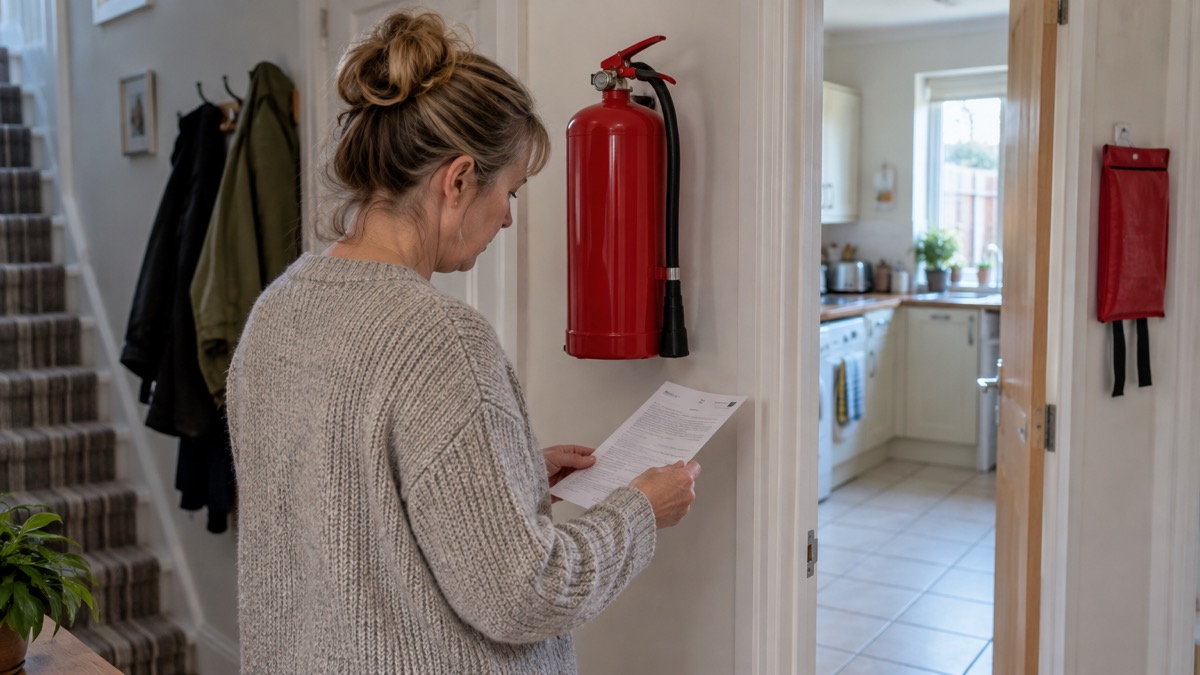
If something is missing or damaged, contact UltraFire through its website before you fit or rely on the item. Do not mount a damaged extinguisher or a blanket with a torn pouch.
The same discipline applies to the appliances your fire kit is there to cover. Fire services advise not ignoring warning signs: if you can smell burning or clothes feel hotter at the end of a cycle, have the appliance checked15. Air fryers should be watched while in use, turned off immediately if you notice burning smells or unusual noises, and the manufacturer contacted if you believe there is a fault16. A working alarm and a blanket are the backstop for those faults, not a reason to ignore them.
Using and storing UltraFire kit safely
An extinguisher and a blanket are only useful if they are where you can reach them and still in working order. Store them on their brackets, away from heat and damp, and check them on a fixed date each year, alongside the alarms. The maker's 5 year warranty on extinguishers and lifetime warranty on alarms are a backstop for faults, not a substitute for checking1.
The wider storage rules from fire and rescue services apply to everything around your fire kit:
- Store matches, lighters and chemicals safely, out of the reach of children6.
- Keep flammable materials in an approved safety container, stored in a fire resistant building made from metal or brick or a garage17.
- Store garden materials or flammable materials such as weedkiller responsibly, for example in a locked shed or container18.
- Store fuel in approved containers and keep it away from heat sources; store fuel outside the home where possible and keep quantities to a minimum19.
- Do not overstock fuels of any type, including paraffin or biofuel, and store them safely20.
- Flammable liquids and cylinders should be stored securely and kept away from ignition sources21.
Portable heaters and open fires are the other common cause of winter fires. Fireboxes and containers should always be placed on a stable surface, and when using biofuel always follow the manufacturer's guidelines and instructions20. A barbecue or fire pit should be set up well away from flammable materials, never left unattended and fully extinguished after use, especially disposable barbecues23. If you see a fire in the countryside, report it to NIFRS immediately on 99923.
For heating and cooking without mains power, see Heating and Cooking Without Mains Power or Gas: A Household Guide. For lighting that avoids naked flames, see Emergency Lighting at Home: Torches, Lanterns and Candles.
Safety notices and recalls
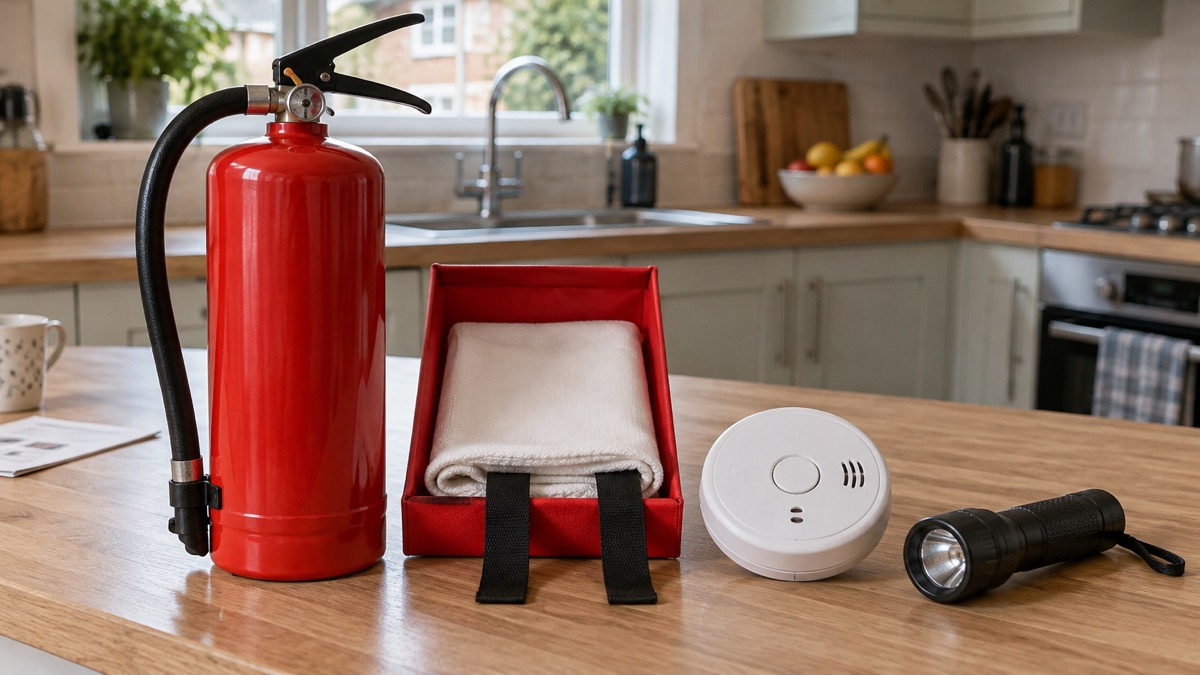
UltraFire's own product pages state the standards its kit is tested to: extinguishers Kitemarked to BS EN3, CE marked and MED approved, and blankets tested and kitemarked to BS EN 18691. Smoke and heat alarms are tested to the British Standards and suitable for BS 5839-6 Grade F1 and F2 domestic installation2. Those marks are what you check on arrival and what you look for if you are ever unsure whether a product is genuine.
Recalls are a fact of life for any household kit, and the pattern to watch is batteries and chargers. The Office for Product Safety and Standards published a product recall for the Ring RPPL360 Fast Charge Lithium Jump Starter presenting a high risk of fire, and advised owners to contact the retailer for up-to-date advice on obtaining a refund and disposing of the unit24. The lesson for a prepping household is to register products where you can, keep the paperwork, and check the government recall list before you rely on a stored battery device.
Batteries are the other fire risk in a kit. Incorrect disposal of vapes and e-cigarettes in general waste or recycling bins can cause fires and explosions in bin lorries and waste centre sites, putting workers at serious risk, damaging equipment, disrupting services and causing environmental harm25. Store spare batteries away from metal, and dispose of them at a household waste site that takes them.
For the household guide to backup power and batteries, see Backup Power at Home: A Household Guide.
Support and warranty
UltraFire's warranty terms are stated plainly on its product pages: all fire extinguishers are supplied with a 5 year warranty, and smoke and heat alarms are backed by a lifetime warranty1. Keep your order confirmation with the product so a claim can be made without hunting for it.
For help beyond the maker, fire and rescue services across the UK offer free home fire safety visits. These give personalised advice about fire safety and, in some services, free fitting of smoke alarms3. A Safe and Well visit covers cooking and smoking, heaters and heating, candles and fireplaces, detection systems, bedtime checks, what to do if there is a fire, and extra help and support8. Derbyshire Fire and Rescue Service offers home safety checks where it is known that there is a higher risk of fire, primarily the more vulnerable groups in the community26. The Fire Kills campaign aims to raise awareness among the public, and especially vulnerable groups, of the potential fire risks and everyday accidents that are the primary causes of domestic fire in the UK4.
Cold weather brings its own support. Suffolk's Warm Homes scheme offers help with fuel payments, lends electric heaters, assesses households for financial assistance towards repairs or replacements if a boiler or heater stops working, discusses energy efficiency improvements and helps access grants for insulation and basic draught proofing27. Public Health Wales advises checking that you have ordered your winter heating fuel if you have it delivered28. If you are older, disabled or medically dependent, see Extra Help in an Emergency: Older, Disabled and Medically Dependent Households.
For the wider picture of how the UK prepares, see How the UK Prepares for Emergencies: A Household Guide.
Sources (28)
- Fire extinguishers and fire blankets, UltraFire, 2026-11-02
- Domestic smoke and heat alarms, UltraFire, 2026-11-02
- Fire safety for parents and carers, Surrey County Council, 2026-10-28
- Safe and Well visit, Mid and West Wales Fire and Rescue Service, 2026-10-29
- Exeter Cathedral Yard fire, Devon and Somerset Fire and Rescue Service, 2026
- Burn awareness, Cheshire Fire and Rescue Service, 2026-05-20
- What should I keep in my first aid kit?, NHS, 2026-10-25
- Safe and Well checks, Surrey County Council, 2026-10-28
- Resilient communities, Scottish Borders Council, 2026-10-29
- Emergency kit, Ready Scotland, 2026-10-29
- Get help and advice in an emergency, Lincolnshire County Council, 2026-10-29
- Household emergency kit, nidirect, 2026-07-06
- Planning for an emergency: kit, Wiltshire Council, 2026-10-29
- Create a household emergency plan, Dumfries and Galloway Council, 2026
- Appliance Safety, Cheshire Fire and Rescue Service
- Air Fryers, Cheshire Fire and Rescue Service
- Wildfires, Ready Scotland, 2026-05-12
- Wildfires: protecting your home and garden, London Fire Brigade, 2026-10-25
- Portable heaters, Cheshire Fire and Rescue Service, 2026-05-26
- Portable heaters, gas fires and open fires, London Fire Brigade, 2026-10-25
- Extreme weather summer guide, London Fire Brigade, 2024-05
- Home oxygen and fire safety, Greater Manchester Fire and Rescue Service, 2026-10-29
- Stay safe this summer, Northern Ireland Fire and Rescue Service, 2026-06-22
- Product recall: Ring RPPL360 Fast Charge Lithium Jump Starter, Office for Product Safety and Standards, 2023-03-27
- Vapes and e-cigarettes, Electrical Safety First, 2026-10-25
- Cold weather, Derbyshire Fire and Rescue Service, 2026-10-29
- Seasonal winter advice, Suffolk County Council, 2026-10-29
- Weather and health, Public Health Wales, 2026-07-16
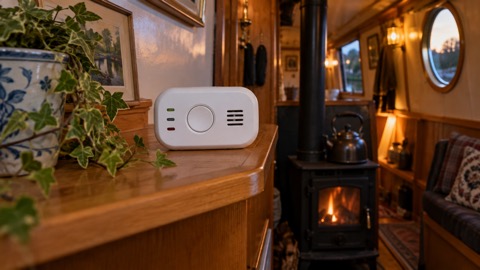 UltraFire UBCO1 Carbon Monoxide Alarm
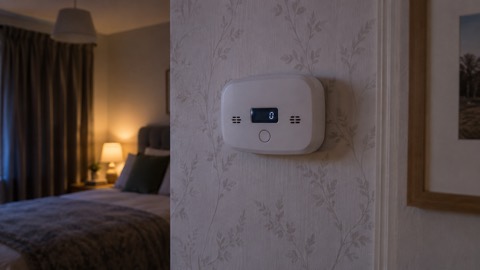 UltraFire UBCO1D Carbon Monoxide Alarm