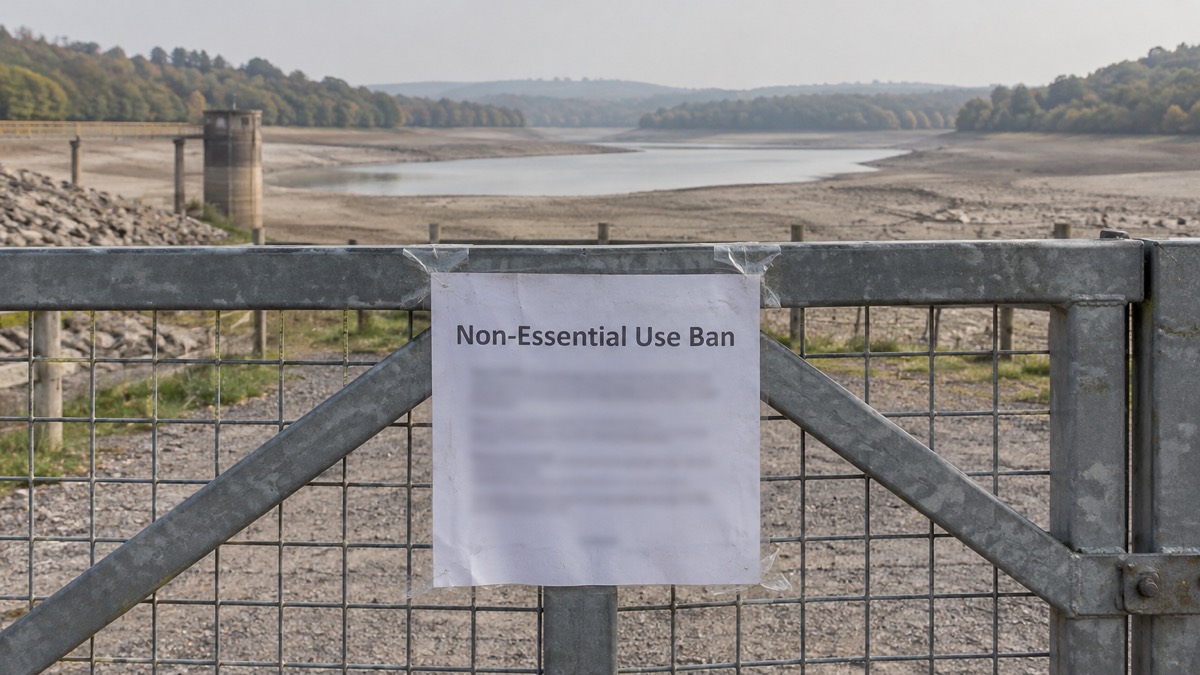
South East Water applied on Friday 2 October 2026 for a non-essential use ban (NEUB) in its Sussex supply area, the company and the Department for Environment, Food and Rural Affairs (Defra) said. The application must be approved by the Secretary of State for Environment, Food and Rural Affairs before a ban can be introduced, and South East Water states it is not currently in force1.
The Department for Environment, Food and Rural Affairs, the Environment Agency and Water Minister Emma Hardy published reservoir figures the same day. At this time of year the Environment Agency would expect England's overall reservoir storage to be almost three-quarters (74.3%) full, but because of this year's drought most reservoirs are less than half full. Ardingly Reservoir in West Sussex was at 23 per cent total capacity on 28 September, and Wimbleball in Somerset at 21 per cent. Most of England's reservoirs are now classed as notably or exceptionally low1.
September was the sixth month of 2026 with less than average rainfall, averaging 65% across the country. The east saw 52% of average rainfall and the south east 57%; Central England saw 59% and the south west 69%. South East Water reports that between March and August, Sussex received just over 56 per cent of expected rainfall, and that Ardingly Reservoir, which serves 228,000 customers in Haywards Heath and the surrounding areas, is only 22.8 per cent full. The company states this has triggered the next level of its Drought Plan1.
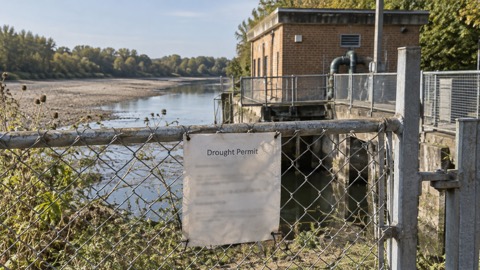
The Environment Agency granted South East Water a Drought Permit for Sussex on Tuesday 29 September, following an application on 28 August. The permit allows the company to reduce the amount of additional water released from Ardingly Reservoir into the Shell Brook tributary of the River Ouse, and to reduce the minimum flow that must remain in the river at Barcombe Mills after water has been taken for customers2.
"South East Water is set to apply to the Government today (Friday) for a non-essential use ban (NEUB) that would leave more water available for households to prevent the need for additional measures."
A non-essential use ban targets certain commercial and non-household uses of water. South East Water states that if the application is approved it would only implement the ban if drought conditions in Sussex become more severe, and that there are no additional restrictions in place as a result of the application2.
| Measure | Detail | Date |
|---|---|---|
| NEUB application (Sussex) | Applied for under a Drought Order; requires Secretary of State approval; not in force | 2 October 20262 |
| Drought Permit (Sussex) | Applied for 28 August 2026; granted by the Environment Agency | 29 September 20262 |
| Hosepipe restriction exemptions removed | Exemptions removed except where hosepipe use is permitted for health and safety purposes | From 9 October 20262 |
| Ardingly Reservoir level | 22.8 per cent full | Reported 2 October 20262 |
Why it matters for households
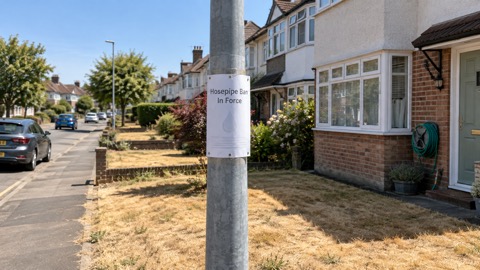
Households in Sussex are already subject to hosepipe restrictions, introduced in July because of low river levels and rainfall. From 9 October 2026 South East Water is removing existing exemptions, so customers will only be able to use a hosepipe where permitted for health, safety or welfare purposes. The company states that a watering can may still be used and that water from baths, showers and sinks can be reused in the garden2.
The non-essential use ban itself would not add restrictions for households. South East Water states it targets commercial and non-household water use, and that household customers are currently subject to the hosepipe restrictions described above2. The hosepipe bans guide explains how temporary use bans work, and the water shortage and hosepipe ban checklist sets out what households may need during a shortage.
Nationally, the Environment Agency's chief executive said the drought is far from over. The agency recently warned that 120% of average rainfall is needed over the coming seven months for the entire country to be out of drought by next spring. The National Drought Group, which includes the Met Office, government, regulators, water companies, farmers and conservation experts, is now meeting weekly as part of a heightened incident response1.
What happens next
The NEUB application now goes to the Secretary of State for Environment, Food and Rural Affairs for approval; no date for a decision has been reported2. The removal of hosepipe exemptions in Sussex takes effect on 9 October 20264. The Environment Agency is working on 10 Drought Permit applications, and Defra states that reservoir storage is set to continue to decline throughout the rest of the year without major interventions such as non-essential use bans, depending on rainfall and demand1. Defra also reports that El Niño is set to put the UK at a slightly greater risk of a wet, stormy autumn, but that drought pressures will persist in some areas1.
Sources (4)
- England’s reservoirs continue to feel drought strain after sixth dry month of 2026 - GOV.UK, gov.uk
- South East Water announces change to current hosepipe restriction | South East Water, southeastwater.co.uk
- Drought Orders | South East Water, southeastwater.co.uk
- Water latest | South East Water, southeastwater.co.uk
 Hosepipe Bans and the Garden
 Hosepipe Ban Fines and Reporting
 Saving Water at Home
 Household Guide to Drought