The UK government published its National Security Strategy on 24 June, describing an outlook of geopolitical uncertainty, greater exposure to economic shocks, rapid technological change and persistent transnational risks such as climate change1. The accompanying UK Government Resilience Action Plan, published in July 2025, states that "security at home", including domestic resilience, is a fundamental element of the strategy1.
The action plan sets out three objectives for this Parliament: to assess continuously how resilient the UK is, to enable the whole of society to take action, and to strengthen the public sector resilience system2. It defines resilience as the ability to anticipate, assess, prevent, mitigate, respond to and recover from natural hazards, deliberate attacks, geopolitical instability, disease outbreaks and other disruptive events2. The government says the consequences of these risks do not fall evenly across society, and that planning for people who are vulnerable in different types of emergencies is core to the plan2.
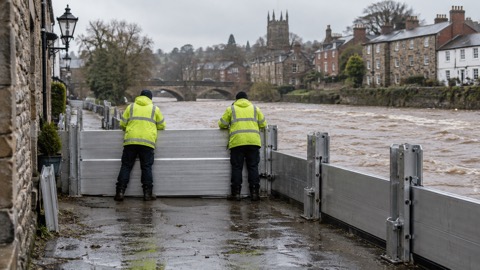
On flooding, the plan states that 6.3 million properties in England are in areas at risk, and that the total could increase to 8 million by the middle of the century, or around one in four properties2. It cites £4.2 billion for flood and coastal erosion resilience over the first three years, and a new 10-year flood and coastal erosion investment programme launching in April 20261. It also cites the government's £2.65 billion total investment for 2024/25 and 2025/26, which it says is better protecting over 52,000 properties across England through new or improved flood defences2.
On alerts, the plan states that the second public national test of the Emergency Alerts system will take place on 7 September, and that as with the first test in April 2023 the message will be sent to every compatible phone nationwide1. It records that Emergency Alerts were issued to assist with evacuations during acute flooding on the River Soar in January 2025 and on the Rivers Roe and Ive in May 20241. Other measures cited include the UK Resilience Academy, launched in April 2025 with £2.55 million of funding for 25/26 and training up to 4,000 people in the public and private sector each year, and Stronger Local Resilience Forum Trailblazers launched in five local areas1. The plan also refers to incidents such as the North Hyde Substation fire, which resulted in the closure of Heathrow airport in March 2025, as demonstrating the importance of resilience across critical national infrastructure2.
"And for the average person, it may involve looking out for vulnerable neighbours and stocking up on some basics like bottled water and a torch."
Why it matters for households
The plan frames resilience as a shared responsibility between individuals, communities, businesses and government at all levels2. For households, the risks it names include national power outages and cyber attacks on institutions, alongside pandemics and flooding2. The foreword gives examples of what readiness may involve for different people, including upgrading cyber defences for a business, planning for a wider range of adverse weather events for a local government employee, and, for the average person, looking out for vulnerable neighbours and stocking up on basics such as bottled water and a torch2. The plan states that assessing and planning for people who are vulnerable in different types of emergencies is core to its approach2. The 7 September test will reach every compatible phone nationwide1.
What happens next
The second national test of the Emergency Alerts system is due on 7 September1. The new 10-year flood and coastal erosion investment programme launches in April 20261. The national exercise for 2025 will be a pandemic preparedness exercise, which the plan describes as the first of its kind in nearly a decade and set to be the biggest in UK history2. The Cabinet Office will instruct the UK Resilience Academy, by the end of 2025, to convene panels of relevant experts to scrutinise plans and preparedness for whole-system civil emergencies across the UK1.
The UK preparedness hub sets out the wider system, including Local Resilience Forums and the England pilots to strengthen them, the national resilience campaign and the Resilience Framework and Action Plan.
Sources (2)
- data.parliament.uk, data.parliament.uk
- UK Government Resilience Action Plan (HTML) - GOV.UK, gov.uk