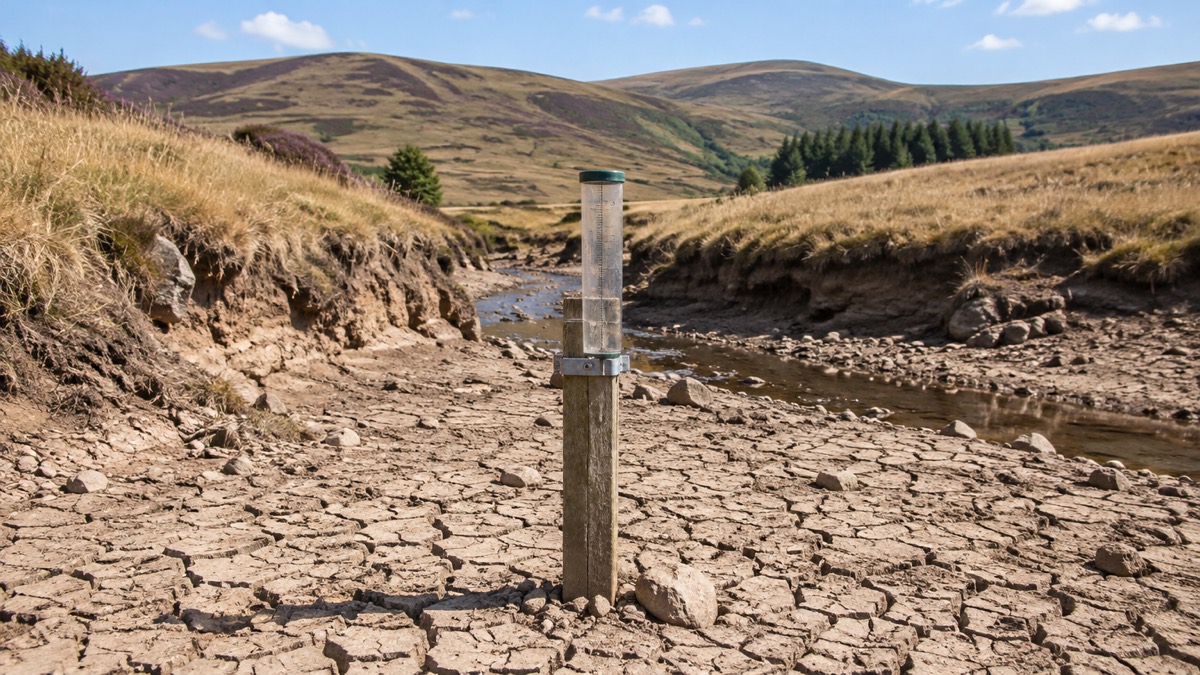
Over the three-month period ending in August 2022, the majority of England, Wales and south-east Scotland were in the "severely dry" and "extremely dry" categories of the Standardised Precipitation Index (SPI), a widely used measure of rainfall deficit1. The assessment was published by Wiltshire and Swindon Prepared, the local resilience forum's public information service, which rates drought as a medium risk, reference NRR52, with moderate impact (3) and medium low likelihood (2)1.
The summer of 2022 (June to August) registered as the fifth driest for England and Wales in a series from 1836, and rainfall across the whole UK was less than two-thirds of the 1991-2020 average1. Many regions, particularly in England, received less than half the average, including Severn Trent, Yorkshire, Anglian, Thames, Wessex and South West; the Anglian, Thames and Wessex regions each recorded their fifth driest summer in records since 18361. The season was also notably hot, with a new UK record temperature of 40.3°C at Coningsby in Lincolnshire recorded on 19 July1. The longer SPI-12 period, September 2021 to August 2022, is described as highlighting the severe duration and magnitude of the event1.
| Measure | Reported position |
|---|---|
| SPI-3, three months to August 2022 | Majority of England, Wales and south-east Scotland severely dry or extremely dry1 |
| Summer 2022, England and Wales | Fifth driest in series from 18361 |
| UK summer rainfall against 1991-2020 average | Less than two-thirds1 |
| Regions below half average rainfall | Severn Trent, Yorkshire, Anglian, Thames, Wessex, South West1 |
| UK temperature record | 40.3°C at Coningsby, Lincolnshire, 19 July1 |
"In the UK, the Environment Agency (EA) decides when we are in drought conditions. The EA works together with water companies to reduce the impact of drought for people in affected areas."
Why it matters for households
A drought is defined in the guidance as a prolonged period of shortages in the water supply, which can follow an unusually low period of rainfall over an extended time1. The Environment Agency decides when drought conditions apply in the UK and works with water companies to reduce the impact for people in affected areas1. The guidance states that what happens with the weather between winter and summer dictates whether temporary use bans are necessary when the temperature rises, and that water companies have a large role1. It adds that water companies can apply for drought permits to help refill reservoirs and work with farmers and others to protect the environment1.
Environment Agency forecasts for 2023 suggested that if winter was dry, with 80% or less of the usual winter rainfall, large parts of the country would likely be at risk of drought continuing into the next summer, and around two-thirds of water companies would see their supply areas impacted by those conditions1. The guidance notes that such a dry winter would risk the start of 2023 reflecting the position at the start of 19761. It also records that the natural environment continues to take time to recuperate from the 2022 summer, with the Environment Agency monitoring how well fish and invertebrates are recovering1.
On saving water indoors, the guidance advises checking the home is leak-free by taking a water meter reading, waiting 30 minutes without using water and taking a second reading, with any change indicating a leak, and repairing dripping taps by changing washers, noting that one drop per second wastes 2,700 gallons per year1. It also sets out advice on shorter showers, full loads in dishwashers and washing machines, capturing water while waiting for it to run hot, and using a water butt1. The background to earlier events is covered in the guide to past UK droughts and heatwaves, and the framework for declaring drought in England is set out in how drought is declared and what each stage means.
What happens next
The guidance states that all sectors are planning for all rainfall scenarios and taking action over winter months to improve supplies and resilience for the next year1. No further dated steps are given in the material published on this page.
Sources (1)
- Drought - Risk Advice & Articles - Wiltshire & Swindon Prepared, wiltshireandswindonprepared.org.uk
 Past UK Droughts and Heatwaves
 Why UK Summers Are Hotter
 Drought Stages in England





