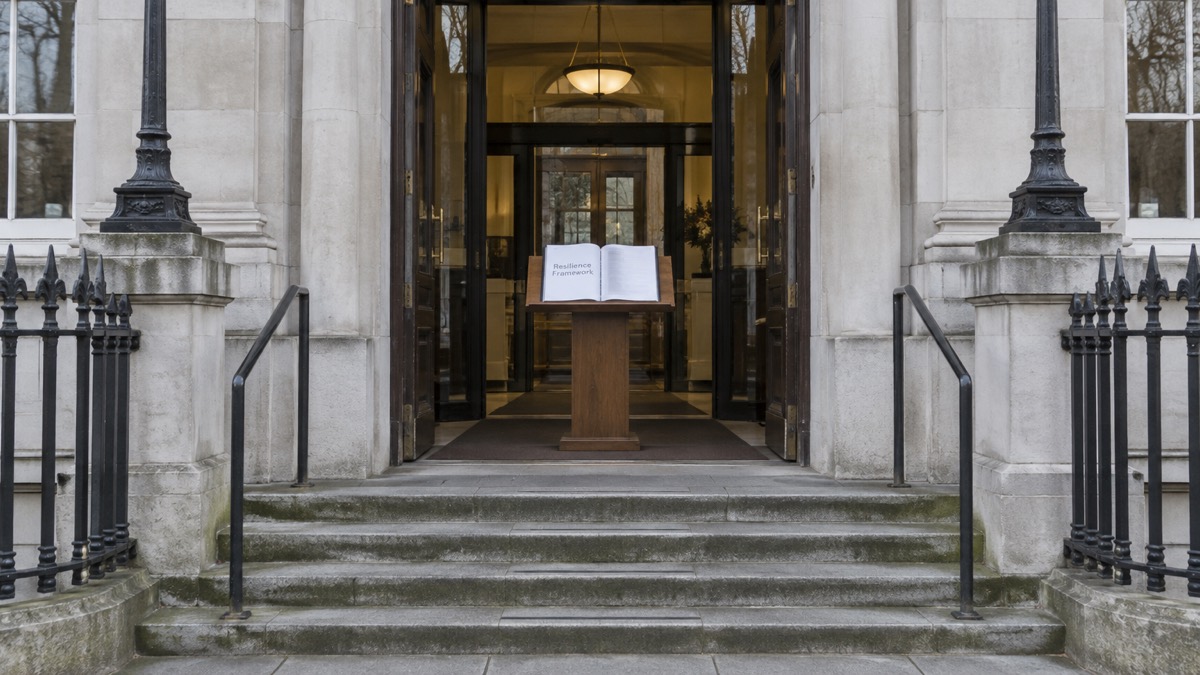
The UK Government Resilience Framework was published in December 2022. The 2023 National Risk Register, published the following year, records that the Framework "set out the core principle that developing a shared understanding of the risks we face is fundamental"1. The Framework is the development covered here; the Register is the later document that describes it.
The Register states that it is the external version of the National Security Risk Assessment (NSRA), the government's assessment of the most serious risks facing the UK, and that it includes information about 89 risks within 9 risk themes2. For the first time since the Register was first published in 2008, the 2023 edition aligns with the structure and content of the classified internal NSRA1. The government describes the Register as more transparent than ever, with information excluded only where there is a specific reason, such as national security or commercial confidentiality2. The Register states that it is not targeted at the general public1.
The assessment behind it is evidence led, with 25,000 pieces of data used in the latest full assessment, finalised in autumn 20221. Non-malicious risks are now assessed over 5 years, while assessment timescales for malicious risks remain at 2 years1. Risks are assessed as "reasonable worst-case scenarios", with impact scored across 7 broad dimensions on a scale of 0 to 5, and likelihood scored from 1 to 52.
"The UK Government Resilience Framework, published in December 2022, set out the core principle that developing a shared understanding of the risks we face is fundamental"
The Register's foreword, by the Rt Hon Oliver Dowden CBE MP, Deputy Prime Minister, Chancellor of the Duchy of Lancaster and Secretary of State for the Cabinet Office, says the UK faces an ever-changing and growing set of risks, citing the invasion of Ukraine by Russia, the effects of the COVID-19 pandemic and the impact of climate change, and states that "all of society needs to work together to strengthen our defences and build a more resilient nation"2.
| Item | Detail |
|---|---|
| Framework published | December 20221 |
| Risks in the 2023 Register | 89, within 9 risk themes1 |
| Data used in latest full assessment | 25,000 pieces of data, finalised autumn 20221 |
| Assessment period, non-malicious risks | 5 years1 |
| Assessment period, malicious risks | 2 years1 |
| Impact dimensions | 7, each scored 0 to 52 |
Why it matters for households
The Framework's stated principle is that a shared understanding of risk underpins preparation and recovery1. The Register that followed sets out the risks the government assesses, including storms, flooding, heatwaves, low temperatures and snow, drought, poor air quality, pandemic and emerging infectious disease, and failures of electricity, gas and water infrastructure2. It also lists cyber attacks on the health and social care system, the transport sector and telecommunications systems2. The Register states that it is not targeted at the general public1; its chapter on individuals and communities includes preparedness advice, and it records that the government published the Community Resilience Development Framework and guidance on planning the coordination of spontaneous volunteers in 20192. The Register also records that the government has launched the Emergency Alerts service, to get urgent messages quickly to mobile phones when there is a risk to life1.
What happens next
The Register records that the government's white paper on AI, published in 2023, commits to establishing a central risk function that will identify and monitor the risks that come from AI, and that the UK Government has committed to hosting the first global summit on AI Safety1. No further dated steps arising from the Framework are given in these documents.
The Framework and the Register are covered in the guide to the UK Government Resilience Framework and Action Plan, alongside the wider UK preparedness pages, including Local Resilience Forums, the England pilots on strengthening them and the Be Ready national resilience campaign.
Sources (2)
- democracy.york.gov.uk, democracy.york.gov.uk
- assets.publishing.service.gov.uk, assets.publishing.service.gov.uk
 UK Resilience Framework