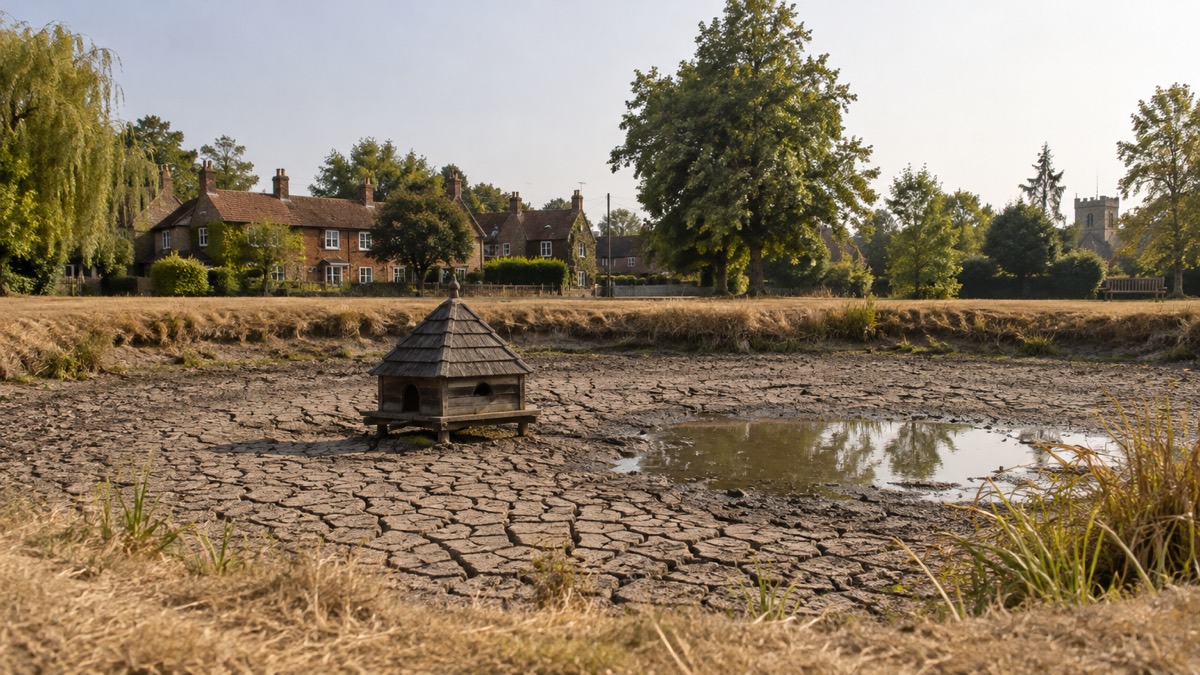
England recorded its driest July on record, the Met Office said on 3 August 2026, with 6.5mm of rainfall across the month. That is 10% of the long-term meteorological average and less than half the previous record of 13.4mm set in 1911, in a series dating back to 18361. Wales also recorded its driest July on record, with 9.3mm, and Southern England saw its driest month ever recorded, with 1.9mm, or 3% of its long-term average1.
The Met Office's provisional figures, published on 3 August and updated on 4 August, cover the whole of July. Its earlier release on 31 July, covering the period to 30 July, had England at 5.6mm and described the figures as subject to change2. The final figures were slightly higher1.
| Nation or region | July rainfall | Share of long-term average |
|---|---|---|
| England | 6.5mm | 10% |
| Wales | 9.3mm | 9% |
| UK | 28.9mm | 35% |
| Northern Ireland | 26.9mm | 30% |
| Scotland | 72.0mm | 69% |
| Southern England | 1.9mm | 3% |
Nineteen counties recorded 1mm of rainfall or less across the entire month: Berkshire, Dorset, East Riding of Yorkshire, East Sussex, Essex, Gloucestershire, Greater London, Herefordshire, Isle of Wight, Kent, Leicestershire, Lincolnshire, Northamptonshire, Nottinghamshire, Oxfordshire, Rutland, Surrey, Warwickshire and West Sussex1. July was also the third driest month ever recorded for England, behind February 1891 and June 19251.
The month was exceptionally warm and sunny as well. England saw its second warmest July for mean temperature on record and its sunniest July on record, and England and Wales each experienced their sunniest calendar month ever observed1. The Met Office said July was the sixth consecutive month of 2026 with above average mean temperatures1. Four months of the year so far have seen above average rainfall (January, February, March and June), with three below average (April, May and July)1.
"The combination of record-breaking dryness, exceptional warmth and unprecedented sunshine has delivered one of the most notable summer months in our historical records."
The drought that built through July has continued. On 14 October, eleven areas of England were still in drought, with Yorkshire the latest to move into drought status on 9 October, and reservoir levels at 54%, 21% below what is expected in the autumn3. The Met Office says above-average rainfall over a sustained seven-month period is needed to bring all areas out of drought3.
Why it matters for households
More than half of England and the whole of Wales were officially in drought during July2. The Environment Agency declared a drought in more than half of the country at the end of that month, and Essex & Suffolk Water introduced a temporary use ban on Monday 3 August, asking customers to use watering cans and buckets instead of hosepipes for plants and cars4. An Anglian Water hosepipe ban had been in place in Norfolk since 11 July, covering garden watering, vehicle cleaning and paddling pools5.
Water companies have reported differing positions on storage. Bournemouth Water said its water storage levels remained good across its region, citing planning and investment ahead of the summer, and that it was exceeding planned targets for leak repairs6. Essex & Suffolk Water reported just 2mm of rain in its area during July, with reservoir levels dropping by 18%4.
The Environment Agency's chair, Helen Wakeham, said all sectors were taking action and thanked the public for following restrictions where in place1. The Met Office's figures show the scale of the rainfall deficit that households, farms and water supplies are recovering from.
What happens next
South East, Southern and South West Water have applied to extend restrictions to businesses through non-essential use bans in parts of their regions, which could cover golf clubs, private schools and commercial car washes. Permission from the Department for Environment, Food and Rural Affairs is required, and the government had not responded to the requests as of 14 October3. Southern Water is also seeking a drought order for the River Test in Hampshire, citing "a clear threat to supplies" in Hampshire and the Isle of Wight3.
The Met Office's full provisional July statistics were released on the afternoon of Monday 3 August2. How drought status is declared and what each stage means is set out in our guide to how drought is declared in England, and current restrictions are tracked in England's 2026 drought: where restrictions apply.
Sources (6)
- Historic July sees record dryness, unprecedented sunshine and exceptional warmth - Met Office, metoffice.gov.uk
- An early look at the July statistics: just how dry has it been? - Met Office, metoffice.gov.uk
- Businesses could be barred from non-essential water use amid supply threat | Water | The Guardian, theguardian.com
- Explaining the month’s water - July, nwg.co.uk
- Five days of rain expected for Norfolk after weeks of drought | Eastern Daily Press, edp24.co.uk
- Drought - Summer 2026 | Bournemouth Water, bournemouthwater.co.uk
 Why UK Summers Are Hotter
 England 2026 Drought Areas





