The UK Health Security Agency (UKHSA) updated its general information guidance on carbon monoxide on 24 May 20221. The page, published on GOV.UK, sets out how carbon monoxide behaves, where households are most likely to meet it, how exposure affects health, and the steps the agency says people should take if an alarm sounds or a leak is suspected1.
The guidance describes carbon monoxide as "a colourless, tasteless, odourless, non-irritating gas produced as a by-product during incomplete combustion of fuels due to there being insufficient oxygen present"1. It states that the most important source of exposure for the general public is "cooking or other fuel burning appliances which are poorly installed, faulty or used inappropriately (including inadequate ventilation)", giving the examples of incorrectly installed home boilers and the use of barbecues and portable generators inside homes, caravans and tents1. For smokers, it says, cigarettes are the major source of carbon monoxide1. Outdoors, road transport is the major contributor to atmospheric concentrations, though the guidance records that these releases fell by 95% between 1990 and 2019, and that total UK releases to the environment fell by 79% over the same period1.
On health, the guidance says a brief exposure to small amounts may cause headache, flushing, nausea, dizziness, vertigo, muscle pain or personality changes, while higher amounts may cause movement problems, weakness, confusion, lung and heart problems, loss of consciousness and death1. Longer exposure to small amounts may lead to flu-like symptoms with tiredness, headaches, nausea, dizziness, personality changes, memory problems, loss of vision and dementia, and the guidance notes it can be hard to tell low-level exposure apart from other common illnesses1. It states that children, pregnant women and older people are more at risk of harm, and that during pregnancy high levels can reduce the oxygen reaching the baby in the womb, potentially affecting growth and development1. People with conditions affecting oxygen delivery to the heart or brain, such as coronary heart disease, angina, asthma or anaemia, are described as particularly at risk1. Carbon monoxide exposure is not expected to result in cancer1.
The guidance sets out what to do if an alarm sounds or a leak is believed to be present, noting that unignited gas does not contain carbon monoxide1:
"stop using all appliances and evacuate the property immediately (try to stay calm and avoid raising your heart rate)"
It adds that people should call the National Gas Emergency Service on 0800 111 999 or the Health and Safety Executive Gas Safety Advice Line on 0800 300 363, should not go back into the property and should wait for advice from the emergency services, and should get immediate medical help1. Anyone who thinks they have been exposed and feels unwell or is worried is told to call NHS 111, contact their GP, or in an emergency contact 9991. The guidance says health usually improves once people are removed from the source, but that it is still important to seek medical advice1. Headaches, tiredness, difficulty in thinking clearly and feeling sick are listed as common symptoms, which can also resemble those of food poisoning and flu1.
Why it matters for households
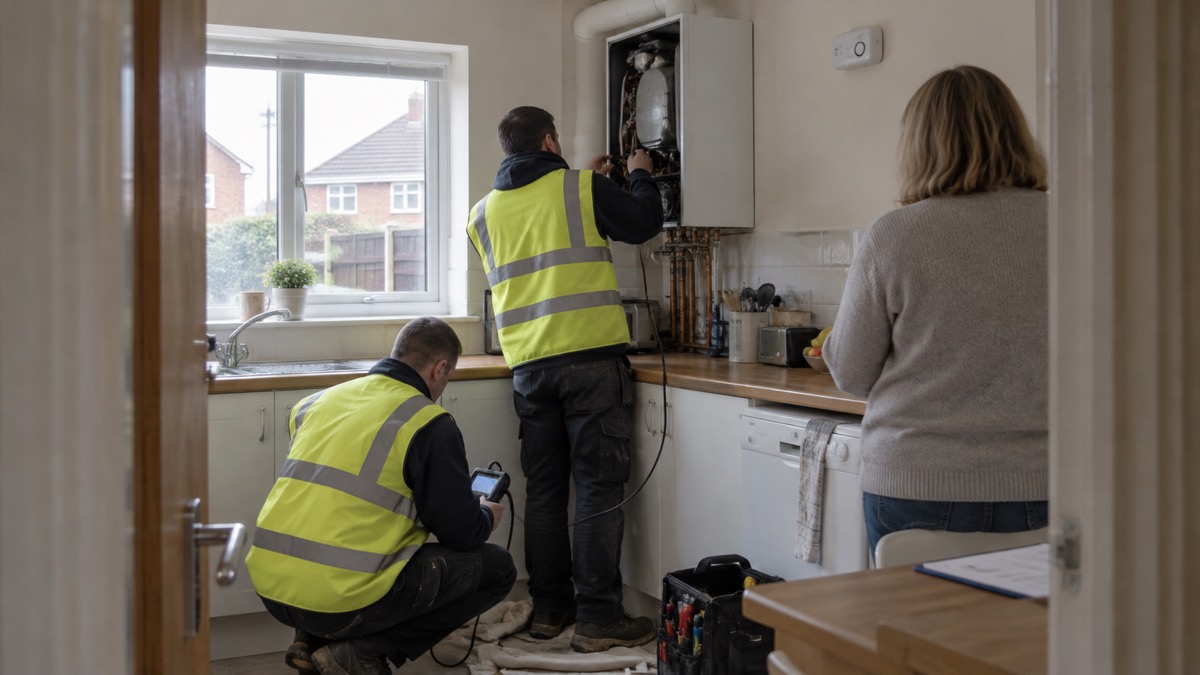
The guidance concerns the appliances most UK homes rely on for cooking and heating. It advises that all cooking and heating appliances using fossil fuels such as gas, oil and coal are serviced regularly by a qualified and registered engineer, naming Gas Safe Register for gas appliances, HETAS for solid fuel and OFTEC for oil1. Chimneys and flues should be kept clean, swept from top to bottom at least once a year by a qualified sweep, and should not be blocked1. On alarms, the guidance says fitting an audible carbon monoxide alarm meeting British or European Standards (BS Kitemark or EN 50291) will help protect against exposure to high levels, but that the alarm will not go off at lower levels and so should not be used as a substitute for regular servicing1. It notes that alarms can be bought from a DIY or hardware store1. The guidance does not give a figure for the number of carbon monoxide incidents or deaths in the UK, and no such figure is included in the updated page1.
What happens next
No further update date or consultation has been announced on the page, which carries the line "Updated 24 May 2022"1. The guidance points readers to the Health and Safety Executive's domestic gas health and safety pages, NHS information on carbon monoxide poisoning and the UK Teratology Information Service for further information1. Questions about the guidance can be sent to chemcompendium@phe.gov.uk or enquiries@ukhsa.gov.uk1.
Households can read more on carbon monoxide alarms and how to choose them, where to put a carbon monoxide alarm, carbon monoxide poisoning symptoms and why a carbon monoxide alarm is beeping, or start from the home emergencies hub.