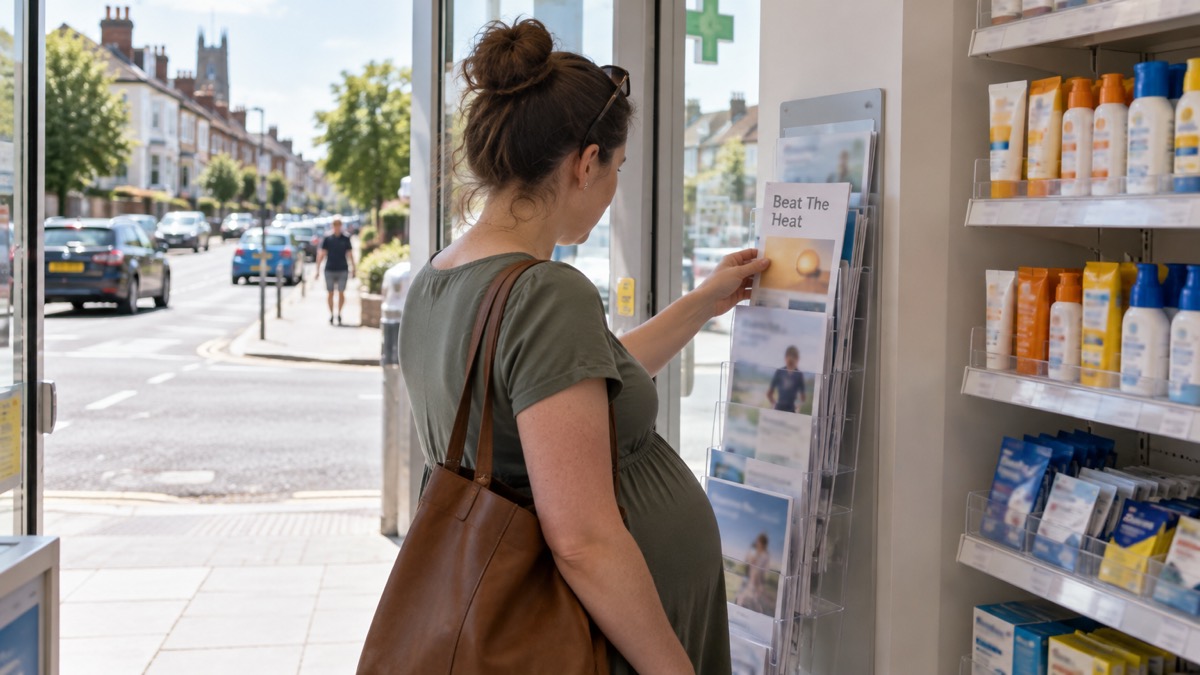
The UK Health Security Agency (UKHSA) and the Centre for Climate and Health Security have added pregnant women to the list of those at higher risk of ill health from the heat in the "Beat the heat" public guidance for England1. The change is recorded in the page's update history, which gives the date as 8 July 20251.
The guidance, reference GOV-19162, was first published on 10 May 2023 and is listed as last updated on 21 July 20261. The update history records the following changes:
| Date | Change recorded |
|---|---|
| 10 May 2023 | First published1 |
| 13 March 2024 | Easy-read versions and translations of guidance, and sign-language videos of the "Keep cool at home checklist", "Stay safe in hot weather" and poster added1 |
| 8 July 2025 | Pregnant women added to those at higher risk1 |
| 30 April 2026 | Updated easy reads, British Sign Language videos and translations of the checklist and hot weather guidance added1 |
| 20 May 2026 | Guidance updated based on new evidence on peak times for temperature and UV1 |
| 21 July 2026 | New translations to "Staying safe in hot weather" added1 |
The page describes the purpose of the documents: "These documents provide information on who is at greatest risk of ill health from the heat, how to recognise when health may be affected by heat, and what to do if you or someone else becomes unwell as a result of the heat"1. It also describes the material as "Information for the public on how to stay safe in hot weather, including how to keep your home cool"1.
The published documents include "Beat the heat: staying safe in hot weather" in HTML and as an easy-read PDF of 9 pages (2.44 MB), a British Sign Language video version, a "keep cool at home checklist" in HTML and as an easy-read PDF of 7 pages (1.77 MB), a BSL video of the checklist, and a one-page poster PDF (364 KB) with a BSL video1. UKHSA gives an email address, publications@ukhsa.gov.uk, for requests for these files in a more accessible format1. The page states that the resources form part of a wider collection of documents on minimising the health effects of adverse weather and building community resilience1.
"Added pregnant women to those at higher risk."
Why it matters for households
The change places pregnant women among the groups the national guidance identifies as at greatest risk of ill health from heat, alongside the other groups it already listed. The guidance applies to England1. It covers how to recognise when health may be affected by heat and what to do if someone becomes unwell as a result1. Households preparing for hot weather can use the checklist to keep the home cool and the main guidance to identify who is at risk1. Our guides on who is most at risk in hot weather and on staying cool in pregnancy during hot weather set out the practical detail, and the heat-health alerts guide explains the yellow, amber and red warning levels.
What happens next
No further update has been announced beyond the 21 July 2026 entry, which records new translations of "Staying safe in hot weather"1. Households can sign up for heat-health alerts, and our guide explains how to sign up for heat-health alerts. The wider heatwaves and drought section covers preparation for hot periods.
 Who Is at Risk in Hot Weather
 Staying Cool in Pregnancy
 Heat-Health Alerts Explained





