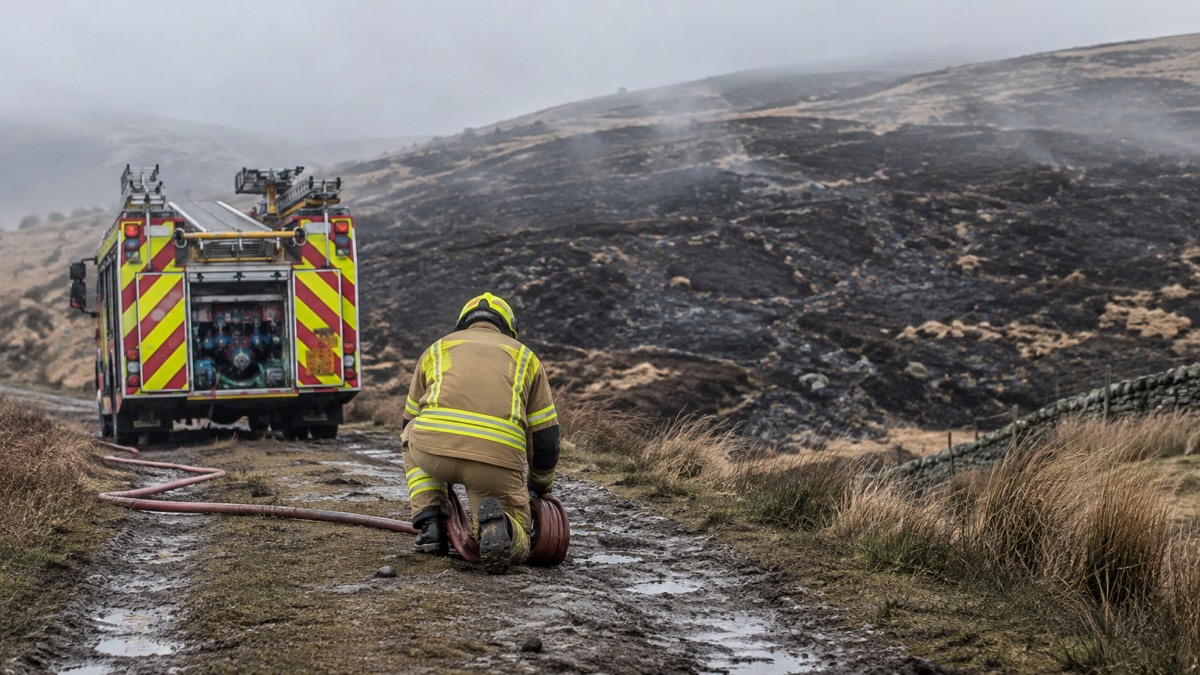
Fire and rescue services in England and Wales had responded to 1,006 wildfires by 11 November 2025, according to National Fire Chiefs Council (NFCC) National Resilience data, surpassing the 994 incidents recorded in all of 2022, which had been the worst year on record1. The Environment Agency's own account of drought management in England records that the 994 figure had already been passed by 4 September 20252.
The NFCC, which issued the figures in a public safety statement on 20 May 2026, said services in England and Wales had responded to 270 wildfires in 2026 as of 1 May1. It attributed many wildfires to everyday activities, including the use of disposable barbecues and carelessly discarded smoking materials1. Ministry of Housing, Communities and Local Government fire data cited by the NFCC shows that in the year ending December 2025, fire and rescue services in England responded to an additional 40,000 incidents compared with the previous year, driven largely by a 29% increase in fires, mostly outdoor primary and secondary fires1.
The Environment Agency lists 2025 to 2026 among the notable droughts of the last 50 years, alongside 2022 to 2023 and earlier events back to 1975 to 19762. It records that rainfall at the end of the year brought most of the country to recovery in December, except for parts of the East and South, and that by 23 March 2026 the country had fully recovered from drought2. The agency also notes that extreme rainfall during or at the end of a prolonged dry period, which may cause local or widespread flooding, is a more likely occurrence in future, citing south west England after the 2025 drought as an example2.
Under the operational guidance definition used by English and Welsh fire and rescue services, a wildfire meets one or more of the following criteria1:
| Criterion | Threshold |
|---|---|
| Geographical area | At least one hectare (10,000 square metres) |
| Sustained flame length | More than 1.5 metres |
| Committed resources | At least four fire and rescue service appliances or resources |
| Duration | Resources committed for at least six hours |
| Threat | Serious threat to life, environment, property and infrastructure |
The NFCC statement also covered water safety, citing Water Incident Database figures published by the National Water Safety Forum showing 193 confirmed accidental drowning fatalities in the UK in 2024, with May recording the highest number at 28 deaths, and 37% of those who drowned running or walking with no intention of entering the water1.
"With the risk of wildfires increasing as we go into the warmer months, we're asking everyone to take a few simple precautions to help keep themselves, their communities and the environment safe this summer."
Why it matters for households
The figures cover England and Wales and describe a trend across the year to 11 November 2025, with further incidents recorded in 20261. The Environment Agency's drought framework sets out how restrictions reach households: water companies in England depend on adequate water resources to meet the needs of over 57 million people, and each company must hold a statutory drought plan describing the actions it will take in a drought2. Companies can implement temporary use bans, formerly known as hosepipe bans, under their own powers2. Between 1996 and 2026 there were 124 drought permits and 57 drought orders issued, with 2025 seeing the highest number of drought permits2. Drought orders, which can authorise supply by standpipes or water tanks, are determined by the Defra Secretary of State in England and have not been used since 19762.
The Environment Agency also notes that around 1 million users depend on some 40,000 private water supplies from streams, boreholes and springs, of which just over half are domestic supplies, and that where circumstances pose a danger to life or human health, the local authority has powers to require the water company to provide an alternative supply such as bottled water, at a cost to those supplied2.
The NFCC's public safety advice, issued ahead of warmer, drier bank holiday weather, includes avoiding disposable barbecues in open countryside, parks and moorland areas; not discarding cigarettes, matches or glass bottles; following local authority guidance on fire risks and restrictions; and reporting any signs of fire immediately by calling 999 and asking for the Fire and Rescue Service1. On water, it advises people not to jump into water to cool off, to supervise children actively in and near water, and not to enter the water after drinking alcohol1. Its guidance for helping someone in trouble is to phone 999, tell the person to float on their back and throw them something that floats1.
What happens next
The NFCC statement was issued on 20 May 2026 ahead of forecast warmer, drier bank holiday weather, and reports the 2026 count as of 1 May 20261. No further update date has been reported. The Environment Agency's drought framework was updated on 8 April 2026 and records full recovery from drought across England by 23 March 20262.
Households can read more on wildfires and grass fires: risk and prevention, the wider heatwaves and drought picture, and how drought permits, orders and emergency rota cuts work.
 Wildfires and Grass Fires





