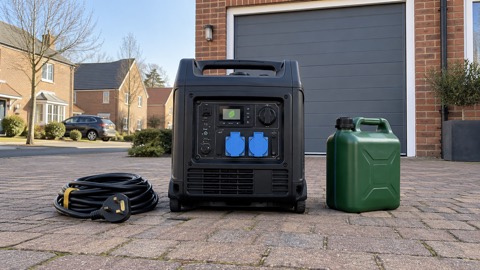
Gorilla Power is a generator brand sold in the UK through Generators Direct, and the range on sale covers two very different jobs. The GP3800iE is a small inverter "suitcase" generator rated at 3,500W running and 3,800W maximum, with an 11.00L fuel tank, 2 x 240V 13A sockets, 1 x USB and 1 x 12V DC output, and recoil or electric starting1. The GP12000DE is a large open-frame diesel unit rated at 12,000W running and 12,800W maximum, with a 35.00L tank, 2 x 240V 32A and 2 x 115V 32A sockets and electric starting2. The range is described as covering everything from portable inverters for camping to heavy-duty diesel and dual-fuel models for industrial and backup power3.
For a household preparing for power cuts, the important point is that a generator is outdoor equipment. The Health and Safety Executive for Northern Ireland is blunt: a portable generator must never be used indoors or in partially enclosed spaces, including garages, even where there is partial ventilation3. Every fire and rescue service in the UK says the same, and the reason is carbon monoxide, which is invisible and can kill4.
So the practical question is not only which model, but where it will stand, how it will be fuelled and how it will be kept ready between emergencies. This page sets out what each type does, what it can and cannot run, and the safety rules that apply to all of them.
What Gorilla Power makes for UK households
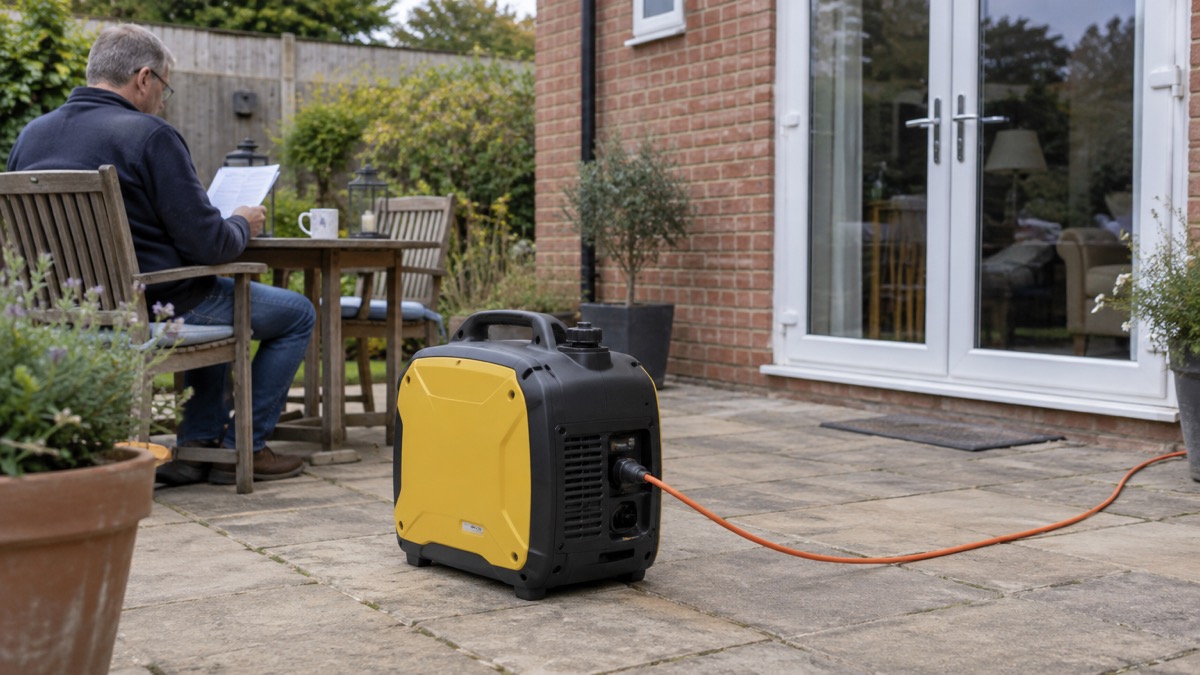
The brand's UK presence is two generator types, both listed as in stock by the retailer: a petrol inverter suitcase generator for lighter duties and an open-frame diesel generator for heavy loads1. That is a narrow range compared with makers who sell a full ladder of sizes, and it shapes how a household should think about it. The small unit suits the common emergency: a few hours or a day without power, with a fridge, a phone and a lamp to keep going. The large unit suits a bigger property or a longer outage where a substantial load has to be carried9.
Neither is a whole-house standby system. A standby generator is wired into the building and starts itself; these are portable machines that you wheel or carry outside, start by hand or by key, and plug appliances into directly. That distinction matters for planning, because it decides what you can realistically run and how much fuel you need to keep.
If you are still deciding what kind of backup suits your home, the Backup Power at Home: A Household Guide sets out the options side by side, from battery stations to generators, and the Power Cuts: A Household Guide covers what to do in the first hour of an outage. A generator is one answer among several, and for many flats and terraced houses a battery power station is the more practical choice because it can be used indoors.
Portable inverter generators for camping and light use
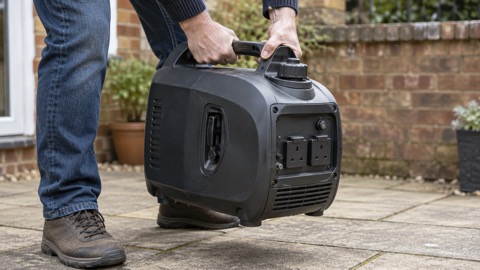
The GP3800iE is the model in this range aimed at lighter use. Its listing describes a true sine wave inverter producing clean power for sensitive electronics, 3,500W running and 3,800W maximum output, 2 x 240V 13A sockets, 1 x USB and 1 x 12V DC, recoil or electric starting, and an 11.00L fuel tank1.
Inverter technology is what makes a generator usable for modern kit. Clarke International explains that inverter generators electronically control and condition the power they produce, and are generally quieter, more compact and more fuel-efficient at lighter loads, which is why they are popular for caravans, camping, laptops, televisions, chargers and other sensitive devices7. For a household, that means a laptop, a router, a phone charger or a television can be run without the worry that comes with raw generator output.
The trade-off is capacity. Clarke notes that a generator which is too small may struggle to start a power tool, run erratically or repeatedly trip its overload protection, and that where several tools are used they should be started one at a time7. The same applies to appliances with motors, such as a fridge or freezer compressor, which draw more at the moment of starting than when running. Plan to bring loads on one by one rather than all at once.
For camping, the machine is portable but the siting rules travel with it. The Health and Safety Executive for Northern Ireland says a generator must never be used indoors or in partially enclosed spaces, including garages, even with partial ventilation3. Humberside Fire and Rescue Service adds that a gas, petrol or diesel generator must never be run inside a caravan, motorhome, tent or awning5. Northern Gas Networks makes the same point for holidays and camping: never operate generators or fuel-powered equipment inside or near enclosed spaces10.
Diesel generators for heavy-duty power
The GP12000DE is the heavy-duty option. The retailer describes it as built for industrial, commercial and backup power needs, with 12,000W running and 12,800W maximum output, a 12.00 kW continuous rating, 12.00 kVA, electric starting, automatic voltage regulation and a 35.00L diesel tank2. It runs on diesel only2.
Champion Power Equipment, a generator maker, sets out when diesel makes sense: it is a strong option when you need reliable backup power for longer periods or have higher power requirements, and suits larger homes, extended outages, regular use and higher-power backup systems9. For a UK household, that translates to a property with a big load, such as a heating pump, a large fridge-freezer and lighting, and an expectation that the outage may run beyond a few hours.
The larger tank is part of that. The GP12000DE carries a 35L fuel tank and a 3.2L oil capacity2. Diesel generators are described as a strong option when you need reliable backup power for longer periods or have higher power requirements9. Champion's guidance is to consider how long you expect the generator to run and how much fuel you will need for an extended outage, because two generators with similar power outputs can have different fuel consumption9.
Diesel also brings storage questions. It is less volatile than petrol, but it does not keep indefinitely, and a household needs a plan for rotating stock and for storing it safely and legally. The Heating and Cooking Without Mains Power or Gas: A Household Guide covers the wider question of what to do when the mains fails, and the Self-Reliance at Home: Rainwater, Off-Grid Power and Living Without Mains page looks at longer-term arrangements.
Dual-fuel generators: what the two fuels mean for your household
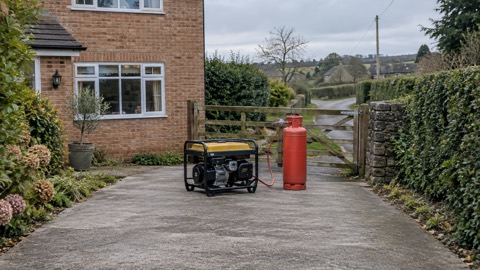
Gorilla Power's UK range as listed does not include a dual-fuel model, but the category is worth understanding because it is the alternative many households consider. Champion Power Equipment explains that dual-fuel generators give you the flexibility to operate using two fuel sources, typically petrol and LPG9.
For emergency planning, the value is resilience of supply. If petrol is hard to obtain, or you would rather not store it, LPG cylinders give a second route. The cost is complexity: two fuel systems to maintain, two sets of storage arrangements, and a need to test both before an emergency rather than discovering a fault during one.
| Fuel arrangement | What it means in an outage | What to plan for |
|---|---|---|
| Petrol only | A single fuel to store and supply | Fuel storage and safe siting9 |
| Diesel only | Suits long runs and heavy loads, larger tanks | Fuel rotation, safe storage, larger machine9 |
| Dual-fuel (petrol and LPG) | A second fuel if one runs short | Two systems to test and store9 |
Whichever fuel you choose, the run time question is the same. Champion advises thinking about how long the generator will run and how much fuel is needed for an extended outage, since similar machines can differ in consumption9. Store petrol only in approved containers, as Clarke International instructs7.
Where a generator must never go
This is the section that matters most, because the mistake is common and the consequence is fatal. Carbon monoxide from a generator is colourless and odourless, and Public Health Wales states plainly that a generator must never be used indoors4.
The official position is consistent across the UK:
- The Health and Safety Executive for Northern Ireland: do not use a generator indoors or in partially enclosed spaces, including homes, garages and crawl spaces, even those with partial ventilation3.
- Mid and West Wales Fire and Rescue Service: do not use any fuel-driven equipment, including petrol and diesel generators or pumps, indoors6.
- Scottish Borders Council: petrol or diesel generators and other fuel-driven equipment should never be brought indoors11.
- Armagh City, Banbridge and Craigavon Borough Council: never run a gas, petrol or diesel-powered generator or a heater that is not designed for this purpose inside a caravan, motorhome, tent or awning5.
- The UK government's flood recovery guidance: petrol or diesel generators and other fuel-driven equipment should never be brought indoors or into enclosed spaces, and using them can be fatal12.
- GOV.UK's flooding advice: a generator must be outside as it will give off poisonous fumes that can kill people13.
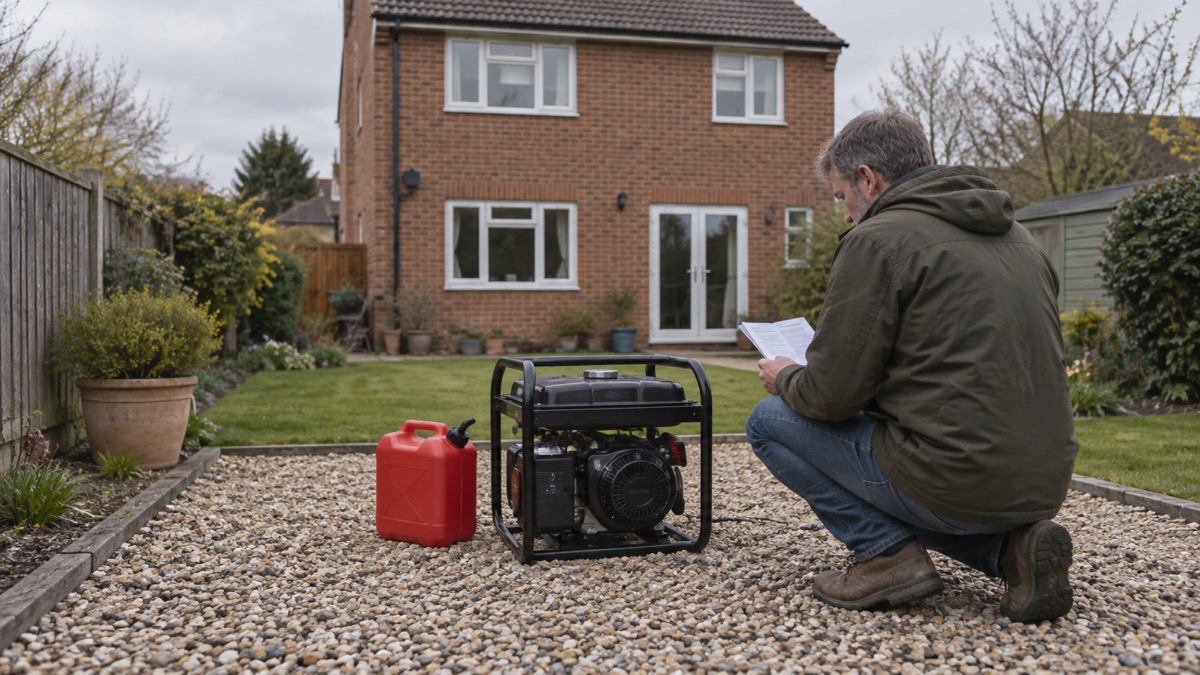
The same rules apply after a flood, when households are drying out and tempted to bring equipment inside. The government's flood recovery advice is explicit that outdoor equipment must not be used inside for drying, heating, cooking or power supply12. Lancashire Preparedness also warns households to be careful using generators during a power cut because they can produce carbon monoxide14.
Running a generator safely in a power cut
A generator can provide temporary emergency power during a power cut. Clarke International notes that smaller models may support selected items such as lighting, phone chargers, a refrigerator or freezer, while larger generators may run additional equipment within their rated capacity7. That is the realistic frame: selected items, not the whole house.
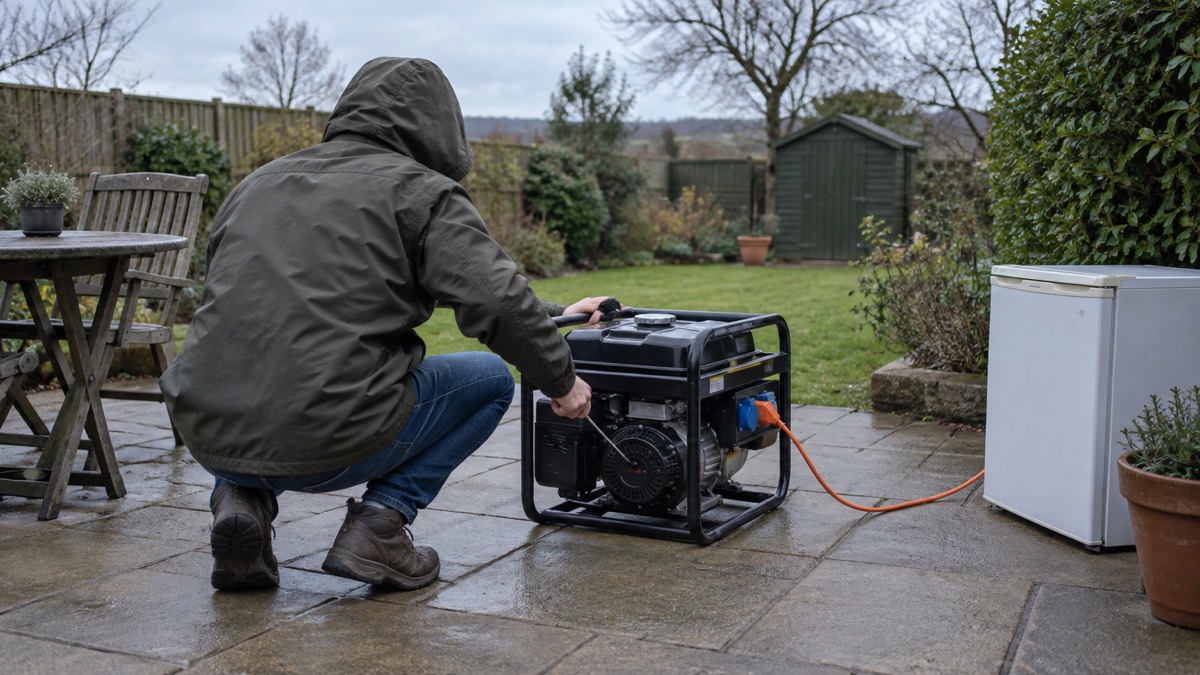
The single most important rule after siting is never to connect a portable generator directly to household wiring or a wall socket. Armagh City, Banbridge and Craigavon Borough Council explains that this prevents backfeeding, where excess electricity flows back into the network and puts neighbours and workers at severe risk8. Clarke International gives the same instruction to householders, warning that backfeeding can cause serious injury, fire or damage7. Appliances should be plugged into the generator itself, using its own sockets.
Other practical points for the night of an outage:
- Keep flammable materials clear of the generator, as the Health and Safety Executive for Northern Ireland advises3.
- Start loads one at a time, because a generator that is too small may trip its overload protection when several are switched on together7.
- Make sure electric gates are open before a storm arrives, so you are not trapped if the power fails15.
- Have torches ready rather than relying on candles, and see Emergency Lighting at Home: Torches, Lanterns and Candles for the safer options.
Storing a generator and its fuel
A generator that has sat unused for a year may not start when you need it. The household routine is simple: run it briefly at intervals, keep fuel fresh, and store everything where a leak or a fire will not reach the house.
Store petrol only in approved containers, as Clarke International instructs7. Keep containers out of the house, away from ignition sources, and never refuel a hot generator. For diesel, the same principles apply: a cool, ventilated outdoor store, protected from water ingress, with stock rotated so the oldest fuel is used first.
The machine itself should be kept dry and covered, with the manual and any tools together, so that a winter power cut does not mean searching a shed in the dark. A generator is part of a wider kit, and the Emergency Kit: What a UK Household Should Keep Ready page sets out what else belongs alongside it: torches, batteries, a radio, warm clothing and a means of charging phones.
Gorilla Power support, warranty and safety notices
Both models in the UK range carry a three-year warranty, according to the retailer's listings1. Keep the proof of purchase and the model and serial numbers with the manual, because warranty claims and recall checks both depend on identifying the exact unit.
On recalls, the official route is the Office for Product Safety and Standards alerts and recalls page on GOV.UK, which Manchester Fire and Rescue Service directs households to when checking appliances16. Electrical Safety First's online product checker holds details of electrical products recalled since 2007, and Fire Scotland points households to it as well17. London Fire Brigade's advice is that the most important thing you can do is regularly check whether your appliances have been recalled, using the government site, the manufacturer's website or Electrical Safety First's register18.
When a recall notice appears, check the serial number of your own unit, because not every recall affects every product sold, and the notice will tell you what to do next19. Registering a new generator with the maker, where that option is offered, means you are contacted directly if a fault is found; Fire Scotland notes that if you choose not to register a product, recalls can still be checked through Electrical Safety First or the UK government website17.
For the wider picture on electrical safety at home, including appliance checks and what to do about a faulty product, see Home Emergencies: Fire, Carbon Monoxide, Gas Leaks and Burst Pipes. Domestic-use Gorilla generators carry a 3-year warranty, while those used for commercial applications have a 12-month warranty20.
Sources (20)
- Gorilla Power GP3800iE 3.80kW Inverter Suitcase Generator, Generators Direct, 2026-07-10
- Gorilla Power GP12000DE 12.80kW Diesel Generator, Generators Direct, 2026-09-04
- Safety tips for using a portable generator in an emergency, Health and Safety Executive for Northern Ireland, 2025-01-26
- Carbon monoxide (CO), Public Health Wales, 2025-12-08
- Caravan, motor home and campervan safety, Humberside Fire and Rescue Service, 2026-10-29
- Carbon monoxide safety, Mid and West Wales Fire and Rescue Service, 2026-10-29
- Generators, Clarke International, 2026-10-25
- Safe use of heaters and generators, Armagh City, Banbridge and Craigavon Borough Council, 2026-10-29
- Home Backup Guide, Champion Power Equipment, 2026-10-25
- Away from home safety, Northern Gas Networks, 2026-10-21
- Flooding advice, Scottish Borders Council, 2026-10-29
- How to recover from flooding, GOV.UK, 2023-12-19
- Prepare your property for flooding, GOV.UK, 2009-10-01
- Loss of essential services, Lancashire Preparedness, 2026-10-29
- Strong winds weather warning: information and advice, nidirect, 2026-10-24
- Maintain appliances and recalls, Manchester Fire and Rescue Service, 2026-10-29
- Lithium-ion batteries, Scottish Fire and Rescue Service, 2025-11-27
- Total recalls: making white goods safer, London Fire Brigade, 2026-10-25
- Product Safety Alerts, Reports and Recalls, North Yorkshire Fire and Rescue Service, 2023-10-27
- Gorilla Power Generators | Vital Power, Vital Power
 Gorilla Power GP3800iE
 Gorilla Power GP6500E-DF
 Gorilla Power GP3500i