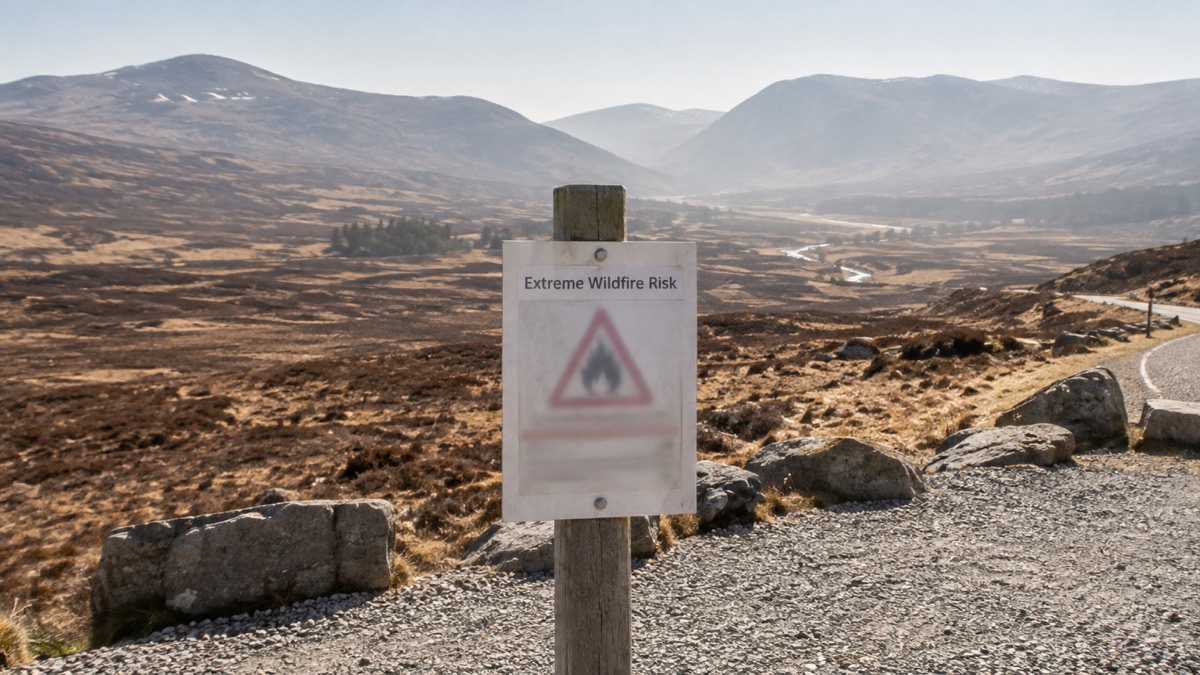
The Scottish Fire and Rescue Service issued "extreme" wildfire warnings for south-west, eastern, central and northern Scotland for Thursday 10 April, according to the National Fire Chiefs Council (NFCC)1. The NFCC, which reissued urgent public safety advice on Friday 11 April, said firefighters in Northern Ireland had battled wildfires over a number of days1.
As of the morning of Friday 11 April, fire and rescue services in England and Wales had responded to 380 wildfires so far this year, compared with 188 for the same period in 2022, which went on to be a record year1. The NFCC said a particularly dry March, followed by warmer-than-average temperatures in April, had seen a number of significant wildfires across the UK over the previous fortnight, and that services were responding to wildfires earlier in the season and typically lasting longer1. It said the Met Office had warned that temperatures were set to peak in London and the South East on Friday1.
The NFCC said most wildfires are caused by human activity, accidentally and some deliberately, and set out public safety advice including avoiding disposable barbecues in open countryside, parks and moorland areas, not discarding cigarettes, matches or glass bottles, following local authority guidance on fire risks and restrictions, and calling 999 immediately if there is a fire1. It asked anyone noticing suspicious behaviour or someone intentionally starting a fire to contact the Police immediately or report anonymously to Crimestoppers on 0800 555 1111.
Under the operational guidance definition used by English and Welsh fire and rescue services, a wildfire meets one or more of the following criteria1:
| Criterion | Threshold |
|---|---|
| Area involved | At least one hectare (10,000 square metres) |
| Sustained flame length | More than 1.5 metres |
| Committed resources | At least four fire and rescue service appliances or resources |
| Duration of commitment | At least six hours |
| Threat | Serious threat to life, environment, property and infrastructure |
"We want people to enjoy this lovely weather, we are just asking that they take extra care. One inconsiderate action or small mistake can have huge consequences when it comes to wildfires, so we are asking that people follow this important advice so that they can keep themselves and everyone else safe."
The NFCC said wildfires have traditionally been limited to primarily rural areas of the UK but can occur almost anywhere in the country, and that in recent years there have been incidents on the rural-urban interface, such as those seen in London in the summer of 20221. It also said the impact of climate change is said to be increasing the risk and severity of wildfires1.
A separate Scottish Fire and Rescue Service warning page carries the same format of risk ratings for South West Scotland and Central-Eastern Scotland, but is dated 9 March 2023 and refers to Friday 10 March and Saturday 11 March, so its dates do not match the April 2025 warnings2. That page set out ratings of EXTREME for South West Scotland and VERY HIGH for Central-Eastern Scotland until 11 March, and said early spring carries a peak risk because dead grass and heather left from the previous year can dry quickly and act as fuel2. It also said many wildfires are started deliberately or through careless, reckless or irresponsible behaviour2.
Why it matters for households
The warnings cover south-west, eastern, central and northern Scotland for Thursday 10 April, with the NFCC's wider advice issued on Friday 11 April as temperatures were forecast to peak in London and the South East1. The NFCC advises households to avoid disposable barbecues in open countryside, parks and moorland areas, not to discard cigarettes, matches or glass bottles, to follow local authority guidance on fire risks and restrictions, and to call 999 immediately if there is a fire1. It also advises reporting suspicious behaviour to the Police or anonymously to Crimestoppers on 0800 555 1111. The NFCC notes that wildfires can occur almost anywhere in the country, not only in rural areas1. The guide to wildfires and grass fires sets out risk and prevention for households, within the wider heatwaves and drought section.
What happens next
The NFCC said it is calling for a long-term cross government response and sustained investment to ensure fire and rescue services can meet emerging threats1. No end date for the April 2025 Scottish warnings has been reported.
 Wildfires and Grass Fires





