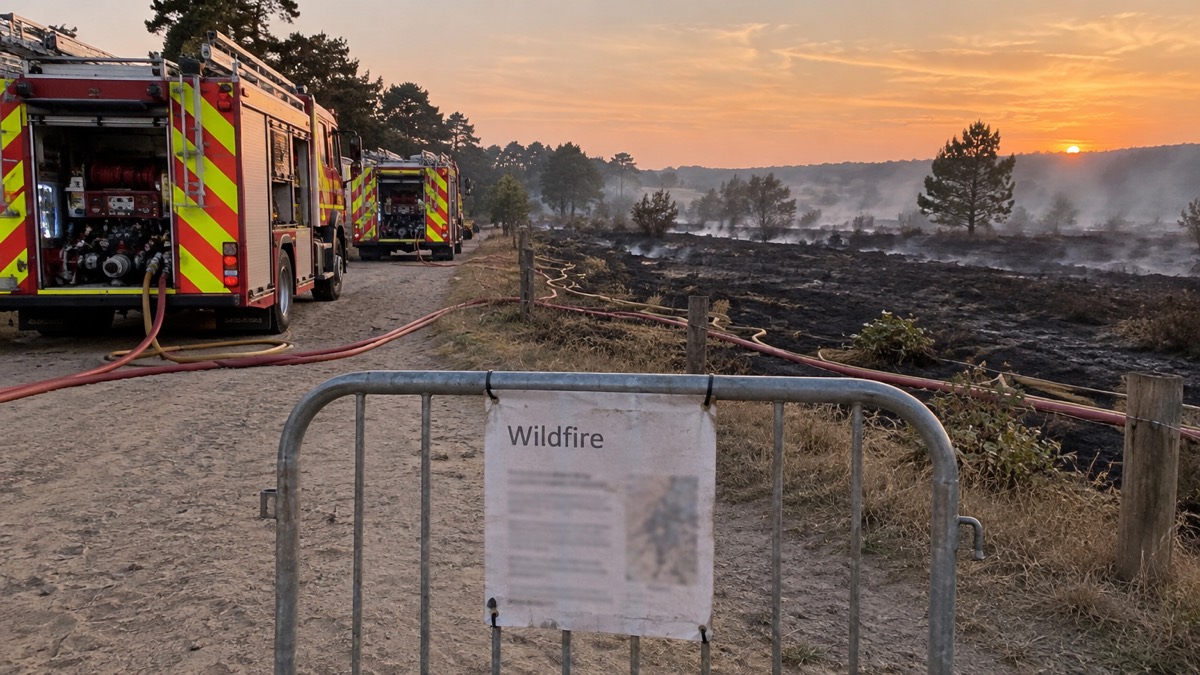
Fire and rescue services in England and Wales responded to 458 wildfires in July 2026, the busiest month for wildfires ever recorded, the National Fire Chiefs Council (NFCC) said on 11 August 2026. The NFCC said crews had responded to 966 wildfires between 1 January and 10 August 2026, including 185 in the first 10 days of August alone1.
The year to 10 August already exceeds the same period in 2022 (748) and 2025 (848), which the NFCC describes as previously two of the busiest years for wildfire activity on record1. The NFCC's National Resilience data gives the following annual totals and monthly figures for 20261.
| Period | Wildfires recorded in England and Wales |
|---|---|
| 2021 | 223 |
| 2022 | 994 |
| 2023 | 293 |
| 2024 | 200 |
| 2025 | 1,017 |
| 2026 (to 10 August) | 966 |
| January 2026 | 1 |
| February 2026 | 2 |
| March 2026 | 87 |
| April 2026 | 173 |
| May 2026 | 43 |
| June 2026 | 17 |
| July 2026 | 458 |
| August 2026 (to 10 August) | 185 |
The NFCC said drought conditions continue to worsen, with more than two-thirds of England and all of Wales officially in drought, and that much of the UK was experiencing a fifth heatwave this summer1. It said wildfires are becoming an increasingly regular feature of operational demand, often requiring large numbers of firefighters and specialist resources for prolonged periods while services continue to respond to other emergencies1. Under the operational guidance definition used by services in England and Wales, a wildfire involves an area of at least one hectare, a sustained flame length of more than 1.5 metres, at least four fire and rescue service appliances or resources, resources committed for at least six hours, or a serious threat to life, environment, property and infrastructure1.
Phil Garrigan, Chair of the NFCC, said:
"The combination of drought conditions and another heatwave means the risk of fires remains high, and these incidents can place huge demands on firefighters and specialist resources."
The NFCC said many wildfires are caused by human activity and are preventable, and urged the public to take extra care in the hot weather. Its advice includes avoiding disposable barbecues in open countryside, parks and moorland areas; not discarding cigarettes, matches or glass bottles; following local authority guidance on fire risks and restrictions; and reporting any signs of fire by calling 999 and asking for the Fire and Rescue Service. It asks anyone who notices suspicious behaviour or sees someone intentionally starting a fire to contact the Police on 101 or report information anonymously to Crimestoppers on 0800 555 1111.
Separately, the alarm maker FireAngel said in a summer fire safety guide published on 23 July 2026 that England and Wales experienced 342 wildfires between January and July 2026, linked to rising spring and summer temperatures, and that Fire and Rescue Services attend around 30,000 wildfires and grass fires in a typical year2. That January to July figure differs from the NFCC's monthly data, which totals 781 wildfires over the same months1. FireAngel's guide also states that BBQs and camping stoves should never be used inside homes, tents, caravans, awnings or enclosed spaces, even after they have stopped cooking, as they can continue producing carbon monoxide, and recommends a carbon monoxide alarm wherever fuel-burning appliances are present2.
Why it matters for households
The NFCC's figures cover England and Wales and run to 10 August 2026, during a fifth heatwave of the summer and with more than two-thirds of England and all of Wales officially in drought1. The NFCC links many wildfires to human activity and says they are preventable, and its advice centres on outdoor behaviour: disposable barbecues, discarded cigarettes, matches and glass, local authority restrictions, and calling 999 at the first sign of fire1. FireAngel's guidance covers the same outdoor cooking equipment in the home and on holiday, warning that barbecues and camping stoves can produce carbon monoxide even after cooking has stopped, and that gas appliances in campervans, caravans and holiday accommodation can present a hazard if not properly maintained or ventilated2. The NFCC's definition of a wildfire means the recorded incidents are those meeting a threshold of size, flame length, resource commitment or threat, not every small outdoor fire1.
What happens next
The NFCC has not reported any further update beyond its 11 August 2026 statement. Its monthly and annual figures run to 10 August 20261. Households can read the site's guidance on wildfires and grass fires: risk and prevention and the wider heatwaves and drought hub.
 Wildfires and Grass Fires





