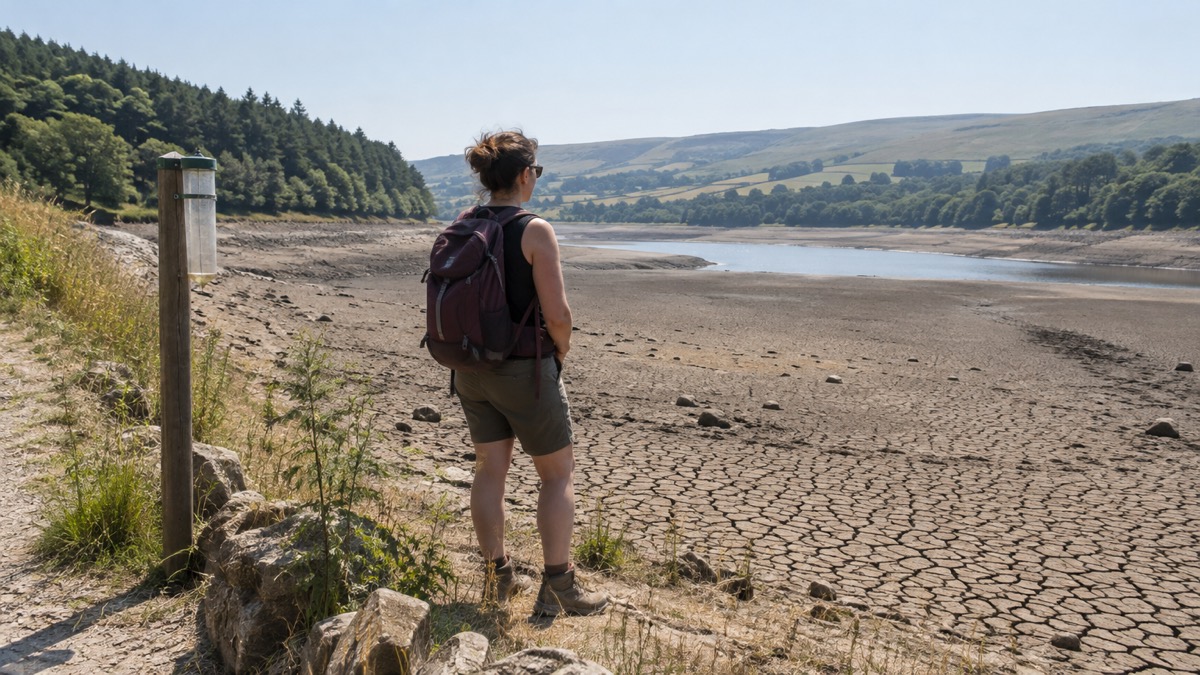
The Met Office has announced that England and Wales provisionally recorded their driest July on record, and that Southern England saw its driest month ever recorded, in a series dating back to 18361. The announcement is reported by SES Water and by South West Water in their published guidance to customers1.
The figures sit alongside restrictions already in force. South West Water states that the Environment Agency has declared half of England, including the South West, in drought2. Its temporary hosepipe ban came into effect at 00:01am on Saturday 8 August and covers all its customers in Devon, Cornwall, parts of Dorset and Somerset and the Isles of Scilly2. The company says the ban followed a prolonged period of hot and dry weather, with record temperatures and rainfall well below seasonal averages over many months, alongside continuous high demand for water, which it says caused increasing pressure on reservoirs and available water resources2.
SES Water, which supplies customers in its own region, set out household water use figures alongside its request that customers, businesses and visitors use water with care during sustained hot weather1. It states that a standard tap uses 10 litres per minute, that leaving the tap running while brushing teeth can waste 20 litres, and that doing so twice a day for a year will waste nearly 15,000 litres1. It gives a standard showerhead as using around 12 litres per minute, and says dishwashers and washing machines can use around 40 litres per cycle, with older models using much more1. It also states that a leaking toilet can waste up to 400 litres of water a day and that many toilet leaks are silent and go unnoticed1.
"We've maximised water production wherever possible, increased leak detection and repairs, moved water around our network and introduced a wide range of operational measures to make the best use of the water available."
Why it matters for households
South West Water states that customers must not use hosepipes for non-essential purposes while the ban is in place, including watering gardens, washing cars, filling paddling pools, swimming pools or hot tubs, cleaning patios or driveways, and cleaning walls and windows2. It states that water can still be used as normal for drinking, washing and cooking, and that many usual activities can be carried out without a hosepipe, for example by using a watering can to water plants or a bucket and sponge to wash a car2. It states that some people and some types of water use are exempt, often based on people having additional needs, requiring water to carry out a business activity, or using water to protect people or animals, and that those with a health condition, disability or extra support need may be exempt; it asks those covered by an exception to be careful with water wherever possible2.
SES Water's guidance includes brushing teeth with a 2-minute timer with the tap off, taking a 4-minute shower, watering plants with a watering can in the morning or evening to prevent evaporation during afternoon sun, keeping a jug of water in the fridge, running dishwashers and washing machines only with full loads, and checking for dripping taps or leaky loos1. It also suggests using unsalted cooking water or old water from a pet bowl on plants, and placing a jug under the tap until it runs cold or under the shower until it runs hot to save water for plants1. Megan Williams of SES Water said climate change is showing that weather patterns are going to be less predictable and put more pressure on resources due to longer periods of warm, dry weather1. South West Water states that it only imposes a hosepipe ban when absolutely necessary and will lift the restrictions as soon as it can2.
The Met Office announcement is described as provisional in both notices1. Neither notice reports a date by which the provisional record will be confirmed, and no final figure for the month's rainfall is given in either1.
What happens next
South West Water states that its hosepipe restrictions remain in place and that it will lift them as soon as it can2. SES Water's notice does not give an end date for its request1.
For the wider picture on hotter, drier summers, see why UK summers are getting hotter and drier and the heatwaves and drought hub.
 Why UK Summers Are Hotter





