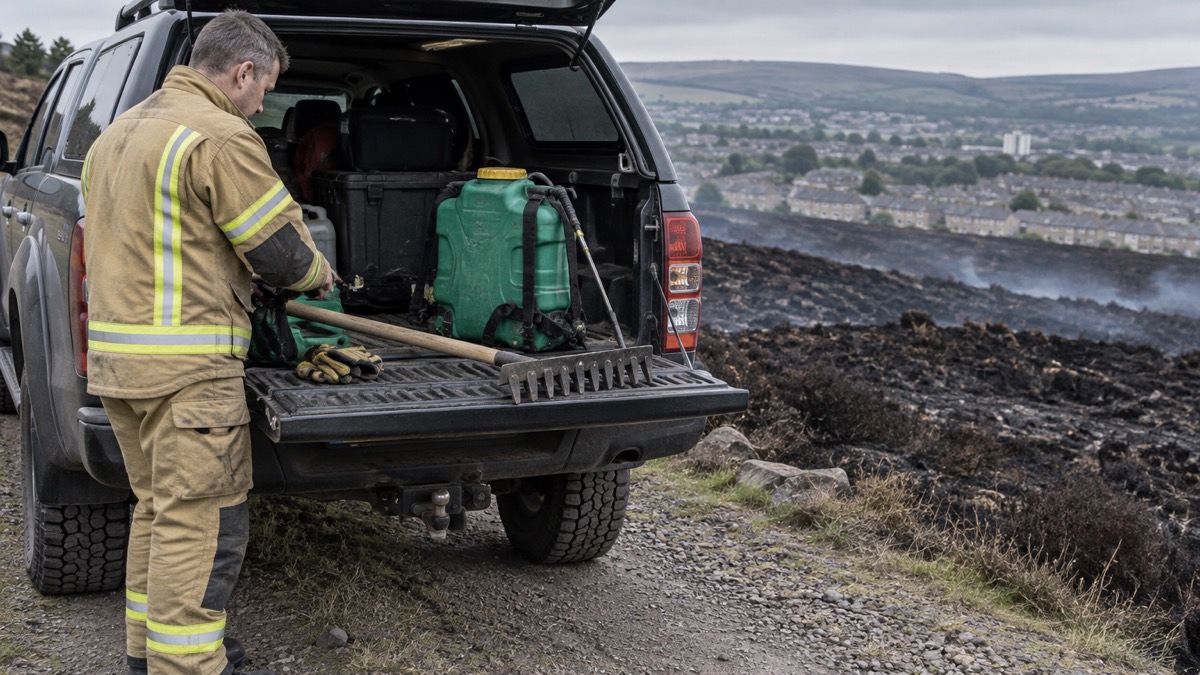
Fire and rescue services in England and Wales responded to 1,004 wildfires during July and August 2026, including 519 in August, which the National Fire Chiefs Council (NFCC) describes as the highest monthly total recorded1. The figures come from National Resilience data provided directly to the NFCC and were published on 29 October 2026, alongside an account of the pressure placed on a joint fire control room in Wales1.
The control room, which provides fire control services for Mid and West Wales Fire and Rescue Service and South Wales Fire and Rescue Service, typically receives around 200 calls per day1. On 13 August 2026 it received more than 2,500 calls, including nearly 2,000 emergency 999 calls, and call volumes rose significantly again around 24 August1. The figures include emergency calls and other calls from fire stations, members of the public and operational partners1. Personnel faced 39 days of sustained activity, with around 30 incidents ongoing simultaneously at times; a team that would ordinarily have seven personnel on duty grew to 26 at the height of the response, some personnel worked shifts of up to 16 hours, and the control room activated Operation Willow Beck, an arrangement enabling fire and rescue services to work with BT to manage call volumes exceeding their own call-handling capacity1.
The NFCC published the account to mark International Control Room Week, which runs from 26 October to 1 November 20261. Natalie Pearce, Group Manager at Joint Fire Control, said:
"In my 28 years working in fire control, I have experienced some incredibly busy periods, but this summer was among the most demanding."
Separate reporting has described the wider context. The Guardian reported on 27 September 2026 that by mid-August this year firefighters in England and Wales had already attended more wildfires than in the whole of 2025, and that this year's summer was the UK's hottest on record, coupled with extreme and persistent drought2. It reported fires affecting heathland in the New Forest, valleys in south Wales and homes in Stourbridge in the West Midlands2. It also reported that England alone experiences roughly 30,000 vegetation fire ignitions each year, and that a study in the journal Environmental Research Letters found the UK's wildfire season lengthened from between one and four months in 2011-16 to between six and nine months in 2017-212.
The Guardian reported that Andy Elliott, described as the UK's only serving fire officer trained in specialist wildfire origin, said: "At the moment there is no capability for wildfire fire investigation in the UK, full stop."2 It reported that the Forestry Commission is planning two courses, on preserving evidence at wildfire scenes and on investigating wildfire origins and causes, both awaiting funding2. Rob Gazzard, the Forestry Commission's wildfire contingency planning adviser, was quoted as saying: "Preparedness and prevention is where you win the wildfire. It's not about response."2
Why it matters for households
The record monthly total covers England and Wales and relates to July and August 20261. The NFCC account shows that demand on emergency call handling can rise more than tenfold on individual days, and that a service can draw on BT arrangements when calls exceed its own capacity1. The Guardian's reporting describes summer fires spreading across roads and into gardens and homes, and burning down into peat layers in some areas2. The NFCC's figures record the number of wildfires attended; they do not give a breakdown of causes, and the Guardian reports that existing data cannot reliably establish how often particular ignition sources are responsible2. The NFCC's guidance for households on preventing wildfires and grass fires is set out in its wildfires and grass fires guide, with wider information in the heatwaves and drought hub.
What happens next
International Control Room Week runs from 26 October to 1 November 20261. The Forestry Commission's two planned wildfire investigation courses are awaiting funding; no start date has been reported2.
 Wildfires and Grass Fires





