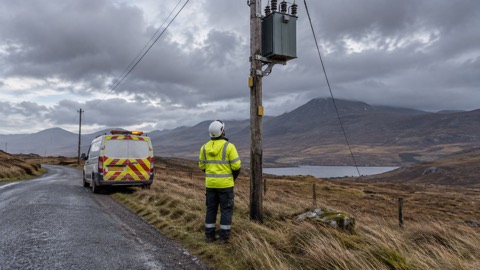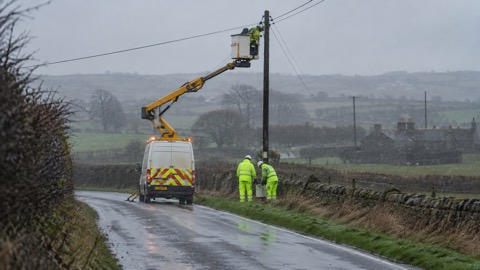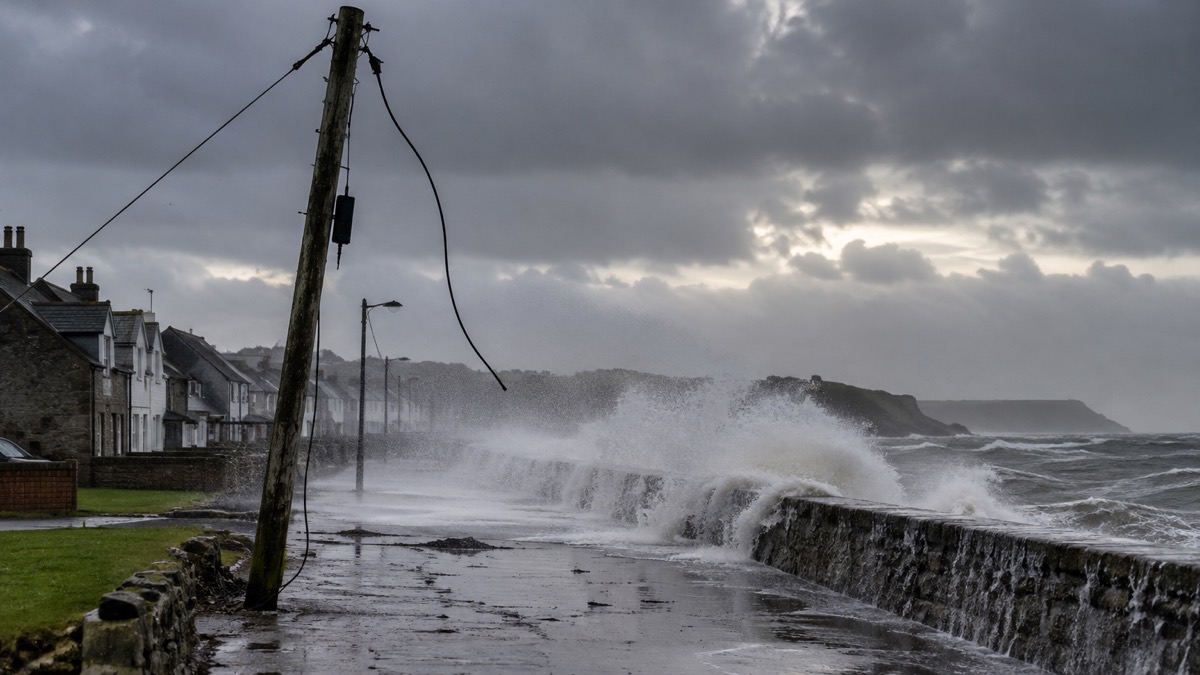
Storm Éowyn, the fifth storm of the 2024/2025 season, hit the UK in late January 2025. Around a million homes were reported to be without power at the peak of the storm as trees and strong winds brought down power lines, with several thousand remaining without power in Scotland and Northern Ireland for a number of days1.
The Met Office issued a red warning for wind, meaning danger to life, covering Northern Ireland, Scotland's Central Belt and much of south-west Scotland, with a wider amber warning area covering the northern half of the UK1. In the red warning area, members of the public were advised to stay at home and all schools were closed1. The highest wind gust in the UK was 87Kt (100mph) at Drumalbin, Lanarkshire, and around 20 further stations recorded 70Kt (81mph) or more across Northern Ireland, central and southern Scotland, northern England and North Wales1. The lowest pressure recorded was 941.9hPa on the Isle of Tiree, Inner Hebrides, the UK's lowest value since 936.8hPa at Stornoway Airport on 24 December 20131.
The Met Office describes the storm as the UK's most powerful wind storm for over a decade, and for Northern Ireland the most significant since the Boxing Day Storm of 26 December 19981. In Scotland, one fatality was reported in Ayrshire as a result of a falling tree, and a fatality was also reported in County Donegal in the Republic of Ireland1. Trunk roads were closed, all rail services were halted in Scotland and the West and East Coast Main Lines closed, with over 1000 flights reported cancelled1. ScotRail reported extensive damage to its network including overhead lines1.
| Measure | Figure | Location |
|---|---|---|
| Lowest pressure | 941.9hPa | Isle of Tiree, Inner Hebrides |
| Two-day rainfall total | 82.4mm | Achnagart, West Highlands |
| Two-day rainfall total | 62.5mm | Holne, Devon (Dartmoor) |
| Two-day rainfall total | 57.0mm | Mickleden, Cumbria (Lake District) |
Rainfall figures cover 23 to 24 January, mostly from storm Éowyn1.
"Around a million homes were reported to be without power at the peak of the storm as trees and strong winds brought down power lines, with several thousand remaining without power in Scotland and Northern Ireland for a number of days."
Why it matters for households
The households most affected were in Northern Ireland, Scotland's Central Belt and south-west Scotland, where the red warning applied and where the Met Office reports the strongest winds occurred1. For those areas, loss of supply was widespread at the height of the storm, and for several thousand homes in Scotland and Northern Ireland it continued for a number of days1. The Met Office advises that in a red warning area members of the public should stay at home, and reports that schools were closed on this occasion1. The power cuts guide sets out how a loss of supply unfolds, and what to do when the electricity goes off covers the first hours. For households in Northern Ireland, NIE Networks, reporting and help explains who to contact. The Met Office notes that storms of the severity of Éowyn are to be expected as part of the UK's climate on a reasonably regular basis1.
What happens next
The Met Office assessment, last updated on 30 January 2025, records the storm's impacts and weather data; no further dated steps are set out in it1.
Sources (1)
- metoffice.gov.uk, metoffice.gov.uk
 How Long Until Power Returns
 What to Do in a Power Cut
 Storms and the Electricity Grid
 Why the Electricity Goes Off
 Power Cuts Household Guide
 Getting Ready for a Power Cut