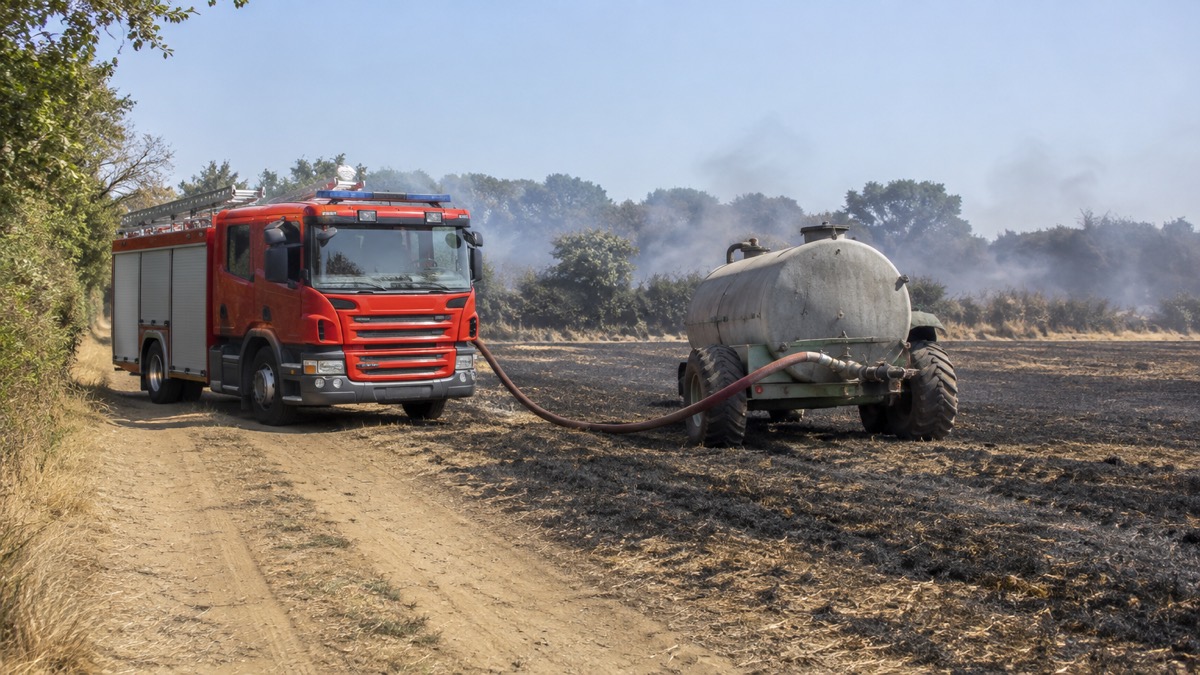
Suffolk Fire and Rescue Service (SFRS) has reported that its crews fought 370 wildfires in July and August 2022, a season its Chief Fire Officer, Jon Lacey, described as the most severe the service had experienced in over a decade. The figure was given in a council news statement published on 18 July 2025, issued in response to the National Farmers' Union (NFU) calling on fire services and farmers to act on wildfire preparedness1.
The statement sets out how the service has since acted on the problem of water supply at fires in the open. The NFU has called on fire services to invest in a coupling adapter developed by farmers, which lets fire engines connect directly to farm-based water bowsers and tanks. According to the council, this gives crews faster access to additional water in remote areas during wildfires and crop fires, when onboard supplies can be rapidly depleted, and reduces the need for complex water relays and the number of resources required on scene1.
The idea was first raised at the Suffolk NFU Annual General Meeting in November 2022, after that summer's wildfire season. Momentum grew in 2023 when SFRS Station Manager and Equipment Officer Alex Smith met the NFU Suffolk Chair and local farmer Glenn Buckingham of Helmingham Estate at the Suffolk Show. Mr Smith said 95% of the farmers the service spoke to across the county said they would be willing to purchase their own couplings1.
The trial is under way at six fire stations, with the equipment also fitted to vehicles:
| Location or vehicle | Detail |
|---|---|
| Fire stations trialling adapters | Ipswich East, Princes Street (Ipswich), Haverhill, Bury St Edmunds, Newmarket, Lowestoft |
| All-terrain vehicles fitted | Three UniMogs |
| Water carriers fitted | Two |
The council reports that the equipment was used later in 2023 at a house fire on the A140, when a local farmer who had attended the Suffolk Show used a homemade coupling to supply additional water to crews on scene. Mr Lacey said the couplings are primarily intended for wildfire response but could also prove valuable where water is difficult to access, for example at a derelict building where supplies have been turned off1.
Why it matters for households
The 370 fires were in Suffolk, and the adapter trial covers six stations in that county, so the direct operational effect is local. The public safety messages issued alongside the trial apply more widely. Councillor Steve Wiles, Suffolk County Council's Cabinet Member for Public Protection, set out the advice the council regularly gives: avoid disposable barbecues in the countryside unless in designated areas, dispose of cigarettes safely, and avoid driving or parking on very dry grass. He also urged people not to light campfires or use sky lanterns, and not to leave behind glass items or other reflective materials, with all litter taken home1. Mr Lacey encouraged farmers to follow the example of a farmer in Stanton who created a fire break with his own equipment during a recent crop fire, which the service said made the fire much easier to contain and extinguish1.
Mr Lacey also encouraged members of the public to download the free what3words app, which gives a unique three-word reference for any location. He said the control room and crews can use the reference to locate a 999 caller and the wildfire, which is useful where there are no landmarks or road names, and that it uses GPS so no signal or data is needed on the mobile phone for it to work1. Households preparing for periods of hot, dry weather can find further guidance in the heatwaves and drought hub.
What happens next
The statement gives no date for the end of the trial or for a decision on wider rollout across Suffolk, and no cost for the adapters has been reported. The NFU's call for fire services and farmers to invest in the equipment was made in the week before publication on 18 July 20251.
Sources (1)
- suffolk.gov.uk, suffolk.gov.uk





