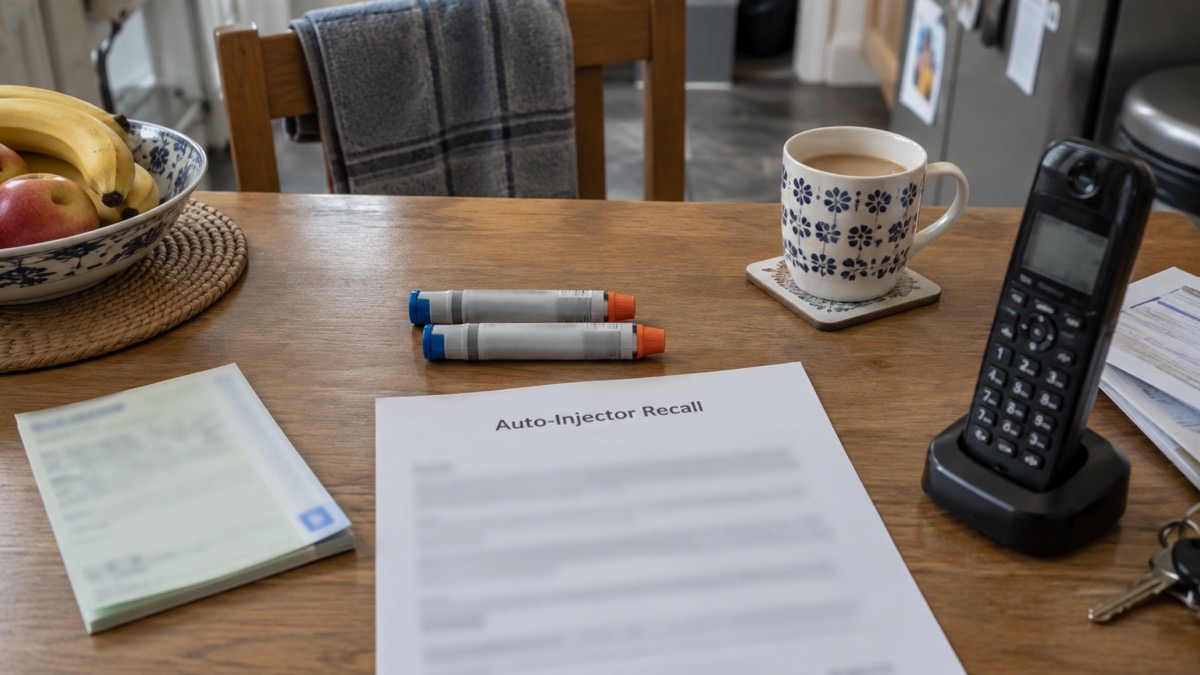
The Medicines and Healthcare products Regulatory Agency (MHRA), with the Department of Health and Social Care, announced on 9 May 2023 the recall of all batches of Emerade 500 micrograms and Emerade 300 micrograms auto-injectors. The recall follows information from the company that makes Emerade: pens were tested and an issue was identified where some pens failed to activate as required1.
The MHRA says there are sufficient supplies of alternative auto-injectors to allow a recall at patient level. No further supplies of Emerade will be available, and patients will be switched to EpiPen or Jext1. Replacement pens will be 300 micrograms (0.3 milligram) strength EpiPen or Jext, which the MHRA describes as suitable replacements for a single Emerade 500 micrograms pen. This is based on study results comparing blood levels of adrenaline after injection; the study found no difference in results with EpiPen 300 micrograms or Jext 300 micrograms pens1.
"As a precautionary measure, all batches of Emerade 500 micrograms and Emerade 300 micrograms pens are being recalled."
The MHRA sets out the following steps for patients and carers1:
| Step | What the MHRA says |
|---|---|
| Replace | Contact your doctor or pharmacist by telephone now to get replacements for you or your child's Emerade 500 or 300 micrograms pen |
| Prescription | Ensure two alternative pens of the same brand are prescribed |
| Return | Once you have two replacement pens in a different brand, return your Emerade pens to a pharmacy, even if they are still in date |
| Training | Receive training on the new device when you collect it, because each brand of auto-injector has a different action |
| Carry | Continue to carry two devices at all times |
The MHRA says patients should be advised to use a second auto-injector immediately if the first pen fails to activate despite pressing firmly against the thigh. An activated Emerade pen has an extended, locked needle cover; if the cover has not extended, the pen has not activated. Further attempts to activate a failed pen should only be attempted once all pens have been tried, and any suspected un-activated pen should be kept for reporting to the MHRA via the Yellow Card scheme and for investigation1.
Why it matters for households
The recall covers every batch of Emerade 500 and 300 micrograms pens, so any household holding one of these devices is affected, whether or not the pen is still in date. Until two replacement pens are collected, the MHRA says patients should continue to carry two devices and, where activation failure is a possibility, press the Emerade pen very firmly against the thigh1. The MHRA advises that an adrenaline auto-injector be given without delay even if there is doubt whether it is anaphylaxis, that an ambulance be called on 999 immediately afterwards stating an emergency case of anaphylaxis, and that a second auto-injector be given 5 minutes after the first dose if there is no improvement or the patient deteriorates after an initial improvement1. It also advises lying flat with legs up to keep blood flowing, sitting up if breathing is difficult1. Where someone is unwell or unable to collect a prescription, the MHRA suggests alternative arrangements such as a family member collecting it1. The MHRA strongly recommends ordering training pens, which contain no adrenaline, from the manufacturer and practising with them regularly1. More on carrying, using and storing these devices is in the guide to adrenaline auto-injectors, and on obtaining medicines at short notice in running out of prescribed medicine.
What happens next
Patients are asked to contact their doctor or pharmacist by telephone now to arrange replacements, and to return Emerade pens to a pharmacy once two replacement pens in a different brand have been obtained1. The MHRA says doctors, nurses or pharmacists can help with training on the new pen, and that manufacturer websites carry training videos and information1.
Sources (1)
- ViewAttachment.aspx, cas.mhra.gov.uk
 Adrenaline Auto-Injectors