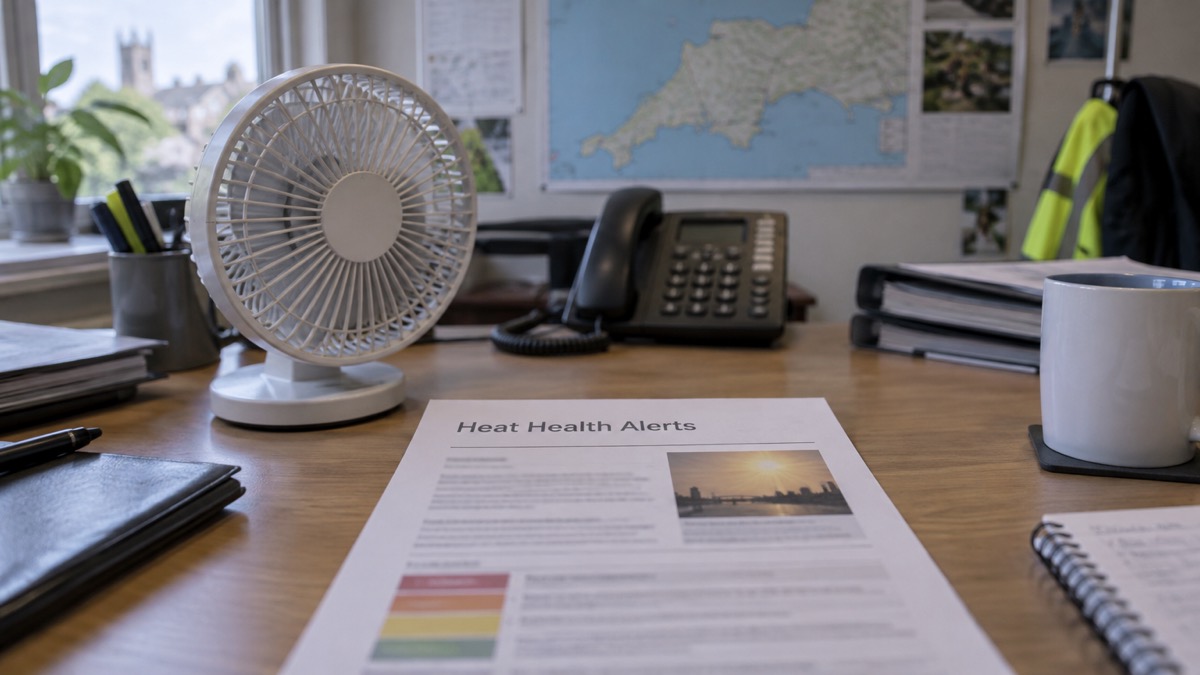
The Heat-Health Alerts (HHAs) transitioned to impact-based alerting in summer 2023, the Met Office and the UK Health Security Agency (UKHSA) have set out in their published guidance on the service. The system is operated by UKHSA in partnership with the Met Office and covers England only1.
Under the impact-based approach, the Met Office regional daytime and night-time maximum temperature forecasts are monitored, and when certain temperature thresholds are reached the two organisations carry out an assessment of the potential impacts and the likelihood of those impacts occurring. A decision is then made on whether an alert is needed and, if so, which type to issue: yellow, amber or red1. UKHSA states that impact-based alerting allows professionals to understand the likely impacts and make informed decisions about the actions they should take2.
The service has been in operation since 2004 and is designed to help healthcare professionals manage through periods of extreme temperature. It is aimed at health and social care professionals and anyone with a role in reducing the harm that extended periods of hot weather can have on health, and UKHSA says the alerts are freely available to be accessed by the public1. The Met Office states that the updated system is more closely aligned with, and complementary to, the National Severe Weather Warning Service1. UKHSA also states that in England there are two early warning systems related to high temperature: the HHAs and the extreme heat warnings that form part of the National Severe Weather Warning Service operated by the Met Office2.
The colours are set out by both organisations as follows1:
| Alert | Meaning |
|---|---|
| Green (summer preparedness) | No alert is issued, as conditions are likely to have minimal impact on health; business as usual, with summer planning and preparedness activities |
| Yellow (response) | Covers a range of situations: heat unlikely to impact most people but which could affect those who are particularly vulnerable, or when confidence in a forecast of more significant impacts is low |
| Amber (enhanced response) | Impacts likely to be felt across the whole health service, with potential for the whole population to be at risk; non-health sectors may also start to observe impacts and a more significant coordinated response may be required |
| Red (emergency response) | Significant risk to life for even the healthy population |
The Met Office describes a yellow alert as covering periods of heat unlikely to impact most people but where those who are particularly vulnerable, such as the elderly with multiple health conditions and on multiple medications, are likely to struggle to cope and where action is required within the health and social care sector specifically. It states that a red alert would be issued in conjunction with, and aligned to, a red extreme heat warning from the National Severe Weather Warning Service1.
"In summer 2023, the Heat-Health Alerts transitioned to an impact-based alerting, which provides users with information over and above the fact that hot weather is likely to occur."
Why it matters for households
The alerts are issued when hot weather is forecast that could lead to impacts on health within the population of England2. The core HHA season runs from 1 June to 30 September each year; should an episode of heat occur outside that period, an extraordinary alert will be issued2. The Met Office gives the season as June to September and states that, should conditions for an alert be reached outside this period, an extraordinary heat-health alert will be issued and stakeholders are advised to take the usual public health actions as recommended in the Adverse Weather and Health Plan1.
Within the core alerting period, heat-health planners are also issued every Monday and Friday to provide weather-health horizon scanning for the following 5 days, 6 to 15 days, and 16 to 30 days2. UKHSA advises people to make sure they are registered to receive the alerts directly by email by completing the registration form2; the Met Office states that individuals can register to receive the alerts1. The current alerting situation can be viewed on a dedicated UKHSA web platform1. The HHAs and Cold-Health Alerts form part of the Weather-Health Alerting system, which underpins the Adverse Weather and Health Plan1. UKHSA has also developed Adverse Weather and Health Plan action cards listing potential actions that organisations and responders should consider, aligned with the yellow, amber and red alerts2.
The Heat-Health Alerts: Yellow, Amber and Red Explained guide sets out what each colour means, and there is a guide to how to sign up for Heat-Health Alerts. More on hot weather and drought is in the heatwaves and drought hub.
What happens next
The core HHA season runs from 1 June to 30 September each year, with extraordinary alerts issued if an episode of heat occurs outside that period2. Heat-health planners are issued every Monday and Friday during the core period2.
Sources (2)
- Heat-health Alert service - Met Office, weather.metoffice.gov.uk
- Heat-Health Alerting system - GOV.UK, gov.uk
 Heat-Health Alerts Explained
 Signing Up for Heat Alerts





