The ChickenGuard PRO is an automatic door opener for a chicken coop. It mounts on the front of the coop above the pop hole, the small up and down sliding door your hens use, and opens and closes that door for you. It works with Devon Hen Houses or with any coop that has a pop hole door that slides up and down1. You can set it to open and close on a timer, let a light sensor do it as dusk falls and dawn breaks, or work it by hand with a button.
For an ordinary household with a few hens, the point of it is the evening. Foxes are nocturnal, and the advice is to lock chickens in the coop at night2. An automatic door means the pop hole closes whether or not you are home before dark, and opens again in the morning without you going out in the rain. The distributor says the unit has been tried and tested by over 300,000 users worldwide1.
The main things to know before you buy are the door weight it can lift, 2kg or 4lb1, the space it needs above the door, which can be as little as around 1 inch rather than the 3 to 4 inches you might assume1, and how it is powered: 4 x AA batteries, which are included, or a USB cable, which is not1. It is made in Britain and comes with a 3-year guarantee1.
What the ChickenGuard PRO does for a coop with a sliding pop-hole door
The unit is an automatic chicken coop door opener1. It mounts on the front of the coop, attached above the pop-hole door, and needs no complicated wiring or cabling1. A cord runs from the unit down to the door, and the motor winds it in to lift the door open and lets it out to close. Because it sits on the outside of the coop, you do not have to take the coop apart or run power into it.
It suits any coop with a pop hole door that slides up and down1. That is the design most small coops use, and it is the one the Poultry Club recommends: the most practical design has a vertical sliding cover which is closed at night to prevent fox damage3. Horizontal sliding pop holes, by contrast, quickly get bunged up with muck and dirt and are difficult to close3. If your coop has a vertical slider, the ChickenGuard PRO is built for it.
What it does not do is protect the flock on its own. A door that closes at dusk is one layer of defence. The rest is the run: build it with strong, meshed fencing at least 6ft tall, sloping outwards, and do not rely on chicken wire, because foxes can chew through it2. Prevent digging by installing fencing a foot into the ground, or by placing a mesh skirt 40cm wide flat on the ground with bricks or large stones on top2. The door closes the coop; the fence keeps the fox away from the door.
If you are new to hens altogether, our guide to keeping chickens covers housing, feeding and the law, and there is a checklist of what you need to keep pet hens. The ChickenGuard PRO is the piece of kit that takes over the twice-daily job of opening and shutting the pop hole.
Three ways to open and close: timer, light sensor or manual button
You can set the timer to open or close at a certain time, or allow the light sensor to do this for you1. The timer is set using the simple and clear LCD display on the unit1. There is also a manual button, so you can open or close the door by hand when you want to.
| Method | How it works | Suits |
|---|---|---|
| Timer | You set opening and closing times on the LCD display1 | Households on a regular routine who want the door shut at a fixed hour |
| Light sensor | The unit opens and closes as the light changes1 | Households whose routine shifts with the seasons, or who are out at dusk |
| Manual button | You press the button to open or close1 | Letting hens out early, shutting them in for the vet, or over-riding the automatic setting |
The light sensor is the setting most people use, because it follows the seasons without you resetting the clock. It is worth knowing how these sensors behave in general, because it affects where you site the unit. On a comparable automatic door, the light sensor takes an average reading every 3 minutes, so covering it with a hand will not activate it, and it is designed not to open in a lightning storm or in car headlights4. Nearby floodlights or street lights will affect the sensor, and the sensitivity is adjustable4. The ChickenGuard PRO's own sensor settings are set on its display1; the principle is the same, so keep the unit away from a security light that comes on at night.
Lifting capability: doors up to 2kg
The distributor gives the ChickenGuard PRO a door lifting capability of 2kg, which is 4lb1. That is the weight of door the motor is built to raise. A standard wooden or plastic pop hole door on a small coop is well inside that, but a heavy home-made door, or one that has swollen with damp, may not be.
Weigh the door before you fit the unit if you are unsure. A door that is too heavy for the motor will not open fully, and a door that jams part way will leave the hens shut in or shut out. Check that the door slides freely in its runners first, and clear any muck or shavings from the channel. The Poultry Club notes that pop holes get bunged up with muck and dirt3, and a door that slides easily by hand is a door the opener can manage.
For comparison, a different automatic door on the market, the ChickSafe, needs the door to weigh between 300 grammes and 4 kg: lighter than that and the internal mechanism will not detect that the door has shut, heavier and it will overload the motor4. The ChickenGuard PRO's figure is the 2kg lifting capability1. If your door is at the top of that range, keep the runners clean and check the door still opens fully after the first week.
Fitting above the pop hole with no wiring
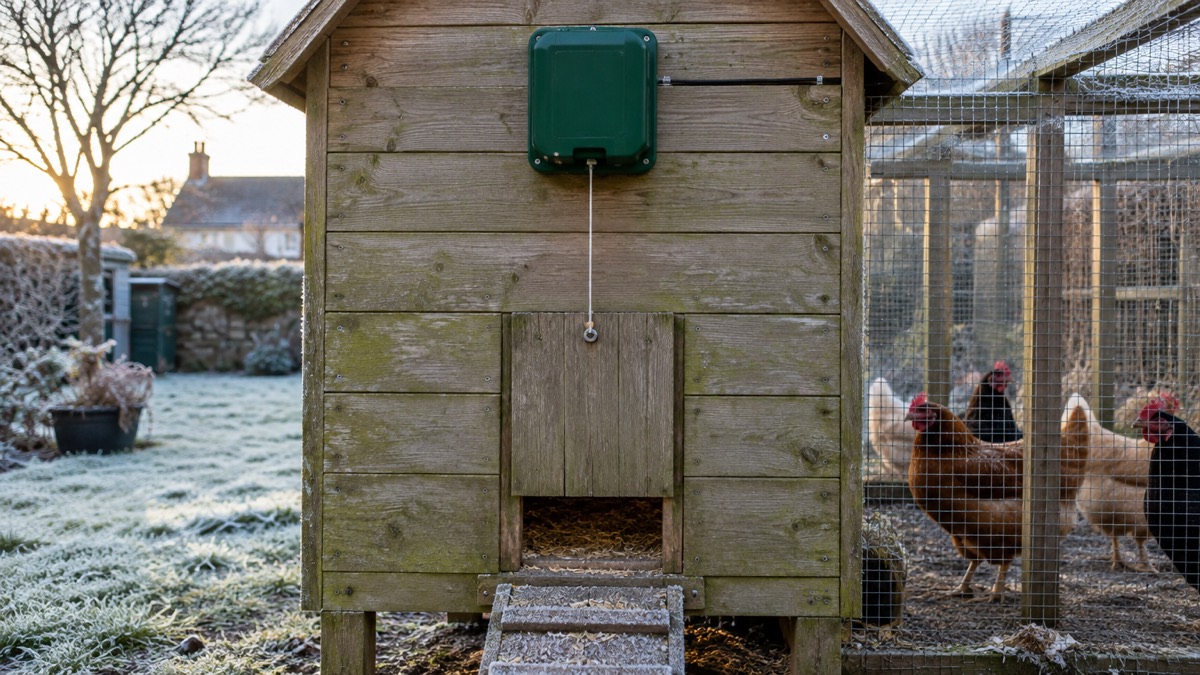
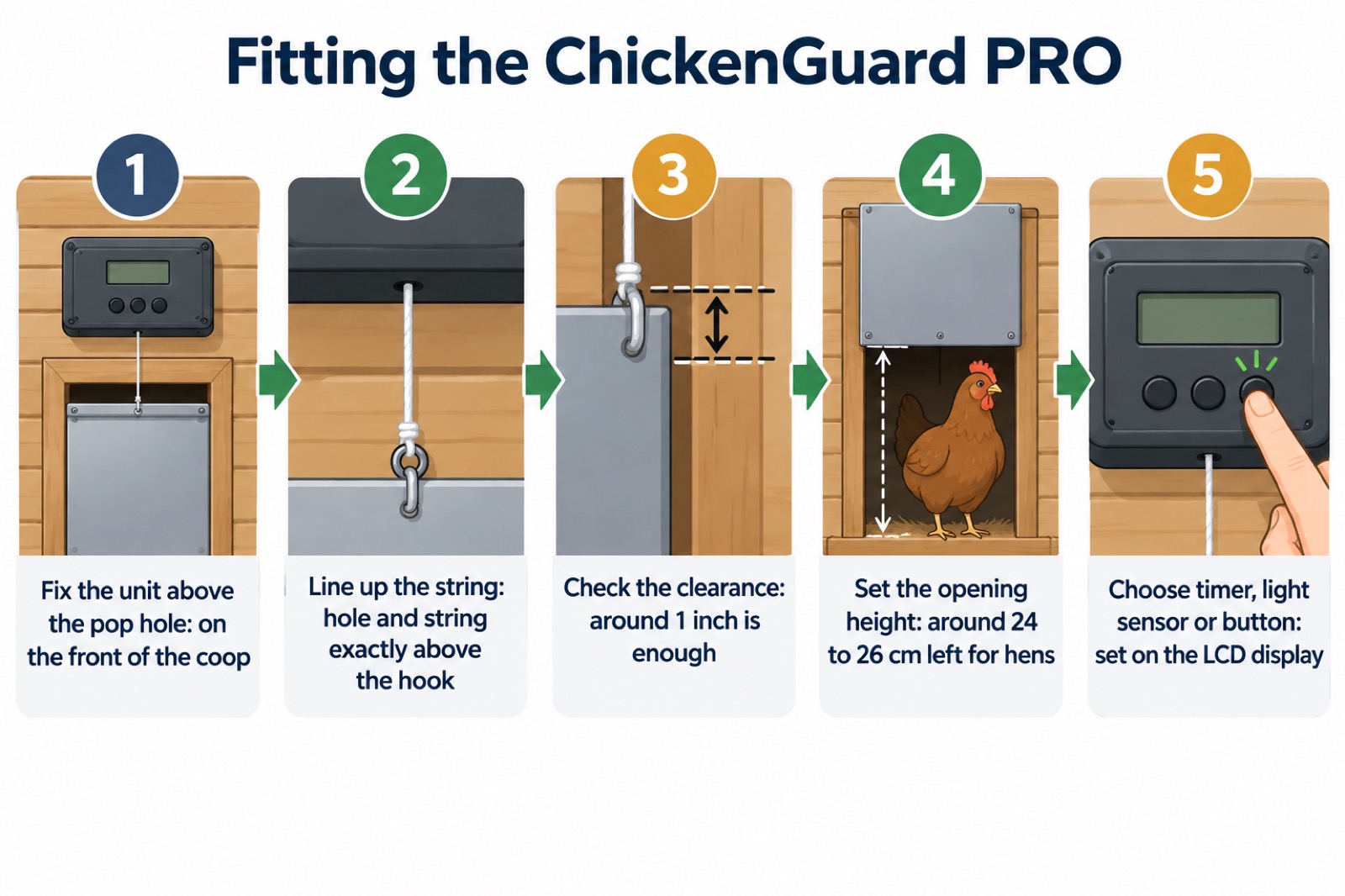
The unit mounts on the front of the coop above the pop-hole door, with no complicated wiring or cabling1. Fitting is a matter of fixing the unit to the coop, running the cord down to the door, and setting it up on the display.
The critical part is alignment. Make sure that the little hole and string are exactly in the middle, directly above the hook or screw you secure the line to1. If the string runs at an angle, the door will be pulled sideways and will bind in its runners. Position the unit slightly off centre if that is what it takes to get the string dead vertical over the hook1.
There does not strictly have to be 3 to 4 inches of space above the door1. The unit works perfectly if you reduce the height to around 1 inch and fit it there1. That is useful on a small coop where the pop hole sits close under the roof, and it is the figure to check before you buy if your coop is compact.
After fitting, you should be left with around 24 to 26 cm for your chickens to enter and exit, which is enough height for them to get through1. Measure the door's travel before you start so you know what opening you will end up with.
Fitting it to a Devon Hen House with a run
The ChickenGuard PRO works perfectly with the Devon Hen Houses, and the door opener can be attached to the Devon with the Runs1. Position it as high as the wooden support for the apex allows, around the air vent areas1.
That raises the obvious worry: does covering part of the vent starve the hens of air? On this coop, no. The unit covering part of the air slits is not going to have an effect on ventilation, because of the large sliding vent on the other side1. The coop has ventilation elsewhere doing the work.
On any other coop, check before you cover a vent. The general principle for any enclosed space where animals or people breathe is that vents stay clear: official fire safety advice for caravans is to make sure the caravan is ventilated and never block air vents, to avoid a build up of poisonous gases5. A hen house is not a caravan, but the principle holds: if the only vent is the one the unit covers, find another way to fix it, or leave that vent clear.
If you keep hens in a run, the space matters as much as the door. Ex-caged hens need a minimum of 1 square metre of clear floor space per bird during the day, and all other hens need a minimum of 2 square metres per bird, plus ideally the opportunity to free range6. The British Hen Welfare Trust advises buying a hen house to accommodate more hens than you want: if you want four hens, buy a hen house to accommodate six, so there is sufficient room7. Our guide to how much coop and run space hens need sets this out in full.
Power: 4 x AA batteries or USB
The unit runs on 4 x AA batteries, which are included, or on electric power through a USB cable, which is not included1. The distributor describes it as having a long battery life and being low maintenance, with no complicated wiring or cabling1.
| Power option | What you need | What to know |
|---|---|---|
| Batteries | 4 x AA, included1 | No wiring at all; you change the batteries when they run down1 |
| USB power | A USB cable, not included1 | You supply the cable; check the connector before buying one |
If you run it on USB power, the cable is your responsibility. The distributor states plainly that cables are not included1. A USB cable made for charging does not carry data, and that is fine here: the unit only needs power9. Buy a cable of the right length for the run from your socket to the coop, and keep the connection out of the wet.
Batteries are the simpler choice for most coops, because there is nothing to wire and nothing to trip over. The trade-off is that you have to remember them. A door that stops working because the batteries have gone flat is a door that leaves the hens out at dusk, so check the unit's display regularly and change the batteries before winter rather than during it.
Built for winter: weatherproof casing and operation down to -20C
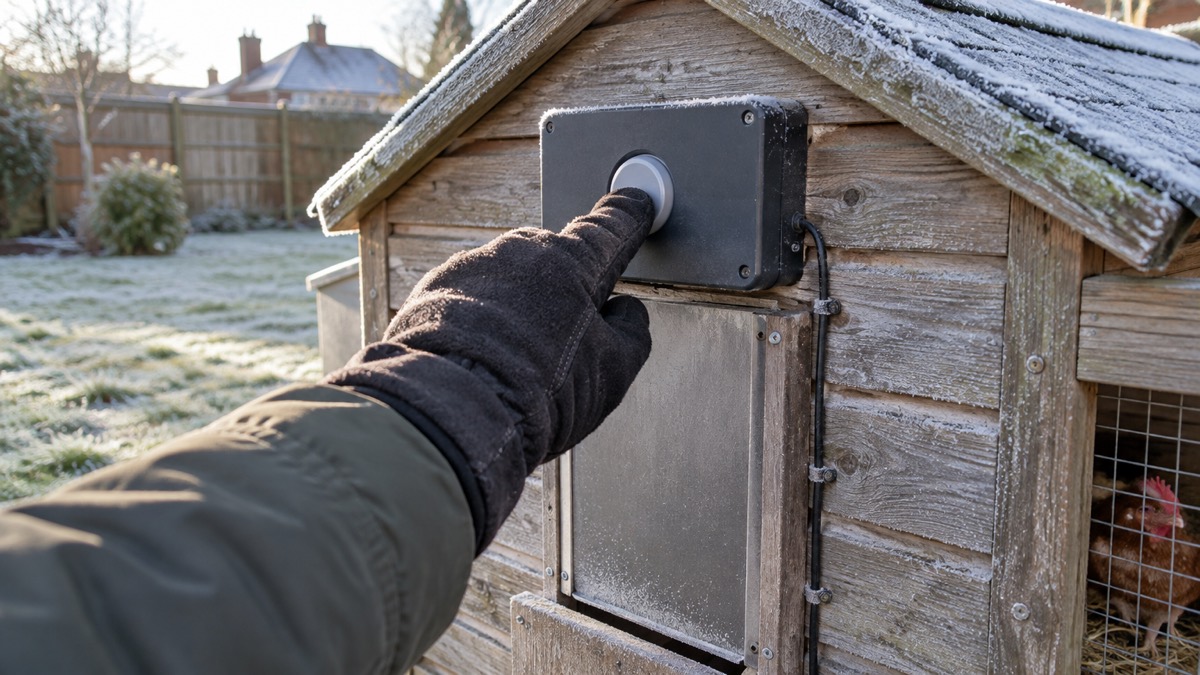
The electronics are enclosed in a weatherproof casing and are made using high-grade materials1. The unit works at -20C1. That is the figure that matters in a British cold snap, when a door mechanism that stiffens or a display that fades leaves you with a pop hole you have to open by hand in the dark.
The buttons are made extra large so that you can easily press them with gloves on in the winter1. That sounds like a small thing until the first hard frost, when you want to open the door by hand without taking your gloves off.
Winter is also when the rest of the coop needs attention. Our guide to chicken health covers the common problems, and daily biosecurity for backyard poultry keepers covers the routine that keeps a flock healthy through the cold months.
The casing protects the electronics, not the door. Check after a storm that the cord still runs straight and the door still slides freely, and clear snow or ice from the top of the coop so it does not fall on the unit.
Support and warranty: 3 years
The ChickenGuard PRO comes with a no quibble 3-year guarantee, and the distributor adds that your unit should last a lot longer than that1. It is made in Britain1.
Keep the receipt and the fitting date. If the unit fails within the guarantee, the distributor's guarantee is what you claim on, so buy from a seller who will honour it and keep the paperwork with the coop's other records.
For comparison, warranty lengths vary across this kind of kit: the Jackery portable power station range carries a 3+2 year extended warranty on most Pro and Plus series models10. That is a different product entirely, but it shows that a 3-year guarantee is a reasonable baseline rather than an exceptional one.
If you are building up a poultry kit, our checklist of what you need to keep pet hens covers the rest, and the self-reliance section has the wider picture on hens, growing food and off-grid power.
Sources (10)
- ChickenGuard Premium Automatic Door Opener, Chicken Coops Direct, 2026
- Chicken Health and Welfare, RSPCA, 2026
- Housing, Equipment and Feed, The Poultry Club, 2026
- ChickSafe FAQ, Brinsea, 2020
- Fire Safety Outdoors, GOV.UK, 2022
- Hen Set-Up, British Hen Welfare Trust, 2026
- Hen Adoption FAQs, British Hen Welfare Trust, 2026
- Avian Influenza (Bird Flu), British Hen Welfare Trust, 2025
- Chargers, Electrical Safety First, 2026
- Jackery Buying Guide, Jackery, 2026