Resuscitation Council UK (RCUK) published version one of Public access defibrillators: A guide for communities in October 20251. The guide covers what defibrillators do and how to use them, registration with The Circuit (the national defibrillator network), purchasing, installation, signposting and maintenance, defibrillators in schools and workplaces, and legal considerations and training options1.
The guide states that out-of-hospital cardiac arrest affects 100,000 people a year in England, of whom resuscitation is attempted by ambulance services in around 30,0001. It says that in 2024, defibrillators were used by members of the public in only 9% of cardiac arrests, and that currently only 1 in 10 people survive an out-of-hospital cardiac arrest1. It states that using a defibrillator within 3 to 5 minutes of collapse can increase survival rates by up to 70%, and that for every minute's delay to defibrillation (where indicated), once resuscitation has started, the chance of survival decreases by 10%1. Early recognition of cardiac arrest, immediate resuscitation and rapid defibrillation can more than double the chance of survival, it says1.
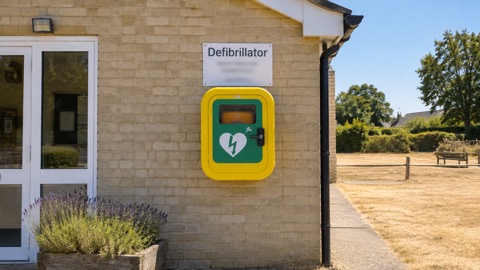
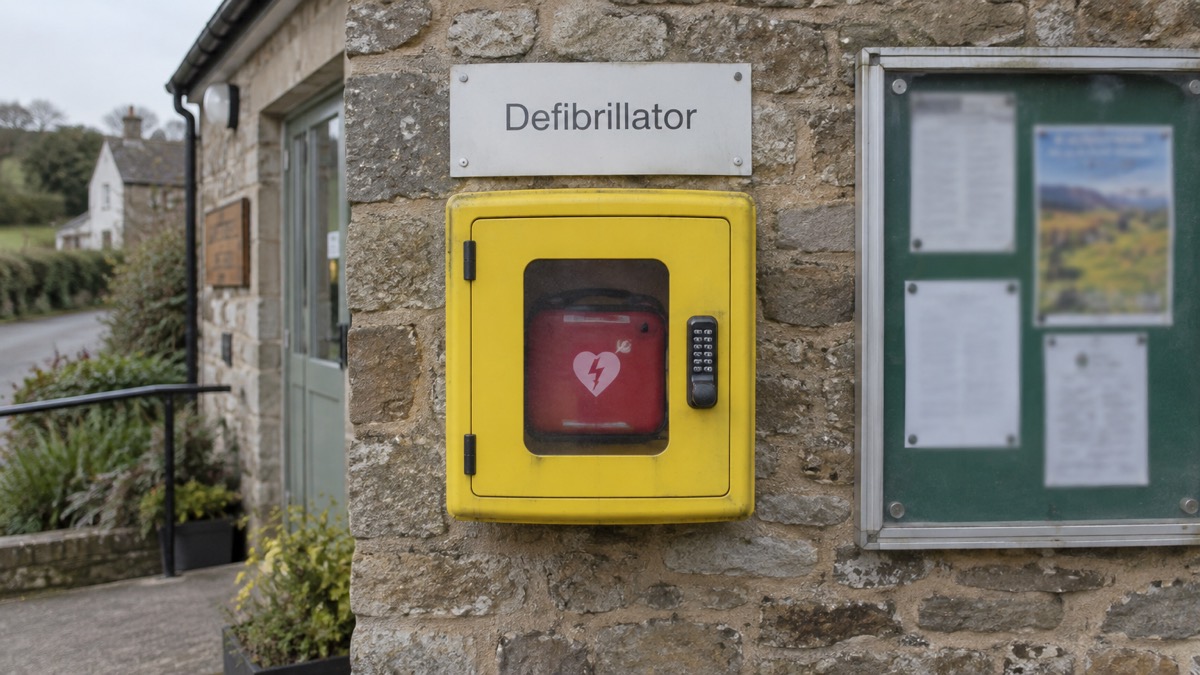
On placement, the guide says a defibrillator should ideally be accessible within 200 metres or two minutes' brisk walk (four minutes there and back) from where it is anticipated it might be needed, and that signage should be a sufficient size to be legible from a distance of at least 50 metres1. It says the cabinet requires a domestic power supply for its heating element to ensure the defibrillator remains operational in colder weather and should be weatherproof1. RCUK's recommendation is that defibrillator cabinets should not be locked1. The guide says data from The Circuit suggests that many occasions where cabinets are forced open are neither vandalism nor theft, rather people responding to genuine emergencies who are struggling to operate the lock or to obtain the unlocking code1. It advises that the unlocking code is accurately recorded on The Circuit so the emergency call handler can provide it to bystanders sent to retrieve the defibrillator during a cardiac arrest1.
On registration, the guide says all ambulance services in the UK are linked to The Circuit, and that registration is simple, quick and free of charge1. It says some ambulance services will not deploy a defibrillator that hasn't had a check recorded for over three months, and that when a Circuit-registered defibrillator is deployed by the ambulance service, the Guardian will receive an email immediately1. Organisations with more than ten defibrillators can register them using an organisation account1. The guide says organisations with defibrillators should have a formal policy to maintain them and ideally ensure they are available for public access 24 hours per day and 365 days per year, wherever possible1. After use, it says it is important to sanitise the defibrillator, return it to its usual place, and replace used disposables, especially the defibrillator pads, so that it is available for further use as soon as possible1.
On children, the guide says adult pads and energy can be safely used on a child if this is the only resource available, and that if using adult pads on a child, care should be taken to ensure the pads are not in contact with each other when delivering a shock1. It says incidents of cardiac arrest in school-age children are rare (1.7% of out-of-hospital cardiac arrests in 2023 were in children less than 15 years of age), but about one-third of out-of-hospital cardiac arrests occur within 300m of a school1. The number of community defibrillators has been increased by the provision of a defibrillator to all state-funded schools across England by the Department for Education, it says1.
On law, the guide states that in the United Kingdom there are no legal restrictions to the use of a defibrillator, and that there may be potential consequences for some employers under common law if a defibrillator is not provided1.
"In 2024, defibrillators were used by members of the public in only 9% of cardiac arrests."
Why it matters for households
The guide is addressed to communities and organisations that hold or are considering a public access defibrillator, and sets out what RCUK says is needed for a device to be usable in an emergency: an unlocked cabinet, a power supply for the heating element, signage legible from at least 50 metres, and registration on The Circuit with an accurate unlocking code1. It states that 999 call handlers will tell a caller the location of the nearest defibrillator registered on The Circuit1. For households, the figures describe how often public defibrillators are used: in 9% of cardiac arrests in 20241. The guide also notes that training is not required to give CPR and use a defibrillator, though familiarisation may support individuals to feel more able and confident to do so1. RCUK supports the widespread installation and public availability of defibrillators1.
What happens next
The guide is marked "Version one | October 2025"1. No further publication or revision dates have been reported.
Households can read about first aid and community resilience, and about public access defibrillators and finding the nearest one.
Sources (1)
- Public access defibrillators: A guide for communities, resus.org.uk