NHS England issued a safety plea on 24 December 2022, asking parents to be alert to the dangers of small toys at Christmas. Its children's doctors acted after surgeons had performed life-saving operations to remove button batteries, magnetic balls and Christmas cracker toys in previous years1.
The number of children under 15 admitted to hospital and treated after ingesting a small object rose from 115 in 2011/12 to 228 in 2021/22, according to NHS Digital data cited by NHS England1. The figures cover children aged 0 to 14 and exclude food, water and liquids such as bleach, and anyone treated in the community or who died before admission1. NHS England said dozens of cases need intrusive surgery at specialist children's hospitals, with a handful requiring major surgery on heart bypass to repair holes caused by batteries and magnets1. The Child Accident Prevention Trust says one to two children a year die in the UK from swallowing button batteries, and that survivors may have life-changing alterations to their anatomy1.
NHS England said button batteries, penny-sized and used in gifts, festive lights, TV remotes, watches, thermometers and musical Christmas cards, can burn through a young person's throat or food pipe in a very short time if swallowed1. It described the case of Ralphie Phillips, who swallowed a button battery in 2021 a day before his first birthday; surgeons took three hours to remove it and the chemical reaction had burnt towards his lungs1.
"But unfortunately we are seeing an increase in the number of children at hospital because they have swallowed a foreign object, double the number we had 10 years ago, and the consequences can be devastating, especially when that object is a button battery or magnetic ball causing irreversible damage."
NHS England set out advice from the Royal Society for the Prevention of Accidents (RoSPA) for parents1:
| Advice | Detail |
|---|---|
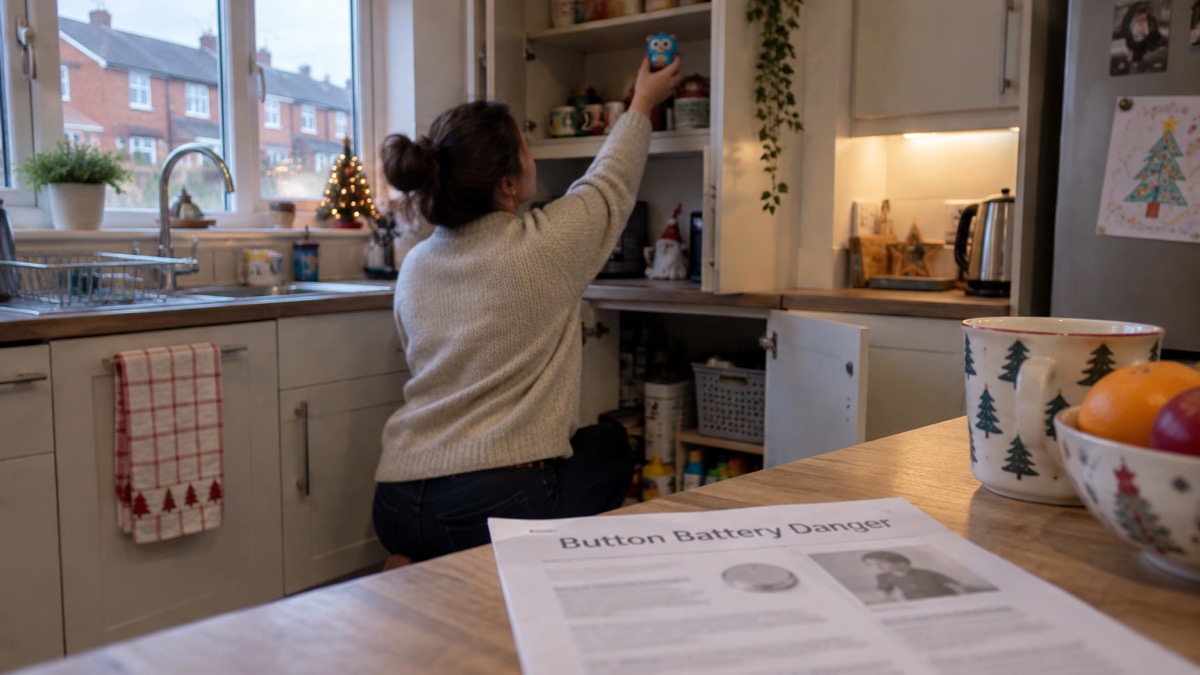
| Lockable compartments | Toys and products using button batteries should have lockable battery compartments |
| Items without them | Musical greeting cards, flameless candles and remote controls do not have lockable compartments; RoSPA advises children should not have access if the compartment is not secure |
| Spare and used batteries | Keep spare batteries locked away and dispose of used ones correctly |
| If a battery is swallowed | Take the child to A&E immediately |
Katrina Phillips, Chief Executive of the Child Accident Prevention Trust, said a stuck battery can cause life-changing injuries or kill, and that parents should check presents as they are unwrapped and keep spare batteries out of reach1. Ashley Martin, RoSPA's Public Health Adviser, said the organisation is aware of deaths and serious injuries in the UK from swallowed toy parts, magnets and Christmas decorations, and that time is very much of the essence1.
Why it matters for households
The warning applies to households with young children over the Christmas period, when new toys, lights and cards come into the home1. NHS England said young children are particularly likely to put small objects in their mouths1. The figures cover hospital admissions only, so the true number of swallowing incidents is not reported1. NHS England's advice, attributed to RoSPA, is that a child who swallows a battery should be taken to A&E immediately, and that parents should seek medical advice at once if they think a child may have swallowed a button battery1. The first-aid hub sets out emergency basics, and teaching children basic life-saving skills and how to ring 999 covers what children can be taught.
What happens next
No further dates or steps have been reported. NHS England published the plea on 24 December 20221.