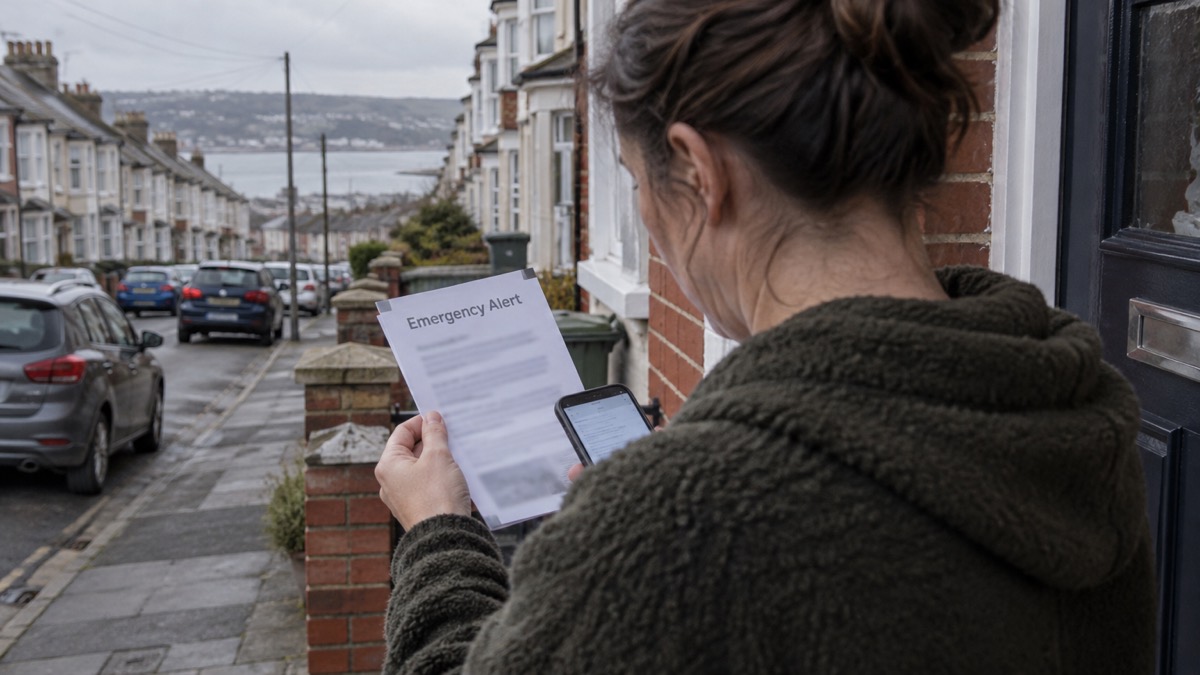
The first Emergency Alert was used in Plymouth in February 2024, Lancashire Resilience Forum reports, after the UK Government tested the Emergency Alert System in 20231. The National Risk Register 2025 edition describes the Plymouth use of an alert as accompanying "a residential evacuation"2.
Emergency Alerts are sent to compatible 4G and 5G mobile phones within an area of risk, and the forum states they "don't need your location or phone number"1. It says alerts "will only ever be issued by Government, or in some instances, the emergency services", and that the service "will be used to warn you about life-threatening emergencies such as severe flooding"1.
The forum describes what a recipient experiences: "you'll hear a loud, siren-like sound and your phone will use a distinct vibration. A message will appear on your screen until you acknowledge it"1. It says that for people who are hard of hearing, the phone will recognise the alert has been received and, depending on the phone's features, the alert will work with screen magnification and may read the message out, having overridden volume settings; the noise "should also be audible for those who use a hearing aid"1.
After acknowledgement, the forum says an alert may still be viewable: on Android phones it may be found in the Messages app or "Emergency Alert History", while on iPhone it appears in notifications, and deleting the notification deletes the alert1.
"In February 2024, [the first Emergency Alert was used in Plymouth.]"
Why it matters for households
The Plymouth alert shows the system being used for a local incident rather than a national test. Households in an affected area with a compatible 4G or 5G phone can expect the siren-like sound, distinct vibration and on-screen message described by the forum, which remains until acknowledged1. The forum states that alerts do not need a user's location or phone number1. It directs readers to gov.uk/alerts for information on what happens when an alert is received, reasons one might be sent and how the system works1.
The National Risk Register 2025 edition, which covers 89 risks across 9 themes, is described in its foreword as underpinning the public guidance at GOV.UK/Prepare, which "sets out the simple and effective steps we can all take to prepare for emergencies"2. The register states that in May 2024 the Government published advice for individuals, households and communities on GOV.UK/Prepare on preparing for emergencies2. It also says this edition "is not targeted at the general public"2.
What happens next
No further use of the Emergency Alert system beyond the February 2024 Plymouth alert is set out in these sources. The National Risk Register 2025 edition states that the National Security Risk Assessment now operates as a dynamic process, with risks reassessed on a more regular basis, over an assessment period of five years for non-malicious risks and two years for malicious risks2.
Households wanting to understand the system can read the guide to Emergency Alerts and how the UK phone warning system works, check whether their phone will receive Emergency Alerts, and find out what to do when an alert arrives.
Sources (2)
- Emergency Alerts launched in UK | Lancashire Resilience Forum, lancashireprepared.org.uk
- National Risk Register - 2025 edition, data.parliament.uk
 Emergency Alerts
 Phones That Get Alerts