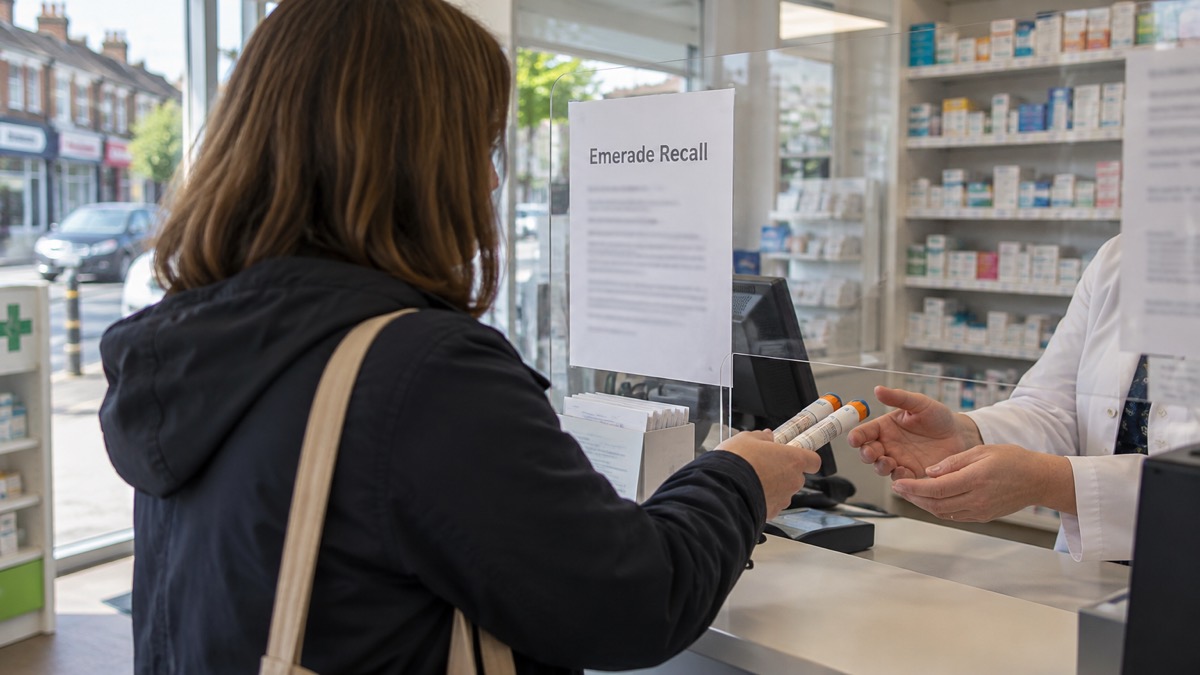
The Medicines and Healthcare products Regulatory Agency (MHRA) issued a National Patient Safety Alert, NatPSA/2023/004/MHRA, on 9 May 2023 covering all unexpired batches of Emerade 500 micrograms (PL 33616/0015) and Emerade 300 micrograms (PL 33616/0014) adrenaline auto-injectors, whose active ingredient is adrenaline (as tartrate)1. Pharmaswiss Česka republika s.r.o. and distributor Bausch & Lomb UK Limited are recalling the pens from patients, and the alert states that future production of both strengths is on hold, so no further supplies will be available1.
The recall followed an ISO 11608 Design Assessment study in which some auto-injectors failed to deliver the product or activated prematurely. The alert says the 1-metre free-fall (vertical orientation) pre-conditioning resulted in damage to internal components of the auto-injector, leading either to failure to deliver the product or premature activation, and that this damage was not visibly apparent following the pre-conditioning but was evident only on subsequent functional testing1. The MHRA says it is unclear what impact this has on auto-injectors in clinical use, and that the recall is a precautionary measure because the issue cannot be identified before the pens are used1. Anaphylaxis UK describes the concern as the device possibly not working or activating prematurely if it has been knocked, for example by being dropped, and notes that pens with internal damage are not easily identified2.
The MHRA, with the Department of Health & Social Care (DHSC), established that there are sufficient supplies of alternative auto-injectors to allow a recall at patient level1. Alternative brands, EpiPen and Jext, are available in a maximum strength of 300 micrograms1. The alert states there is evidence to suggest that a single EpiPen (300 micrograms) or Jext (300 micrograms) pen will be a suitable replacement for a single Emerade 500 micrograms pen, based on two studies (including one by the manufacturer of Emerade) comparing blood levels of adrenaline after injection1. Anaphylaxis UK reports that the studies found a 300 microgram dose given by EpiPen or Jext achieves the same adrenaline level in the blood as Emerade 5002.
Actions required of GPs and pharmacy teams were to be completed by 12 May 2023, including stopping supply, quarantining stock and identifying and reviewing affected patients1. The alert sets out the position for patients and carers:
"immediately inform patients and carers to request a new prescription to replace each Emerade 500 micrograms and Emerade 300 micrograms auto-injector with an adrenaline pen in an alternative brand"
| Item | Detail |
|---|---|
| Products recalled | Emerade 500 micrograms (PL 33616/0015) and Emerade 300 micrograms (PL 33616/0014), all unexpired batches1 |
| Reason | Free-fall testing caused internal damage leading to failure to deliver or premature activation; not visible before use1 |
| Replacements | EpiPen 300 or Jext 300; one 300 microgram pen considered a suitable replacement for one Emerade 500 microgram pen1 |
| Return of old pens | To any pharmacy, after two replacement pens of equivalent strength have been obtained1 |
| Deadline for health professional actions | 12 May 20231 |
| Future supply | Production of both Emerade strengths on hold1 |
Why it matters for households
The recall covers every unexpired Emerade 300 and 500 microgram pen held by patients, carers, schools and healthcare settings, including pens in emergency anaphylaxis kits such as dental surgery kits1. The MHRA advises patients and carers to request a new prescription for an alternative brand, to return Emerade pens to a pharmacy once two equivalent strength replacement pens have been obtained, and to receive training on the new device, because each brand works differently1. Anaphylaxis UK advises patients to contact their GP by telephone for a replacement prescription and to be trained in the new device when collecting it2. The MHRA states that patients should continue to carry two devices at all times in case a second dose of adrenaline is needed before the emergency services arrive1. Prescribers should issue no more than two auto-injectors per patient of any brand or strength, except where schools require separate pens to be kept on the premises, in which case no more than four pens per child may be considered1. The alert also sets out what to do in an reaction: administer an adrenaline auto-injector without delay even if there is doubt whether it is anaphylaxis, call 999 immediately afterwards and say it is an emergency case of anaphylaxis, and administer a second auto-injector 5 minutes after the initial dose if there is no improvement or the patient deteriorates after an initial improvement1. Patients should be advised to use a second auto-injector immediately if the first pen fails to activate despite pressing firmly against the thigh1. For healthcare professionals restocking anaphylaxis kits, DHSC advice is to stock ampoules with dosing charts, needles and syringes rather than pens of any brand, to preserve pen supplies for patients1. Further detail on carrying, using and storing these devices is in our guide to adrenaline auto-injectors, and related alerts are collected in the health emergencies and first aid hubs.
What happens next
The actions for GPs and pharmacy teams had a completion date of 12 May 20231. The alert gives no date for a resupply of Emerade pens; it states only that future production is on hold and that patients will need to be switched to an appropriate alternative1.
Sources (2)
- National Patient Safety Alert: Class 1 Medicines Recall Notification: Recall of Emerade 500 micrograms and Emerade 300 micrograms auto-injectors, due to the potential for device failure, NatPSA/2023/004/MHRA - GOV.UK, gov.uk
- Recall of Emerade 300 and 500 microgram adrenaline auto-injector devices - Allergy UK incorporating Anaphylaxis UK, anaphylaxis.org.uk
 Adrenaline Auto-Injectors