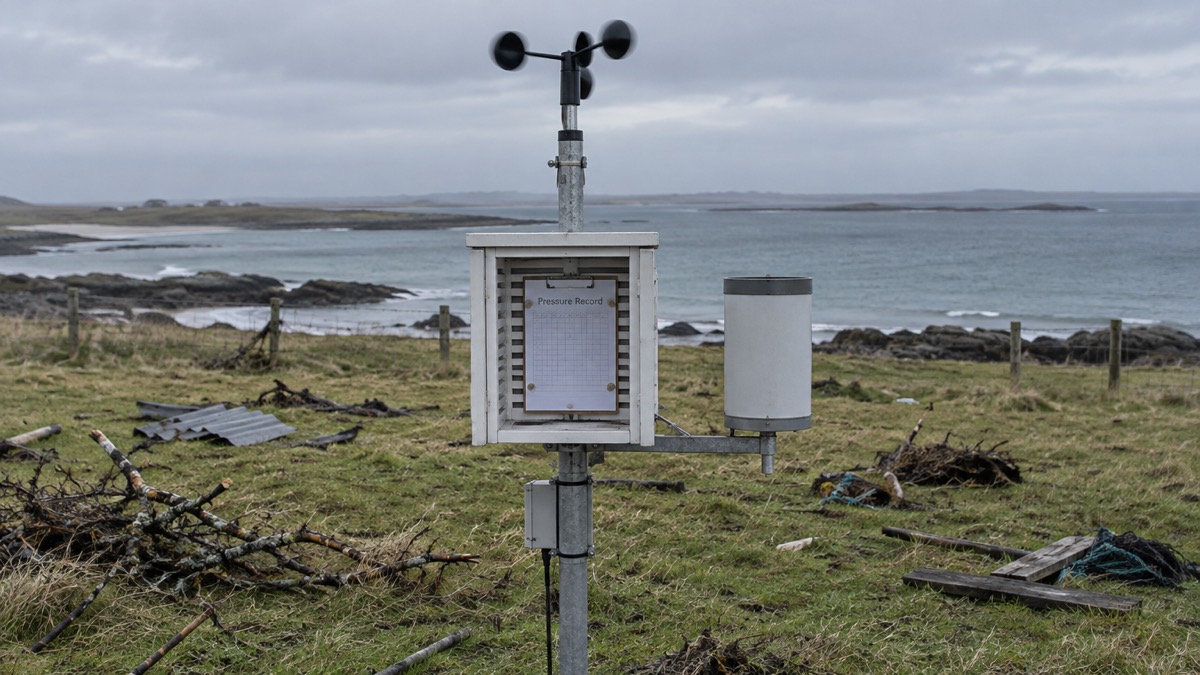
Storm Éowyn, the fifth storm of the 2024/2025 season, brought the UK's lowest recorded pressure since storm naming was introduced in autumn 2015, according to a Met Office report on the storm. A station on the Isle of Tiree in the Inner Hebrides recorded 941.9hPa, the lowest value since 936.8hPa was recorded at Stornoway Airport in the Western Isles on 24 December 20131. The Met Office says the 2013 reading was itself the UK's lowest pressure since 18861.
The storm deepened rapidly as it interacted with a powerful jet stream, a process the Met Office calls "explosive cyclogenesis". Central pressure fell by 50hPa within 24 hours, from 991hPa at 0000 UTC on 23 January to 941hPa at 0000 UTC on 24 January, more than double the formal definition of 24hPa in 24 hours1. The lowest pressure at Tiree was recorded at 0900 UTC on 24 January1.
The Met Office describes Éowyn as the UK's most powerful wind storm for over a decade, and for Northern Ireland the most significant since the Boxing Day Storm of 26 December 19981. The highest gust in the UK was 87Kt (100mph) at Drumalbin, Lanarkshire. Other notable gusts included 83Kt (96mph) at Brizlee Wood, Northumberland, 81Kt (93mph) at Aberdaron, Gwynedd and 80Kt (92mph) at Killowen, County Down, with around 20 further stations recording 70Kt (81mph) or more1. At upland mountain stations, Cairnwell recorded a gust of 117Kt (135mph) and Great Dun Fell an hourly mean wind speed of 84Kt (97mph) in the hour ending at 1100 UTC on 24 January1. Fifteen stations with records of 10 years or more set new January maximum gust speed records, including six in Northern Ireland whose records the Met Office describes as 25+ year records1.
| Measure | Figure | Location | Date |
|---|---|---|---|
| Lowest pressure | 941.9hPa | Tiree, Inner Hebrides | 24 January 2025 |
| Previous lowest since 2015 | 936.8hPa | Stornoway Airport, Western Isles | 24 December 2013 |
| Highest gust | 87Kt (100mph) | Drumalbin, Lanarkshire | 24 January 2025 |
| Highest gust, upland station | 117Kt (135mph) | Cairnwell, Aberdeenshire | 24 January 2025 |
| Peak homes without power | Around one million | UK | 24 January 2025 |
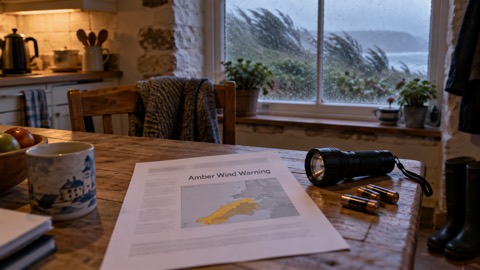
The Met Office issued a red warning for wind, meaning danger to life, covering all of Northern Ireland, Scotland's Central Belt and much of south-west Scotland, with a wider amber warning area covering the northern half of the UK. Red warnings were also issued by Met Éireann and the Isle of Man Government1. The report notes this red warning came only seven weeks after a red warning for wind for Storm Darragh in early December 2024, and that the last red warning for Scotland had been from Storm Isha in January 20241.
"In the red warning area, including all of Northern Ireland and Scotland's Central Belt, members of the public were advised to stay at home and all schools were closed."
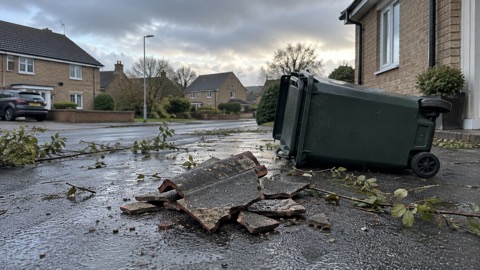
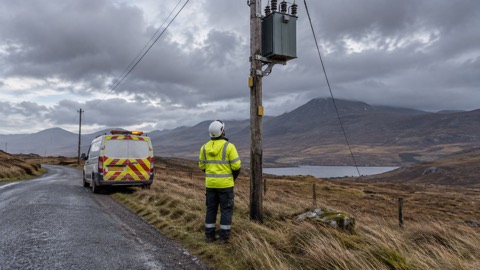
Around a million homes were reported to be without power at the peak of the storm as trees and strong winds brought down power lines, with several thousand remaining without power in Scotland and Northern Ireland for a number of days1. Trunk roads were closed, all rail services were halted in Scotland and the West and East Coast Main Lines closed. A section of the M9 was closed in both directions and part of the A1 closed due to overturned vehicles, while ferry services and over 1000 flights were reported cancelled1. One fatality was reported in Ayrshire as a result of a falling tree, and a further fatality was reported in County Donegal in the Republic of Ireland1. The storm also brought over 50mm of rain across western upland areas, with two-day totals from 23 to 24 January including 82.4mm at Achnagart in the West Highlands and 62.5mm at Holne on Dartmoor1.
Why it matters for households
The Met Office's account sets out what households across the northern half of the UK faced within a single day: loss of power for around a million homes at the peak, closed trunk roads and rail lines, cancelled ferries and flights, and closed schools and shops. For households in the red warning area, the Met Office reports that members of the public were advised to stay at home. Several thousand homes in Scotland and Northern Ireland remained without power for a number of days after the storm, and the Met Office reports widespread damage to properties from strong winds, with trees and debris blocking roads and rail lines1. The report also records that 15 trees were uprooted or broken and a further 25 badly damaged in Scotland's national botanical collection at the Royal Botanic Garden in Edinburgh1.
The Met Office's climate analysis states that storms of the severity of Éowyn are to be expected as part of the UK's climate on a reasonably regular basis1. Households preparing for storms and snow can read the site's guidance on the subject.
What happens next
No further steps have been announced. The Met Office report was last updated on 30 January 20251.
Sources (1)
- metoffice.gov.uk, metoffice.gov.uk