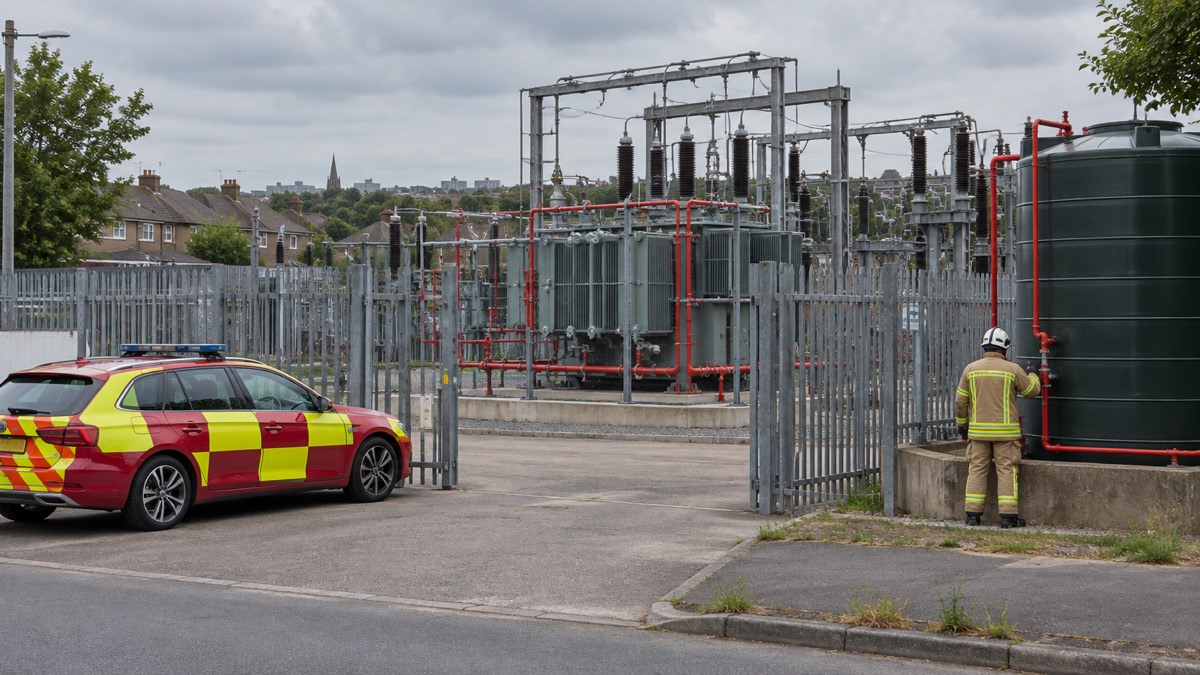
A fire risk assessment carried out in July 2024 indicated that the fire suppression system at North Hyde 275kV substation, near Hayes in West London, was still out of service, according to the final report of the North Hyde Review published on 30 June 20251. The review says the assessment also indicated that a fire on any of the three supergrid transformers would not be suitably suppressed1.
The report sets out the earlier history of the system. A National Grid Electricity Transmission review in 2022 indicated that the fire suppression system on SGT1 and SGT3 at the substation was inoperable1. The suppression system had been added to those two transformers in 2002, and the substation itself was built in 1968 with limited physical distance and no fire barrier between SGT1 and SGT31. A third transformer connecting the 275kV and 66kV substations was built in 20101.
The review found that the controls in place were not effective and failed to identify that action had not been taken on an elevated moisture reading in one of SGT3's bushings, detected in oil samples taken in July 20181. It says an opportunity to act was missed in 2022, when a decision was taken to defer basic maintenance on SGT3, and the issue went unaddressed1. The review also found that risks at the site were managed through multiple separate processes, meaning there was no single structured process to provide a cumulative assessment of the risk to the whole site1.
"a further fire risk assessment report conducted in July 2024 indicated that the fire suppression system at North Hyde substation was still out of service."
The incident itself began at 23:21 on Thursday 20 March 2025, when SGT3 and the circuit connecting it to the wider transmission system tripped1. The review found that a catastrophic failure on one of SGT3's high voltage bushings caused a fire to ignite on the transformer, most likely caused by moisture entering the bushing and causing a short circuit1. At 23:49, 28 minutes after the loss of SGT3, SGT1's protection systems operated and switched SGT1, and its circuit, out of service1. This resulted in the loss of all supplies at the 275kV and 66kV substations1.
The report gives the following account of the effects and the response.
| Time and date | Event |
|---|---|
| 23:21, Thursday 20 March 2025 | SGT3 and its circuit trip1 |
| 23:49 | SGT1 protection systems operate; all customers fed from North Hyde are disconnected1 |
| 00:42, Friday 21 March | Metropolitan Police Service declares a major incident1 |
| 01:11, Friday 21 March | Heathrow Airport Limited decides to close Heathrow Airport1 |
| 09:49, Friday 21 March | North Hyde 66kV busbars re-energised1 |
| 00:55, Saturday 22 March | SGT2 energised and connected to the wider transmission system1 |
| 17:13, Wednesday 26 March | London Fire Brigade issues the stop message, five days and 18 hours after it first arrived1 |
The outage led to 71,655 domestic and commercial customers losing power, including 66,919 of SSEN Distribution's domestic and commercial customers and an additional 4,736 customers of Independent Distribution Network Operators supplied via North Hyde 66kV and 22kV substations1. Heathrow Substation A also lost supply1. The Metropolitan Police Service, supported by its Counter Terrorism Command, confirmed on Tuesday 25 March that it had "found no evidence to suggest that the incident was suspicious in nature" and closed its investigation into the fire1.
Why it matters for households
The review describes how a single transformer failure at one substation removed supply from more than 70,000 domestic and commercial customers, and how the loss of one supply point left part of Heathrow Airport's private network without power to operationally critical systems1. It found that the design and configuration of that network meant the loss of one of three independent supply points would lead to a suspension of operations for a significant period, with plans in place to reconfigure the network on an estimated timescale of 10 to 12 hours1. NESO, National Grid Electricity Transmission and SSEN Distribution told the review they were not previously aware of the potential impact to Heathrow Airport of the loss of a supply point1.
The review also reports that energy network operators are not currently aware whether customers connected to their networks are Critical National Infrastructure, that there is no cross-sector requirement for such operators to ensure continuity of operations in response to power disruption, and that they have no priority within the electricity legal or regulatory framework1. It says work is underway, led by government, to identify and analyse cross-sector dependencies1. For households, the report records that customer restoration occurred within expected timeframes and that communications with the public and domestic customers were effective, although some commercial customers said the communications they received were less coordinated1. The wider impact to the local area, including road, rail and the environment, was relatively contained1. Households preparing for supply interruptions can read the guide to power cuts.
What happens next
The review makes a series of recommendations, including that fire and asset risk assessments be in place for all energy facilities, explicitly cover site level risk where multiple assets are on one site, and be updated or explicitly cater for relevant equipment being unavailable or out of service1. It also recommends that asset management processes include robust controls to ensure identified issues are categorised and followed up, with particular attention to any area reliant on manual controls1. The review says these recommendations will require close cooperation across industry, regulators and lead government departments to ensure they are effectively implemented1. The report was published on 30 June 2025, following an interim report on Tuesday 6 May 20251.
Sources (1)
- download, neso.energy