If the mains water stops, or you are told to boil it before drinking, a tub of water purification tablets in the cupboard gives you a way to make stored or collected water safer. Purisaf tablets are made by Maclin Group and contain sodium dichloroisocyanurate, usually shortened to NaDCC, the same family of chlorine disinfectant used in many emergency water tablets1. Each 1.7g tablet gives 1 part per million of available chlorine per 1,000 litres of water, so a small tub treats a very large volume1. If you ever spill a large amount, over 100kgs, report it to the Environment Agency or your local water authority3.
They are not a licence to drink any water you find. The maker is explicit that water with suspected faecal contamination or industrial pollution is very dangerous and should be avoided, and that foul-smelling water may mean algae and should be filtered first if possible1. Tablets work best on water that is already reasonably clear, and the maker says to test for residual chlorine before drinking and retreat if there is none1.
For a household, the practical points are simple. Buy a tub, note the date, store it dry and out of reach of children, and learn the dose and contact time before you need them. The tablets have a shelf life of up to 5 years, which makes them a sensible long-term item for a water store or an emergency kit1.
What Purisaf is and what it does for a household
Purisaf Water Purification Tablets are chlorine-based water sanitisers. The maker's datasheet describes them as broad spectrum water sanitisers for water treatment, and classifies the product as a disinfectant and/or a biocide, made by an EU Biocides Products Directive Article 95 listed supplier2. In plain terms, they release chlorine into water, and that chlorine is what reduces the level of bacteria and other organisms in it.
For a household preparing for emergencies, that matters in a few specific situations. A water supply interruption is one of the hazards the government's Prepare campaign asks households to think about, and having a way to treat stored or collected water is part of the answer3. A flood that contaminates a private supply, a storm that cuts power to a pump, or a burst main that leaves taps dry are all moments when a tub of tablets earns its place in the cupboard.
The tablets are also used for cleaning water systems rather than just drinking water. The maker gives instructions for chlorinating domestic plumbing, treating a well, and scrubbing out a spring box or silt trap1. Those are bigger jobs than most households will ever do, but they show the range of what the product is for: it is a disinfectant for water systems, not only a drinking-water additive.
Purisaf is sold under the Maclin Group name and the maker states the tablets are equivalent to more expensive brands such as Aquatabs and Oasis 10001. That is the maker's own comparison; what matters for your kit is the dose, the contact time and the testing routine, which are set out below.
Specifications to check on the label
Before you rely on any water tablet, read the label. The maker's datasheet says the active ingredient, sodium dichloroisocyanurate or troclosene sodium, must be stated on the label, and gives the product number PN5572. The table below sets out what the maker publishes about the product, so you can check a tub against it.
| Specification | What the maker states |
|---|---|
| Product | Purisaf Water Purification Tablets 1000 (1.7g NaDCC)1 |
| Active ingredient | Sodium dichloroisocyanurate (troclosene sodium), 30 to 60% w/w1 |
| Other content | Adipic acid 10 to 25% w/w2 |
| Appearance | White flat bevelled solid tablet2 |
| Odour | Characteristic chlorine odour2 |
| Solubility | Freely soluble2 |
| pH in solution | 5.0 to 6.0 approximately2 |
| Signal word | WARNING2 |
| Hazard classification | Eye irritant category 2; STOT single exposure category 3; aquatic acute and chronic category 12 |
| Transport classification | UN3077, class 9, packing group III, environmentally hazardous substance, solid2 |
| Unique formula identifier | HTH1-804M-G00C-HYP42 |
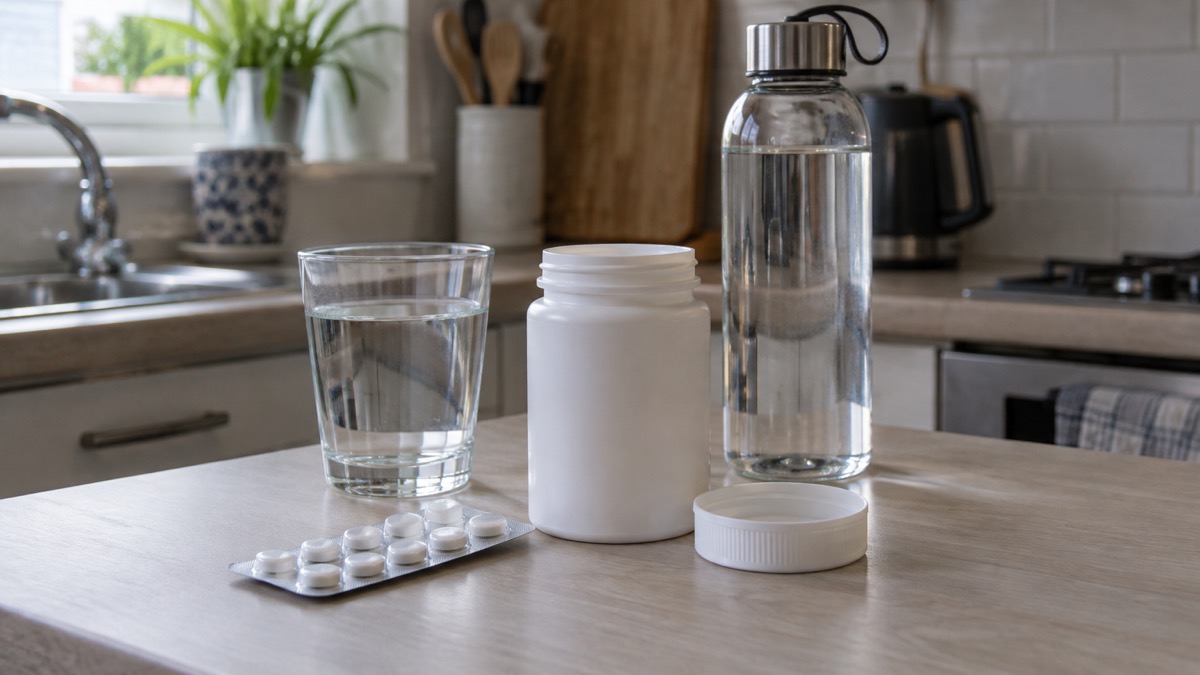
The unique formula identifier, or UFI, is the code you would quote to a poison centre or a health professional if someone swallowed or splashed the product. Write it on the inside of your cupboard door or keep the datasheet with the tub, so it is to hand in a hurry.
The maker also states that the tablets are simple to private label and available in bulk and exported globally1. That means the same tablet may reach you under a shop's own name, so check the active ingredient and the strength rather than the brand name alone.
How to use Purisaf safely
Chlorine tablets are a chemical, and the maker's datasheet treats them as one. Wear appropriate personal protective equipment, including gloves and goggles, avoid contact with skin and eyes, and avoid inhaling dust from the tablets2. Do not mix them with acids, including urine, because mixing releases chlorine gas2.
The dose depends on the water. For high-risk water, the maker specifies 10 to 20 ppm, which is 10 to 20mg per litre, with extended contact times of up to 20 minutes1. For routine treatment the maker's headline figure is that each tablet gives 1 ppm available chlorine per 1,000 litres1. Because the strength you need varies with the water, the maker says it is important to test the water after treatment, especially as the risk increases, using test strips measuring 0, 1, 3, 5 and 10ppm bands with a colour-coded reagent test1.
"Important Note: Always test for residual Chlorine smell or Chlorine reading before drinking. If no residual Chlorine smell, retreat."
If you get tablets in your eyes, the maker's first aid instruction is to flush immediately with clean drinking water or isotonic water for at least 5 minutes, making sure to flush under the upper and lower eyelids, removing contact lenses if present, and to seek medical attention if irritation persists while continuing to flush2. If someone breathes in dust, move them to fresh air, and if breathing is difficult have a trained person administer oxygen; if symptoms persist, seek medical attention2.
For treating a well, the maker's method is to make up 25 tablets in a 25 litre solution, pour half into the well and operate the pump until chlorine is detected, stop pumping and add the rest, leave for a minimum of one hour, then pump again with all taps open and check for a chlorine smell at each tap1. After that, wait 12 hours before checking for a minimum strength of 2 ppm, and refill the system with drinking water1. For domestic plumbing, the maker specifies turning off the mains supply to the header tank, dosing the tank to a minimum of 50 ppm, testing with high-level chlorine indicator strips, running each tap until chlorine is smelled, leaving the system for at least one hour, and repeating the process if residual chlorine drops to 25 ppm1. These are specialist jobs; if you are unsure, use a qualified plumber.
What Purisaf can and cannot do in an emergency
Purisaf tablets are a water treatment, not a water supply. They cannot make water appear, and they cannot make an unsafe source safe in every circumstance. The maker's own list of water conditions is the clearest guide to the limits: faecal contamination is very dangerous and should be avoided, industrial pollution should be avoided, and foul-smelling water may mean algae and should be filtered first if possible1.
What they can do is give you a measured, testable way to disinfect water you have stored or collected, with a dose you can check against a test strip. That fits the pattern of official emergency advice, which asks households to know how to turn off their gas, water and electrical supplies in an emergency3. It also fits the wider principle in the government's Be Ready campaign: know the hazards, have a plan, and have the kit to carry it out4.
In a flood, the priority is to turn off gas, water and electricity if you can, and to stay out of flood water5. Water tablets are for the days after, when the mains may be off or a boil notice may be in place. They are not a substitute for following the water company's advice, and they are not a treatment for water that has been contaminated by sewage or chemicals.
A filter and a purifier do different jobs. A filter removes particles and some organisms; a purifier, such as a chlorine tablet, disinfects. The maker of one filter brand states that once a filter cartridge has been wetted and brought into use, it should be replaced after a maximum of three months or when it reaches its rated volume6. That is a reminder that any water kit has a working life and needs checking, which is why the tablets and the filter belong on the same six-monthly checklist.
Storing Purisaf at home
Store the tablets in their original container and keep them dry2. The maker's datasheet also gives spill advice: report large spills over 100kg to the Environment Agency or local water authorities, and dilute a spill with large volumes of drinking water where possible2.
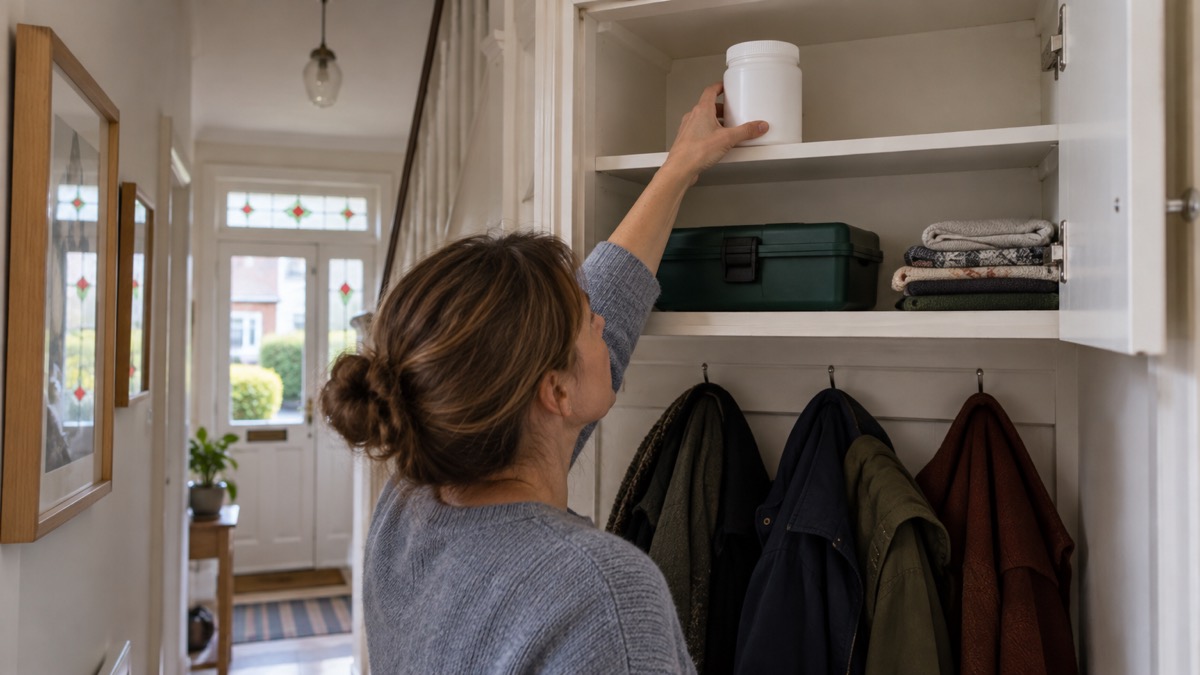
The wider official advice on storing chemicals at home is consistent: store medicines and chemicals safely and securely, keep products in their original containers, read labels and follow safety instructions, and dispose of unwanted medicines safely7. Fire services add that hazardous items such as cleaning supplies, chemicals and flammable liquids should be stored in secure containers away from heat sources8. A high cupboard, away from the boiler and away from anything that could get damp, meets both points.
The tablets are not flammable themselves, but the maker warns that contact with combustible material may cause fire, and that the product decomposes above 240 to 250°C with release of chlorine and other toxic fumes but no visible flame2. That is another reason to keep the tub away from heat, and away from anything that could smoulder.
Shelf life and when to replace it
The maker states that Purisaf tablets have an extended shelf life of up to 5 years1. That is a long time in emergency-kit terms, but it is not indefinite, and the date on the tub is the one that counts.
Official guidance suggests setting a reminder every six months to check expiry dates and swap out items that need replacing, or to update your kit if your circumstances change4. A six-monthly check is also a good moment to look at the tub itself: is the lid tight, is the label readable, has the tub been stored somewhere damp or hot? If the tablets have clumped, changed colour or the tub has been open and exposed, replace them rather than rely on them.
The same check applies to the rest of your water kit. A filter cartridge has its own working life once wetted, and the maker of one brand states a maximum of three months after first use6. Write both dates, the tablet expiry and the filter change date, on the same card inside the cupboard.
| Item | Working life | What to do at the six-monthly check |
|---|---|---|
| Purisaf tablets | Up to 5 years from the date on the tub1 | Check the date, the lid and the label; replace if in doubt |
| Filter cartridge (once wetted) | Maximum of three months6 | Note the date it was first used and replace on time |
| Test strips | Check the pot for its own date | Keep them dry and in date so the test means something |
Keeping it away from children and pets
The tablets carry the signal word WARNING and are classified as causing serious eye irritation2. Treat them as you would any household chemical: out of reach, out of sight, and in the original labelled container.
Official advice on child safety is consistent across the UK. The Keep Safe 6 rule used in Wales says to keep things out of reach and out of sight, including medicines, oils, vape liquids, perfumes and laundry products9. Fire services say to keep things that can cause fires out of children's reach10, and the Health and Safety Executive says to keep fuel out of the reach of children11. The same principle applies to a tub of chlorine tablets.
Pets matter too. Official food safety advice says to keep pets away from food and food preparation surfaces12, and the same separation applies to chemicals. Do not store the tablets where a pet could knock the tub down, and do not leave a part-used tub on a worktop.
If a child does swallow a tablet, do not wait for symptoms. The maker's safety datasheet says that if symptoms persist you should seek medical attention2. Keep the tub or the datasheet with you when you call.
Safety notices and recalls
The Office for Product Safety and Standards issues recalls and alert notices on its website13. That is the place to check whether a product in your home has been recalled, and it is worth a look whenever you do your six-monthly kit check.
The maker's datasheet sets out the hazards to know about. The product is an eye irritant and a respiratory irritant, and it is classified as hazardous to the aquatic environment2. It is not flammable itself, but contact with combustible material may cause fire, and it decomposes above 240 to 250°C with release of chlorine and other toxic fumes2. The transport classification is UN3077, class 9, packing group III, environmentally hazardous substance, solid2.
If you ever need to report a problem with the product, the maker's own product page and datasheet are the first place to check for current information1. For a safety concern about any household product, the Office for Product Safety and Standards issues recalls and alert notices on its website13.
Support and where to get help
Purisaf is a single-product line from Maclin Group, and the support you are most likely to need is information: the product page for dosing and shelf life, and the datasheet for hazards, first aid and storage1. Keep a copy of the datasheet with the tub, or note the UFI and the first aid instructions on a card inside the cupboard door.
For water emergencies, the official advice is to follow your water company and local authority. The government's Prepare campaign sets out what to do when the water supply is interrupted3, and the Be Ready campaign sets out the wider principle of knowing the hazards and having a plan4. For a flood, the London Fire Brigade advises being ready to turn off gas, water and electricity if possible5.
For household chemical safety, the maker's datasheet says to move a person to fresh air after inhalation and to seek medical attention if symptoms persist2. For product safety, the Office for Product Safety and Standards publishes recalls and alerts13.
If you are building a water plan from scratch, the Water in an Emergency guide sets out how much to store and how to treat it, and the Emergency Kit guide shows where water treatment fits alongside the rest of your kit. For the wider picture of how households prepare, see Getting Started.
Sources (13)
- Purisaf Water Purification Tablets 1000, Maclin Group, 2026-03-16
- Purisaf Chlorine Tablets datasheet DS183-PN557, Maclin Group, 2025-05-27
- Water supply interruptions or outages, Prepare campaign, 2026-10-12
- Be ready for emergencies, Be Ready campaign, 2026-10-21
- My street is flooding, London Fire Brigade, 2026-10-25
- Water Filter Purifier Soft Flask FAQs, LifeSaver, 2026-10-28
- Home accident prevention, Public Health Agency Northern Ireland, 2026
- Hoarding fire safety, Warwickshire County Council, 2026-10-29
- Poisoning and accidental swallowing, Aneurin Bevan University Health Board, 2026-10-29
- Reducing risks to children, Wiltshire and Swindon Prepared, 2026-10-25
- Staying safe with fire and explosion risks, Health and Safety Executive, 2026
- Food poisoning advice, Northumberland County Council, 2026-08-11
- Electrical items - Fire safety at home | London Fire Brigade, London Fire Brigade