
Orient Gene is the name on a range of COVID-19 rapid lateral flow test kits that were issued to households across the UK during the national testing programme. If you are looking it up because you have found a box in a cupboard, the first thing to know is that the official guidance covering these kits was updated on 30 April 2024 to remove information about ACON Flowflex, Orient Gene and SureScreen tests, because all test kits issued will have expired by now1. An expired test is not a reliable test.
That does not make the brand irrelevant to a household plan. Rapid tests are a small, cheap part of being ready for an outbreak: they let you find out quickly whether a cough or fever is COVID-19, so you can stay home and keep it away from others. The same skills apply to any test you buy in future: read the leaflet, take the swab properly, read the line at the right time, and know what a void result means.
This page covers what the tests do, how to use one, how to read a faint line, what to do with the result, and how to store and replace tests so they work when you need them. It does not rank Orient Gene against other makers.
What Orient Gene makes for UK households
Orient Gene's presence in UK homes came through the COVID-19 testing programme rather than through shops. The brand's household product is a single-use rapid lateral flow test: a sealed pouch, a swab, a small plastic cassette and a buffer liquid, with a leaflet.
For emergency planning, the useful way to think about it is as a diagnostic tool with a shelf life, not as durable kit. It does nothing during a power cut, a flood or a storm. Its moment is an outbreak: when several people in the house are unwell and you want to know whether it is COVID-19, a test taken early lets the household act sooner. The UK Health Security Agency continues to monitor COVID-19 variants, including highly divergent ones such as BA.3.2, a descendant of the Omicron BA.3 lineage that re-emerged in South Africa in late 2024 and has since been sporadically detected across multiple continents6. That is the context in which a household might want a test to hand.
Testing has also moved on. In Northern Ireland, home test kits can be requested through the official route, and the guidance sets out how a kit is delivered and collected7. Arrangements differ between the four nations, so check your own nation's public health website rather than assuming an old leaflet still applies.
Rapid lateral flow tests: what they do for a household
A rapid lateral flow test gives a result in the time it takes to make a cup of tea, without a lab. It detects proteins from the virus on a swab taken from the nose or throat, depending on the kit. The value to a household is speed and privacy: you can test at home, before deciding whether to visit an elderly relative, go to work, or send a child to school.
Lateral flow tests have been shown to work against variants. When Omicron emerged, a Suffolk public health release stated: "We know lateral flow tests are effective as detecting Omicron"8. That is a 2021 statement about a specific variant, but it establishes the principle that these tests are not tied to one version of the virus.
What a test cannot do is tell you that you are definitely free of infection. A negative result on the day you take it does not cover an infection you caught yesterday. That is why the timing of a test matters as much as the test itself, and why a household plan should include a small supply rather than a single kit.
| What the test gives you | What it does not give you |
|---|---|
| A result at home within minutes | Proof you are infection-free |
| A way to act quickly on symptoms | Any use in a power cut or flood |
| Privacy, no appointment needed | A result you can read after the stated time |
| A record you can show an employer or school if asked | A substitute for medical advice |
How to take a rapid test at home
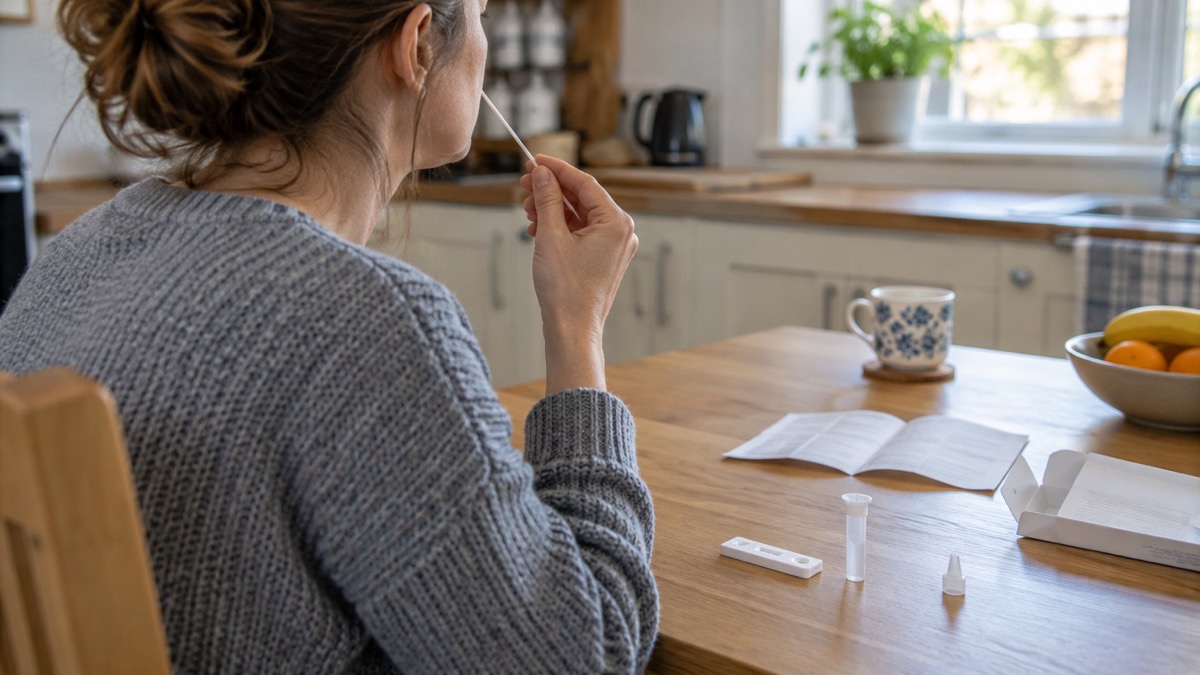
Read the leaflet in the box before you open anything. Official guidance is blunt about this: always follow the directions on medicine packets and information leaflets, and never take more than the stated dose9. The same discipline applies to a test: the timing of the swab, the number of drops and the reading window are all set by the maker, and improvising gives you a result you cannot trust.
The steps below are the common shape of a home rapid test. Your kit's leaflet overrides them where it differs.
- Wash your hands with soap and water and dry them. Set out the cassette, swab, buffer and leaflet on a clean surface.
- Blow your nose and swab as the leaflet directs, usually the nostrils or the back of the throat and nose. Note whether your kit is nose-only: official guidance describes, for example, the Getein Biotech test as a nose-only test with a teal and white pack1.
- Place the swab in the buffer tube and squeeze or stir as instructed, then add the stated number of drops to the cassette well.
- Start a timer and read the result only within the window the leaflet gives. A line that appears after the window is not a result.
- Record the result and the date, and dispose of the kit as the leaflet says.
If someone is collecting tests for you, official guidance says they will also need to give their name and address3. Keep the box and leaflet with the kit so the instructions stay with it.
Reading the result, including a faint line
A rapid test shows a control line to prove it worked, and a test line if it detects the virus. A faint test line is still a line: the leaflet will tell you whether any visible line counts as positive, and in most kits it does. Read the cassette in good light, at the time the leaflet states, and do not re-read it later.
If the control line does not appear, the test has not worked. The NHS describes this as an unreadable result, which some tests call a void result, and says it means it is not possible to say if you had COVID-19 when the test was done; do another test as soon as possible3. A void result is not a negative.
If you are unsure what you are seeing, take a photograph in daylight and compare it with the picture guide in the leaflet. If it still is not clear, treat it as void and test again.
What to do after a positive or negative result
A positive result is an instruction to act. Official guidance for Suffolk residents is clear: "If you have a positive COVID-19 test result you should try to stay at home and avoid contact with other people for 5 days after the day you took your positive test, even if you have no symptoms"2. Five days is the figure to plan around: it affects who does the shopping, who collects prescriptions, and whether a carer needs to be arranged.
A negative result with symptoms does not mean you are well. It means the test did not detect the virus at that moment. Rest, fluids and keeping away from vulnerable household members remain sensible, and if symptoms worsen, seek advice through NHS 111 or your GP.
For a household with someone at higher risk, a positive result is also the moment to check the medicine box. If you have a positive COVID-19 test result you should try to stay at home and avoid contact with other people for 5 days after the day you took your positive test, even if you have no symptoms10. If you need help while staying home, the Extra Help in an Emergency guide covers older, disabled and medically dependent households.
Storing tests in a home emergency kit
A test kit belongs in the household emergency kit, but in a dry, room-temperature place rather than a damp cupboard or a shed. Official guidance on the household emergency kit says it should be kept somewhere in the house where everyone can get to it if needed10. That is the right home for a box of tests: known to everyone, reachable without moving furniture.
Keep the kit together with the leaflet, and add a note of the expiry date on the box lid so nobody has to squint at small print in the middle of an illness. The wider Emergency Kit guide sets out what else belongs alongside it.
| Store it | Avoid |
|---|---|
| Dry, room-temperature cupboard | Damp bathrooms and sheds |
| Where everyone can reach it | High shelves and locked cupboards |
| With its leaflet and expiry date noted | Loose in a drawer without instructions |
| Away from children's reach | Beside cleaning chemicals |
Expiry dates and when to replace a test
The expiry date is the whole story with an issued kit. Official guidance was updated on 30 April 2024 to remove information about ACON Flowflex, Orient Gene and SureScreen tests, because all test kits issued will have expired by now1. If your box came from the national programme, it is past its date and should not be relied on.
Replace rather than hoard. A test that has sat in a warm cupboard for two years may give a false negative, which is worse than no test because it gives false reassurance. Set a reminder every six months to check expiry dates and swap out items that need replacing, or update your kit if your household needs have changed7. In Northern Ireland, home kits can be requested through the official testing page7.
Where a rapid test can mislead you
A rapid test is a snapshot, and snapshots mislead in predictable ways. The commonest is timing: testing too early, before the virus is detectable, gives a negative that feels like permission to carry on as normal. The second is reading outside the window, which can turn a negative into a faint positive or the reverse. The third is a void result treated as a negative: if your test result could not be read, it's not possible to say if you had COVID-19 when the test was done, and you should do another test as soon as possible3.
A fourth is an expired or badly stored kit. A test past its date, or one kept in a damp bathroom, may not perform as the maker intended. A fifth is a kit without proper marks: official product safety guidance says products sold in Great Britain may display CE marking, UKCA marking, or both, and advises buying from a reputable retailer4.
None of this makes tests useless. It makes them a tool to use carefully, alongside judgement about symptoms and contact with vulnerable people.
Safety notices and recalls
There is no recall of Orient Gene tests in the official notices available here. The recalls that do appear in official channels show the pattern to watch for: a product is withdrawn, the reason is stated, and owners are told what to do. A recent example is the recall of Hunter Price licensed hot water bottles, where the products were recalled as a precautionary safety measure because certain batches may pose a burns risk due to a weak joint at the top seam12.
Product safety notices also show why origin and traceability matter. A safety report on Pimple Popping Squishes containing needles sold via AliExpress lists the country of origin as unknown13. For a test kit, the equivalent check is the maker's name, the batch number and the marks on the box.
Support and where to get help
If a test result leaves you unsure what to do, the first call is your GP or NHS 111. For households in Scotland, NHS Inform carries advice on infections and symptoms14. For anyone in the Western Isles, the local resilience guidance lists support contacts, including Food Support (Western Isles) on 01851 600501 and Western Isles Women's Aid on 01851 70475015.
For a household managing illness alongside a power cut, flood or storm, the Health Emergencies guide covers outbreaks and medicine supplies, and Staying Informed and in Touch covers how to keep in contact when the usual routes fail. If you are building a kit from scratch, start with Getting Started.
Sources (15)
- COVID-19 self-test help, GOV.UK, 30 April 2024
- Seasonal winter safety advice, Suffolk Fire and Rescue Service, 29 October 2026
- COVID-19 rapid lateral flow test, NHS, 3 March 2025
- Product safety campaigns, Peterborough City Council, 29 October 2026
- Lithium batteries, Surrey County Council, 28 October 2026
- Should we be worried about the current COVID-19 variants, UK Health Security Agency, 8 October 2026
- Testing for COVID-19, Public Health Agency Northern Ireland, 29 November 2024
- Health bosses urge book your booster as Omicron uncertainty prompts Plan B, Suffolk County Council, 10 December 2021
- What should you have in your medicines box, Leicester, Leicestershire and Rutland ICB, September 2025
- Household emergency kit, nidirect, 6 July 2026
- Chemical safety in the home, nidirect, 14 April 2026
- Product Recall: Hunter price licensed hot water bottles (2311-0157) - GOV.UK, GOV.UK
- Product safety report: Pimple Popping Squishes containing needles sold via AliExpress, GOV.UK, 9 October 2026
- Your Health Guide Winter 2025-6, NHS Western Isles, December 2025
- Resilience, NHS Western Isles, 28 October 2026