
Lifeventure is a UK outdoor and travel equipment maker whose products are light, compact and built to be carried, which is exactly the profile that suits household emergency kit. The three products documented on its own pages are the Thermal Blanket, the Water Filter Purifier Soft Flask and the Titanium Kettle. Each does a job a UK household needs in a power cut, a flood evacuation or a night away from home: staying warm, carrying drinkable water and boiling it1.
This page sets out what those products do, how they fit into a grab bag alongside the items official guidance tells you to keep ready, how to store and care for them so they work when needed, and where to turn for support, warranty cover and recall information. The maker's own specifications are used throughout, alongside official UK guidance on emergency kits from the Met Office, the Prepare campaign, fire and rescue services and councils.
What Lifeventure makes for UK households
Lifeventure's range is aimed at travellers and campers, and that design brief happens to match what an emergency grab bag demands: kit that is light enough to carry, small enough to store, and functional without mains services. The products documented by the maker cover three of the core needs in UK official guidance on emergency kits: warmth, water and the ability to heat food and drinks.
The Thermal Blanket is a lightweight, compact blanket which, when wrapped around the body, reflects and retains over 90% of radiated body heat. The maker describes it as windproof, waterproof and lightweight, built from strong, flexible metallised polyester materials, and it carries DofE Recommended Kit certification. It is also highly visible and radar reflective, which matters if you are ever waiting for help outdoors1.
The Water Filter Purifier Soft Flask is a soft bottle with a built-in purification filter, available in 500ml and 1000ml sizes. The Titanium Kettle is a camping kettle with folding handles, an easy pour spout and a ventilated lid, made from ultra-lightweight food-grade titanium, and it includes a drawstring mesh bag2.
Where each of these fits your wider preparations is covered in the site's guides to emergency kit, water in an emergency, heating and cooking without mains power and first aid. If you are starting from nothing, begin with getting started, because a single blanket or flask is only useful as part of a plan.
Towels and quick-drying travel kit
Quick-drying fabric kit earns its place in a grab bag because it can be used, wrung out and packed again the same day, and because it does not stay damp in storage. That last point matters more than most people expect: NHS inform in Scotland warns that dirty and damp dishcloths are the perfect place for bacteria to breed, and advises washing dishcloths and tea towels regularly, letting them dry before use, and washing them using the hot cycle of your washing machine7. The same hygiene logic applies to any fabric you store away for an emergency. Pack it dry, or you will unpack something musty and possibly mouldy when you need it most.
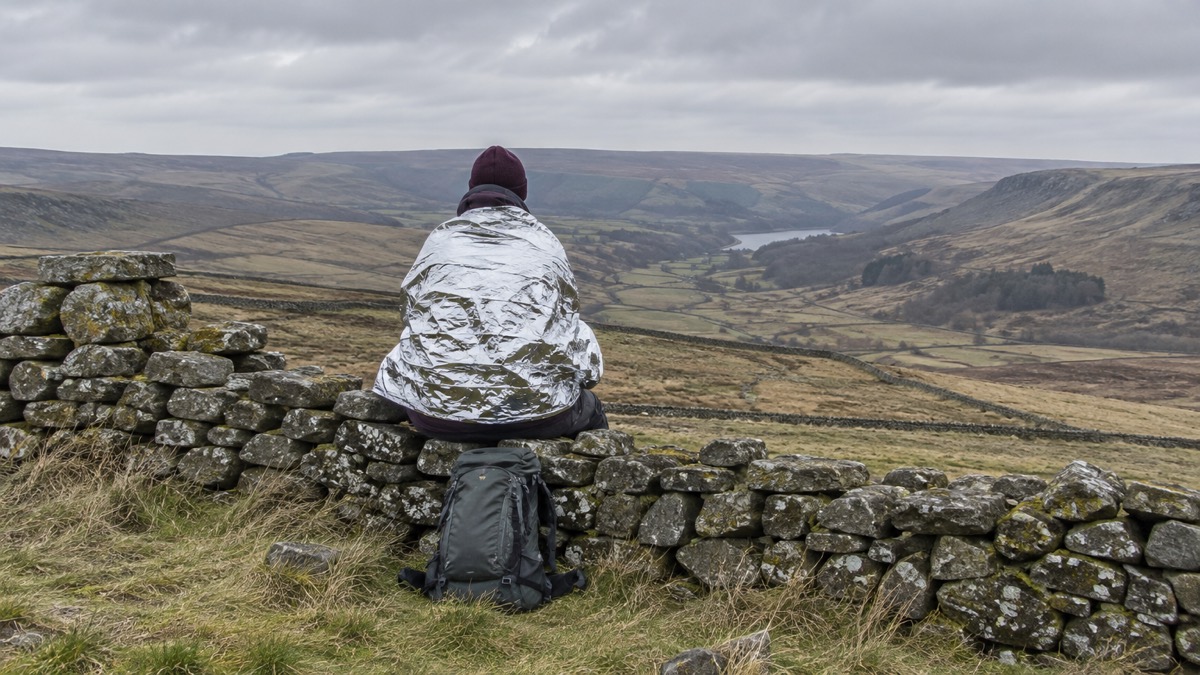
On the drying side, the maker's own fabric-adjacent product in the documented range is the Thermal Blanket, made from strong, flexible metallised polyester materials rather than absorbent cloth1. Metallised material does not soak up water the way a cotton towel does, which is why this style of blanket packs down small and shakes dry. It is a retention layer, not a comfort layer: it works by reflecting radiated body heat back towards you, and the maker states it retains over 90% of that heat when wrapped around the body1.
For a household putting together a grab bag, the practical combination is a thermal blanket for warmth plus ordinary quick-drying items for hygiene. A towel that dries quickly takes up little room and lets you keep the rest of the bag dry after use. The emergency kit guide covers the full list of what to keep ready.
Flasks and bottles for keeping drinks and water to hand
Carrying water is the single most repeated piece of official advice for UK emergencies, in both hot and cold scenarios. The Prepare campaign's hot weather guidance is to drink plenty of fluids and take a refillable bottle filled with water when going out8. NHS guidance for warm weather says to carry a refillable water bottle with you9, and the Government's Beat the Heat advice adds taking extra water for journeys on public transport or by car10. In cold-weather and power-cut scenarios the advice flips to warmth: one council power-cut tip is to boil some water and keep it in a thermos flask, so you can make hot drinks or fill a hot water bottle if it gets cold11. Neath Port Talbot's emergency kit checklist likewise lists ready-to-eat food, a warm drink in a flask and bottled water if you have to leave your home12.
The Lifeventure Water Filter Purifier Soft Flask covers the water side of this. It is a durable BPA-free soft flask with a built-in filter, available in 500ml and 1000ml sizes, with the 500ml measuring 60 x 70 x 245mm2. You can drink purified water directly through the filter, or squeeze water through the filter to decant it into another bottle or container, which is useful when you need to fill a larger container for a household rather than one drinker2.
| Specification | Water Filter Purifier Soft Flask |
|---|---|
| Sizes | 500ml and 1000ml2 |
| Dimensions (500ml) | 60 x 70 x 245mm2 |
| Filter capacity | Up to 250 litres per cartridge2 |
| Bacteria removal | 99.9999% (E.Coli, Salmonella, Dysentry)2 |
| Virus removal | 99.99% (Rotavirus, Norovirus, Hepatitis A)2 |
| Protozoa removal | 99.9% (Giardia, Cryptosporidium, Amoebae)2 |
| Also filters | Particulates including microplastics, sediment and silt; chemicals including chlorine, benzene and chloroforms; heavy metals including lead, arsenic and chromium2 |
| Filter life indicator | Built in, tracks when the filter needs replacing2 |
| Leak prevention | Twist valve and cap protects the drinking spout2 |
The filter uses what the maker calls Disruptor electro-adsorptive technology for fast flow2. Treat the removal figures as the maker's own published specifications, and remember what a filter flask is for: making available water drinkable when you cannot rely on the tap. It does not replace storing bottled water, which appears on every official grab bag list, and the water guide explains how much to store and how to keep it safe.
For hot drinks, the Titanium Kettle boils water on any suitable heat source, and a thermos flask then holds that water hot for later, as the power-cut guidance suggests3. If you are boiling water outdoors at a barbecue or camp stove, Cheshire Fire and Rescue Service advises keeping a bucket of water or sand nearby for emergencies13. The heating and cooking guide covers safe ways to heat food and drinks without mains power, and the heatwaves guide covers the hot-weather side.
Dry bags and waterproof storage for documents and kit
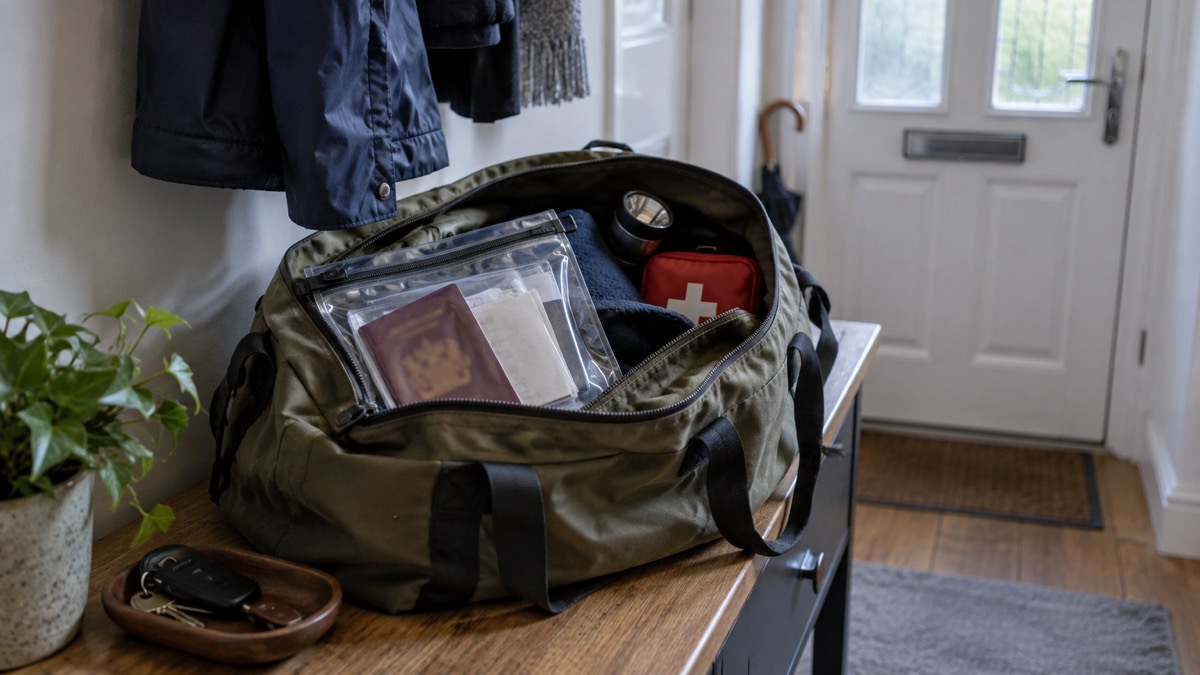
Waterproof storage is the least glamorous part of an emergency kit and one of the most important, because the items most easily ruined by water are the ones hardest to replace: passports, driving licences, insurance documents and birth certificates. The Prepare campaign's flooding guidance is explicit: move sentimental or valuable items upstairs or keep them in a high place such as the top shelf or drawer of a cabinet, and store important documents such as birth certificates in resealable water-tight plastic bags to help protect them from water damage5.
Flood preparation guidance takes the same approach for the home: move sentimental or valuable items upstairs or keep them in a high place such as the top shelf or drawer of a cabinet, and store important documents such as birth certificates in resealable water-tight plastic bags to help protect them from water damage5. Doing both, sealing the paper and lifting it above flood level, is what keeps documents readable when water gets in.
A practical arrangement for a household is:
- Resealable water-tight plastic bags for birth certificates and other paper originals, stored high as well as sealed5
- A dry bag for the whole kit, so one grab carries everything at once
- Copies rather than originals in the grab bag where you can, with originals kept somewhere safe and high5
Test your seals before you rely on them. Close the bag, squeeze it gently and feel for air escaping; look for grit or stiffness in the zip strip, because dirt stops a zip seal closing fully. The flooding guide covers the fuller flood preparations, including what to move where and when, and the lighting guide covers the torch side of the grab bag.
Sleeping liners and bedding for a night away from home
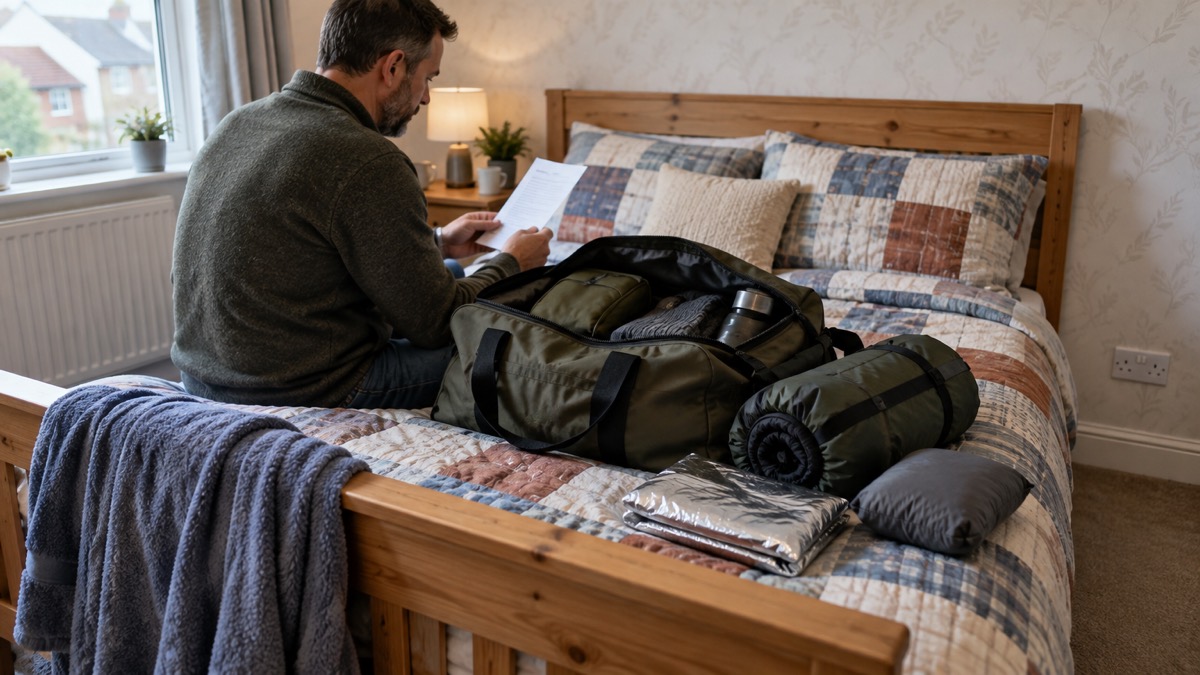
If an emergency sends you out of your home at short notice, official guidance assumes you may need to sleep somewhere else with your own bedding. Fareham Borough Council's advice for chemical accidents is blunt: get an overnight bag ready as you may be evacuated14. The Be Ready household emergency plan tells households to keep blankets, sleeping bags and warm clothing15, and the Met Office's winter preparation advice is to have blankets and thick clothes ready and easily accessible to keep everyone in the household warm11. Scottish Borders' resilience advice adds that having additional blankets or duvets to hand helps keep you warm both sitting and in bed16.
The Lifeventure Thermal Blanket is the lightest-weight answer in the maker's documented range: windproof, waterproof, lightweight, and retaining over 90% of radiated body heat when wrapped around the body1. It is a retention layer for an emergency, not a substitute for a proper sleeping bag, so pair it with the bedding your household already owns. If anyone in your household needs specialist equipment, Devon and Somerset Fire and Rescue Service notes that fire retardant bedding packs usually contain a duvet, pillow, duvet cover, pillowcase and fitted sheet, and are recommended for particular circumstances17.
Two safety points belong alongside any discussion of bedding and sleeping arrangements. First, clear the floor around beds and along escape routes: Staffordshire's falls prevention advice is to remove trip hazards such as loose rugs, cables and clutter [39 in the site's guides, see the falls prevention source], which matters doubly at night in an unfamiliar room. Second, if anyone in your household is deaf or hard of hearing, Cheshire Fire and Rescue Service and Surrey Fire and Rescue Service both advise placing vibrating pads under a pillow or mattress, so a smoke alarm can wake them in an emergency18. Pack those pads with the bedding, not separately, so an evacuation night does not become an unsafe one. The extra help guide covers planning for households that need additional support.
Packing Lifeventure kit into a grab bag
A grab bag is the container official guidance keeps coming back to, and its contents list is remarkably consistent across UK sources. The Met Office's winter advice is to put together a grab bag with bottled water, medicines, a torch, radio and batteries, copies of important documents and a change of clothes, in case you have to leave home quickly or your power and water are disrupted4. Its WeatherReady campaign gives the same list20. Basingstoke and Deane Borough Council goes further, listing a wind-up torch or torch with spare batteries, bottled water, non-perishable food and snacks, spare glasses and hearing aid batteries, spare car and house keys, spare phone chargers or a small battery pack, spare pet supplies, a written list of key contacts, a first aid kit, spare clothes, blankets, toiletries, hand sanitiser, baby formula, nappies and wipes, children's entertainment, and a wind-up or battery-powered radio21.
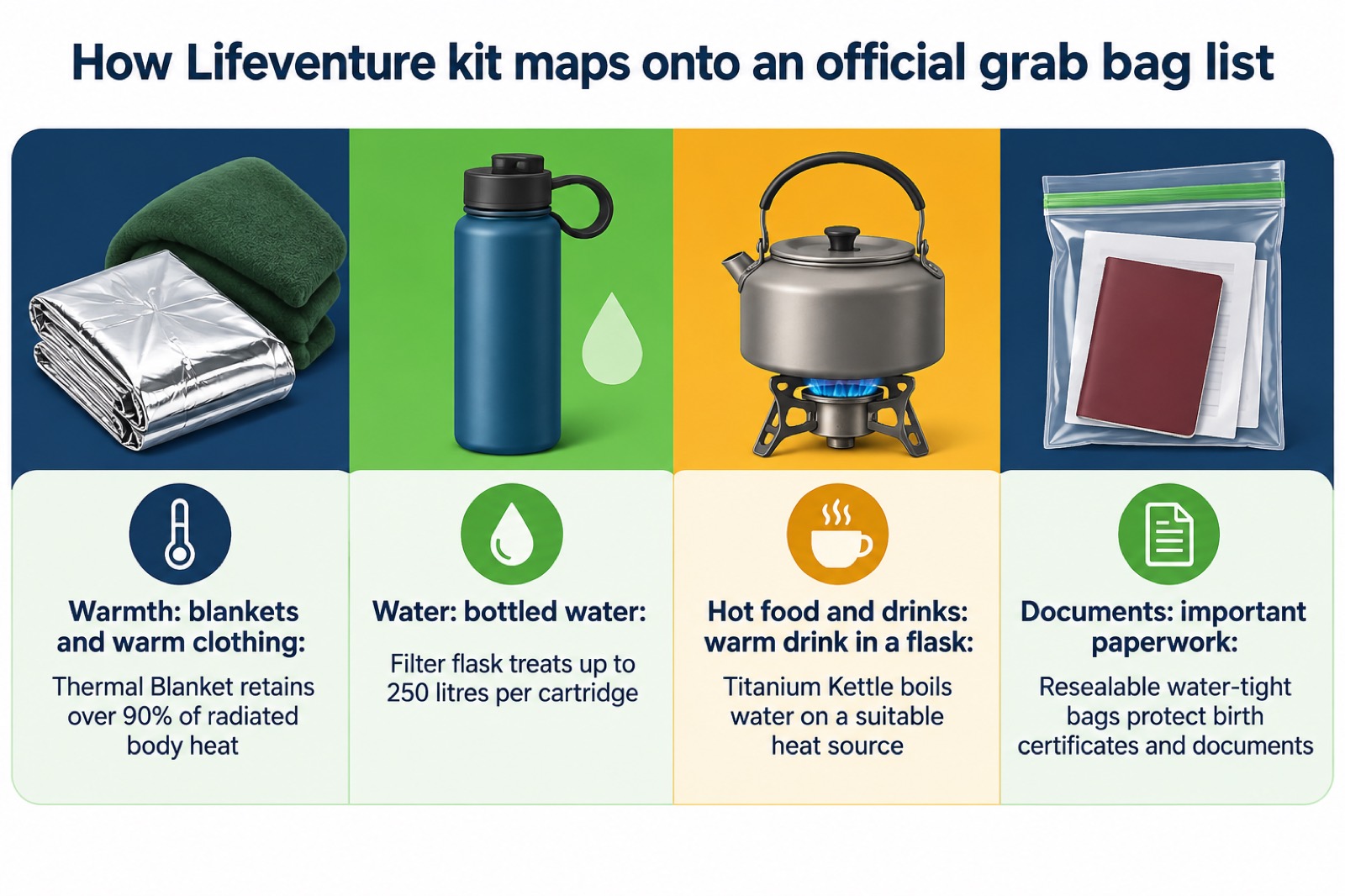
Where the Lifeventure kit slots in:
| Grab bag item (official lists) | Lifeventure kit that serves it |
|---|---|
| Blankets and warm clothing15 | Thermal Blanket, windproof and waterproof, retains over 90% of radiated body heat1 |
| Bottled water4 | Water Filter Purifier Soft Flask as a back-up that treats up to 250 litres2 |
| Warm drink in a flask12 | Titanium Kettle to boil water for a thermos3 |
Central Bedfordshire Council advises that a grab bag should be kept in either a box or waterproof bag that can be accessed quickly22, and the Prepare campaign's flooding guidance says to store the bag somewhere you can easily get to5. If you have pets, Medway Council's pet grab bag list adds a lead or carrier for every animal, any medications they need, pet food, vaccination certificates, litter, paper towelling or bedding, and toys, stored in an easy to reach place23; North Yorkshire Fire and Rescue Service's storm advice likewise says to put together a grab bag with food, insurance documents and any other essentials your pet may need24. The pets and animals guide covers that in full, and the storms and snow guide covers the weather events most likely to send you to the bag.
Storing and caring for kit so it is ready when needed
Kit you cannot find in a hurry is kit you do not have. Nottinghamshire Council's advice is that keeping a bag of items you might need in an emergency is a great way to be ready to react, and that you may want to keep an emergency kit in your car and your home, or just a list of where to find the items25. The nidirect guidance for Northern Ireland makes the same point about location: if you are at home and an emergency happens, try to gather some essential items before you leave the property, and to make this easier, keep such items in the same place within the home26. Pick one place, tell everyone in the household where it is, and keep it there.
Care for the kit itself in three habits:
- Dry everything before storing. NHS inform's warning that damp cloth breeds bacteria applies to anything fabric you pack away7. Wash on a hot cycle where the item allows, dry fully, then store.
- Track the filter. The soft flask's built-in filter life indicator exists so you do not have to guess when the cartridge, rated at up to 250 litres, is due for replacement2. Check it when you pack the bag and again at your regular kit check.
- Check seals and closures. Squeeze-test dry bags and document wallets, and inspect zip strips for grit and stiffness, before each check rather than after each use.
Central Bedfordshire Council also advises keeping a vehicle emergency kit ready in your vehicle for incidents where you are stranded for a long period unexpectedly, whether because of traffic or weather22. A thermal blanket and a filter flask are well suited to a car kit, since both are light and compact1. Slough's guidance for evacuation sites adds that at an evacuation site you should have, or be able to readily obtain, food, water, veterinary care, handling equipment and generators if necessary [58 in the sources], which is a reminder that a grab bag covers the first hours, not the whole incident. The emergency kit guide has the full storage and checking routine.
Support, warranty and returns
For the maker's water filtration products, the published warranty terms come from the LifeSaver Wayfarer user manual. LifeSaver provides a 2-year limited warranty for defects in materials and workmanship for all products purchased directly or via authorised partners27. In case of defects within this period, you return the product with proof of purchase to the original retailer, and LifeSaver will at its discretion repair, replace or refund27. The manual also states that customers bear the initial transport or shipping costs to the UK factory, with LifeSaver covering return shipping, and that beyond this document LifeSaver gives no further warranties, promises or representations27.
The practical takeaways for a household are simple. Buy from a retailer or channel you can return to, because the warranty runs through the original retailer. Keep the proof of purchase somewhere you can find it, ideally with the grab bag inventory rather than in a shoebox. And note the maker's contact point for its filtration products: the manual directs customers to www.iconlifesaver.com27. For Lifeventure's own product pages, lifeventure.com is the maker's site, and each product page there carries the current specifications and availability.
For the filter flask specifically, the maker describes it as easy to clean with replaceable parts2, and the Wayfarer manual lists its own replaceable components, including a replaceable activated carbon disc and a replaceable ultrafiltration cartridge27. Replacement parts extend the life of the product well beyond a single filter cycle, which is what makes a filter flask a reasonable long-term investment for a household kit rather than a one-trip item.
Safety notices and recalls
No recall affecting the Lifeventure products documented on this page appears in the material available here, but recalls in this general category of goods do happen, and the official advice is to check rather than assume. London Fire Brigade's product recall campaign puts it plainly:
"The most important thing you can do is to regularly check if your appliances have been recalled."
using the Government's product recall site, the manufacturer's website or Electrical Safety First's recall register6. Peterborough City Council's trading standards team notes recent examples in outdoor-adjacent equipment: the Office for Product Safety and Standards has issued product recalls on 21 different life vests, and there have been recent product recalls on 15 different types of climbing harnesses due to serious safety concerns28. Safety-critical outdoor equipment is recalled when faults are found, so build a recall check into your regular kit review.
One further safety point applies to any modern emergency kit: much of it contains lithium-ion batteries. South Wales Fire and Rescue Service notes that these rechargeable batteries are found in mobile phones, vaping devices, e-bikes and scooters, vacuum cleaners, tablets, iPads and ear pods29. If your grab bag includes a power bank or any device with a rechargeable battery, store and charge it according to the maker's instructions, and do not leave it charging unattended. The backup power guide covers safe use of battery packs and chargers in more depth.
Sources (29)
- Lifeventure Thermal Blanket product page, Lifeventure, 2026
- Lifeventure Water Filter Purifier Soft Flask product page, Lifeventure, 2026
- Lifeventure Titanium Kettle product page, Lifeventure, 2026
- 10 things you should do now to prepare for winter, Met Office, 2026
- Flooding: be informed about hazards, Prepare campaign, 2026
- Total recalls: making white goods safer, London Fire Brigade, 2026
- Preparing and cooking food safely, NHS inform, 2025
- Hot weather advice, Prepare campaign, 2026
- Warm weather advice, West Midlands Ambulance Service NHS Foundation Trust, 2026
- Beat the heat: staying safe in hot weather, UK Government, 2026
- 12 tips to prepare for a power cut, Horsted Keynes Parish Council, 2026
- NPT Prepared emergency kit checklist, Neath Port Talbot Council, 2026
- Barbecue fire safety, Cheshire Fire and Rescue Service, 2026
- Major incidents and hazardous substances, Fareham Borough Council, 2026
- Be Ready Household Emergency Plan, Be Ready campaign, 2026
- Be more resilient in 30 simple ways in 30 days, Scottish Borders Council, 2026
- Equipment for carers, Devon and Somerset Fire and Rescue Service, 2026
- Smoke alarms, Cheshire Fire and Rescue Service, 2026
- Smoke alarms and detectors, Surrey County Council, 2026
- Top tips to be WeatherReady, Met Office, 2026
- Emergency preparedness, Basingstoke and Deane Borough Council, 2026
- Emergency kits and grab bags, Central Bedfordshire Council, 2026
- Looking after your pets in an emergency, Medway Council, 2026
- Stay safe during Storm Babet, North Yorkshire Fire and Rescue Service, 2023
- Preparing for an emergency, Nottinghamshire County Council, 2026
- Household emergency kit, nidirect, 2026
- LifeSaver Wayfarer user manual, LifeSaver, 2026
- Product safety campaigns, Peterborough City Council, 2026
- Lithium-ion batteries guidance, South Wales Fire and Rescue Service, 2026