
Lakeside Flood Solutions is a UK supplier of flood protection equipment for homes, and the thing to understand before you contact it is that the kit is only half of what is on offer. The company's model, as with any serious flood gate supplier, starts with a free site survey and risk assessment: someone looks at your doors, air bricks and thresholds and works out where water would get in before anything is quoted. Only then does the question of a gate, a barrier or a supply-only order arise.
That order matters. Official guidance is clear that the first step in flood preparedness is checking whether your property is at risk at all, by postcode search on the flood maps or by asking your council for site-specific surface water information1. If you are at risk, the sensible next step is a proper survey: guidance for households in flood risk areas suggests considering a chartered surveyor to show where flood water might enter, how fast it will flow and where it could cause the worst damage2. A maker's own survey does the same job for its own products.
This page covers what Lakeside makes and supplies, how its surveys, installations and supply-only orders work, what you should receive at handover, what the warranty and annual check involve, and who it supplies across the UK. It does not quote prices, and it does not rank one maker's kit against another's. For the household side of flooding, from warnings to clean-up, start with Flooding: A Household Guide.
What Lakeside Flood Solutions makes and supplies
Lakeside sits in the part of the flood protection market that supplies physical barriers for individual properties: gates and boards that close off a doorway, covers and seals for air bricks, and the associated frames and fittings that hold them in place. These are the products that decide whether water reaches your skirting boards or stops at the threshold.
The range of what exists in this market is worth knowing before you talk to any supplier. Official guidance describes flood doors, air bricks and hydrosacks, and notes that some flood protection products can be in place permanently while others need to be installed when flooding is expected2. That single distinction, permanent or deployable, is the most useful question you can ask about any product on a quote.
- Permanent fittings stay on the building all year and need no warning time to deploy. They suit a door you use every day and a household that may be away when water arrives.
- Deployable fittings are put in place when flooding is expected. They need storage space, a warning, and someone fit enough to fit them in the time available.
- Ancillary items such as air brick covers and seals close the other openings that water uses.
For the household view of what to buy and how to choose between types, see Flooding: A Household Guide. Floodline can also give useful information about buying flood protection equipment, alongside up-to-date flood warnings and advice7.
Flood gates: design, supply and installation
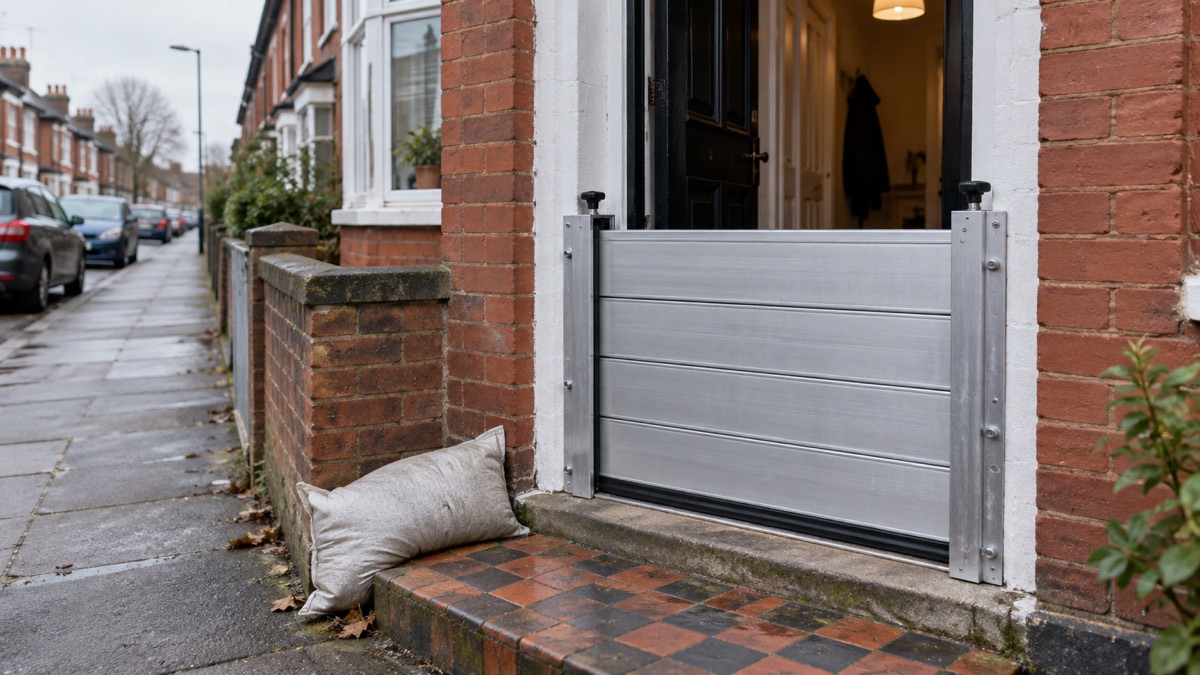
A flood gate is a barrier across a doorway that seals against the frame, and the design question that matters most is how it seals. The most basic method, described in official damage limitation guidance, is a strong wooden or metal barrier secured flat against the wall or frame surrounding a door or window, with the pressure of floodwater itself helping to seal the barrier8. That principle, water pressing the barrier tighter against its seal, is what a well-designed gate is doing.
Around that principle sit the details that decide whether a gate works in your house: the frame it fixes to, the threshold it sits on, the depth of water it is rated for, and whether it can be left in place or must be fitted on the day. Ask for the rated depth and the test evidence for the exact model quoted.
Installation is where a good product most often fails. A gate is only as watertight as the frame and seal around it, and the work involves cutting, fixing and sealing into an existing wall. That is why the survey comes before the quote, and why the handover and the annual check described below are part of the product rather than an extra.
A free site survey and risk assessment comes first
The survey is the point at which a generic product becomes a plan for your house. It should establish where water would enter, which openings need protection, what depth the property faces, and which of those openings can practically be protected at all. Guidance for households in flood risk areas recommends considering a chartered surveyor's flood survey for exactly this: where flood water might enter, how fast it will flow and where it could cause the worst damage2.
Before any of that, confirm you are in a flood risk area. Derbyshire County Council's advice is that the first step to flood preparedness is checking whether your property or workplace is at risk, by postcode search on the flood maps for planning or by contacting the council for site-specific surface water flood risk information1. In Wales, the Flood Risk Assessment Wales map also shows all the areas covered for free flood warnings and alerts10.
If your property has flooded before and you want to know why, your council as Lead Local Flood Authority may be able to carry out a flood investigation to identify the cause and whether the risk could be reduced in future11. That investigation, plus a survey, gives you a far better brief than a photograph of a wet carpet.
- Check the map by postcode, or ask the council for site-specific surface water information1
- Register for warnings so you have advance notice while you decide3
- Ask about a flood investigation if the property has flooded before12
- Book the survey and ask what it covers, who carries it out and whether it is free
Installed or supply only: how each order works
There are two ways to buy flood protection, and they suit different households. An installed order means the supplier surveys, supplies and fits, and takes responsibility for the finished barrier. A supply-only order means you or your own builder fit the kit, which can suit a household with a trusted contractor, a new build, or a property outside an installer's area.
| Installed | Supply only | |
|---|---|---|
| Survey | Carried out by the supplier before quoting | May be limited or charged separately; ask |
| Fitting | By the supplier's own fitters | By your builder or contractor |
| Responsibility for the seal | With the supplier | With you and your fitter |
| Handover and demonstration | Part of the order | Ask what is provided |
| Best suited to | Households wanting a finished, warranted barrier | Households with their own contractor, or outside a fitting area |
Whichever route you take, the same physical facts apply. Some products can be in place permanently, others need to be installed when flooding is expected2. A supply-only buyer takes on the deployment question themselves: where the boards are stored, who fits them, and how long it takes in the dark with water already in the road.
If you are fitting your own, the official fallback for a warning is worth knowing: block doors with floodboards if available, and air vents with plastic sheeting and sandbags14. The same instruction is published in Welsh by Mid and West Wales Fire and Rescue Service14. That is the improvised version, not a substitute for a fitted barrier, but it is what the fire service tells households to do when a warning arrives and nothing better is in place.
Options for locking and concealment
Two practical questions come up at every survey: how the barrier is held in place, and how much of it you can see when it is not in use.
On locking, the mechanism has to do two jobs. It must hold the barrier tight against its seal before any water arrives, and it must stay tight as pressure builds. Ask how the gate is locked or clamped, whether the fixings are accessible from inside only, and what happens if the lock is operated while the gate is under load.
On concealment, the choice is between a fitting that is visible all year and one that sits flush or recessed when not deployed. Lakeside offers discreet concealment with durable powder coating and covers2, and its air brick covers can be recessed into the opening or face-mounted to the exterior wall3. Deployable boards store away but must be found and fitted. Neither is better in the abstract; it depends on whether anyone is reliably at home when a warning comes.
Official guidance lists the options households are choosing between: flood gates or flood sacks, specialist doors, and seals for air bricks15. If you are weighing these up for your own property, Flooding: A Household Guide sets out the household view, and Storms, Snow and Ice: A Household Guide covers the weather that most often brings the water.
Handover: your O&M manual, demonstration and training
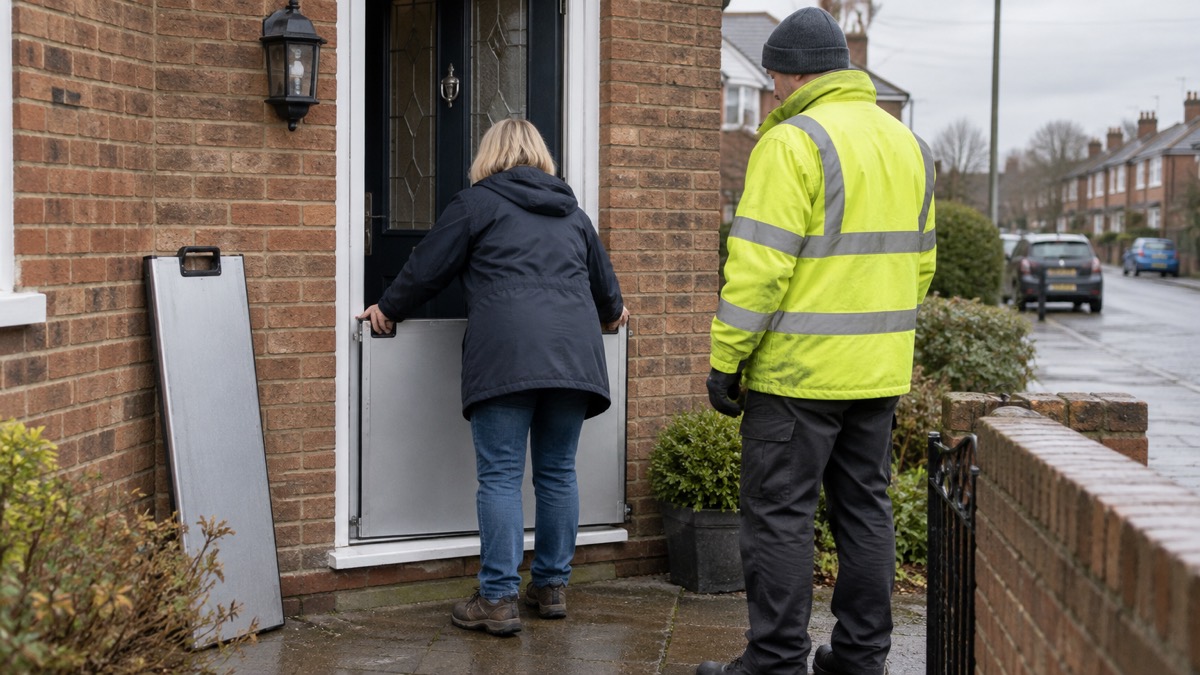
A flood barrier is equipment you may not use for years and then need to fit correctly in the dark. Handover is where that gap is closed, and it should not be rushed.
Ask for the operation and maintenance manual for your specific installation, a demonstration of fitting and removing the barrier, and a chance for everyone who might need to fit it to practise. If the household includes someone who would struggle with the weight or the fixings, say so at the survey rather than at handover.
Training is not a formality in this field. The Devon Pathfinder community resilience project built its flood warden training around six modules: an introduction to flood risk issues, the role of emergency services, the use of sandbags, the role of a flood group, health and safety risks awareness, and Personal Protective Equipment16. A household handover is a smaller thing, but the same principle applies: knowing the risks and having the right protection to hand is part of being ready.
Keep the paperwork with your household emergency documents. Official advice for London households is to have medicines and insurance documents to hand when flooding is expected17, and the O&M manual belongs in the same folder. Flood wardens are advised to keep a stock of emergency flood packs and rain ponchos, and to keep a record of training completed and next due dates18; a household can borrow that habit for its own barrier.
Warranty and the annual maintenance check
Seals, frames and fixings degrade, and a barrier that was watertight when fitted may not be years later. The annual check is the mechanism that keeps the warranty meaningful, so ask three questions before you order: what the warranty covers, how long it runs, and whether an annual inspection is a condition of it.
The wider principle is familiar from home safety. Landlords are advised to make sure appliances and flues are kept in good order and checked for safety at least once every 12 months19, and tenants are prompted to ask whether there is a regular maintenance programme for gas heaters and appliances, and whether chimneys and flues are cleaned and checked regularly20. Flood barriers are not gas appliances, but the logic is identical: equipment that protects life and property is checked on a schedule, not remembered in an emergency.
Put the annual check in the diary at handover, and record the date. If you sell the property, the manual and the maintenance record are part of what the next owner needs.
Who Lakeside supplies in the UK
Flood protection is arranged differently across the UK, and it is worth knowing which body covers your postcode before you buy.
Floodline, the Environment Agency's service, provides flood warnings and advice and runs a 24-hour service7. In Wales, Natural Resources Wales runs its own free flood warning service giving advance notice of river and sea flooding13, and the Flood Risk Assessment Wales map shows the areas covered10. Northern Ireland has separate arrangements, and there the Homeowner Flood Protection Grant pays 90 per cent of the survey and estimated installation costs, up to a maximum grant, with a homeowner typically paying a share of the overall costs depending on the size and type of property6.
For local reporting, councils and water companies take different routes. In the North East, for example, published contacts include Newcastle Council on 0191 278 7878 (ask for Envirocall), Northumberland Council on 0345 600 6400, Northumbrian Water on 0800 328 7648 and the Environment Agency on 0345 988 1188, with 999 for immediate danger22. Your own council's flooding pages will list its equivalents.
- England, Scotland and Wales: Floodline, provided by the Environment Agency, on 0345 988 11884
- Wales: Natural Resources Wales free flood warning service13
- Northern Ireland: Homeowner Flood Protection Grant, 90 per cent of survey and installation costs, up to a maximum grant6
- Local reporting: your council and water company, with 999 for immediate danger22
If you are starting from scratch rather than buying kit, Getting Started: Preparing Your Household for an Emergency sets out the order to do things in, and Community Resilience: A Guide for Neighbours and Local Groups covers the group schemes that often share equipment and training.
Sources (22)
- Personal responsibility, Derbyshire County Council
- Preparing for a flood, Natural Resources Wales
- Preparing for flooding, Surrey County Council
- Groundwater flooding, GOV.UK, 2023
- Flood preparedness, Southend-on-Sea City Council
- How to protect your home from flooding, nidirect
- Preparing for flooding, Somerset Council
- Damage limitation guide, Dover District Council, 2001
- Flooding and health: public advice, GOV.UK, 2024
- Check your flood risk on a map: Flood Risk Assessment Wales, Natural Resources Wales
- Flood Recovery - Next steps, Nottingham and Nottinghamshire Local Resilience Forum
- Natural Resources Wales / Preparing for a flood, Natural Resources Wales
- Flood risk in Anglesey: be prepared, Isle of Anglesey County Council, 2013
- Flooding advice, Mid and West Wales Fire and Rescue Service
- Flooding, West Yorkshire Prepared
- Devon Pathfinder community resilience flood report, Devon County Council, 2020
- Be flood aware, London Assembly
- Be flood ready: guidance for flood wardens, Harborough District Council
- Student and rented accommodation safety, North Yorkshire Fire and Rescue Service
- Landlord responsibilities, Greater Manchester Fire and Rescue Service
- https://www.suffolk.gov.uk/roads-and-transport/flooding-and-drainage/report-a-flood-in-suffolk, Suffolk County Council
- Northumbria Local Resilience Forum, Northumberland County Council