
Fireblitz is a British maker of fire fighting equipment, best known for its refillable fire extinguishers. Its range covers the extinguisher types a UK household is most likely to need: water, ABC dry powder, AFFF foam, carbon dioxide and wet chemical, plus fire blankets, fire buckets, stands, covers, trolleys and signage, and automatic fire suppression units for engine compartments1. Every extinguisher in the range is refillable, which matters for a household because it means the unit is designed to be serviced and refilled rather than replaced each time it is discharged or reaches the end of its service life1.
If you have arrived here because you own a Fireblitz extinguisher or fire blanket, or you are considering one, this page sets out what the maker produces, which fires each type of extinguisher is suited to, where fire kit belongs in your home, how to use it safely, and when to stop fighting a fire and get out. Fire and rescue services are clear on the last point: get out, stay out and call 9992. An extinguisher is for a small, contained fire in its early moments, and only if you can tackle it while keeping a clear escape route behind you.
What Fireblitz makes for UK households
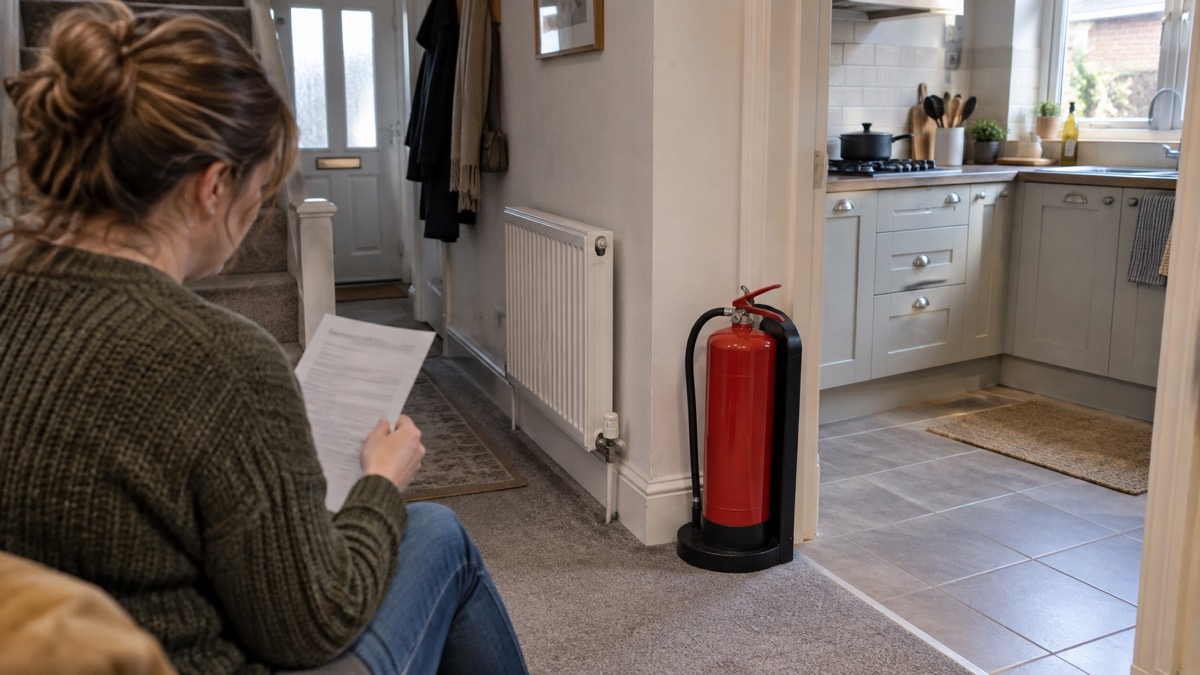
Fireblitz's product range falls into four groups that matter to an ordinary household. The first is extinguishers: refillable water, ABC dry powder, AFFF foam, carbon dioxide and wet chemical models, sold in sizes from small domestic units up to commercial and industrial capacities1. The second is fire accessories: fire blankets and buckets, extinguisher stands, covers and trolleys, and signage, which are the bits that keep extinguishers visible, protected and where they should be1. The third is marine and vehicle equipment: a marine range of ABC dry powder, AFFF foam and water extinguishers, and automatic fire suppression units commonly used to protect machinery, plant and boat or vehicle engine compartments1. The fourth is the wet chemical range aimed at cooking oil fires, including a model accredited to EN3 by BSI and Kitemarked4.
For a household, the practical starting point is not the brand but the risk. Fire and rescue service guidance divides fires into six classes, A to F, and states plainly that there is no single type of fire extinguisher that can deal with all types of fire3. So the right Fireblitz product depends on what is most likely to burn in your home: solids such as furniture and textiles, flammable liquids, electrical equipment, or cooking oil and fat in the kitchen. The sections below take each in turn.
Fire safety kit sits alongside the rest of your household preparations. The government's Be Ready checklist includes a torch and spare batteries, blankets, sleeping bags and warm clothing as part of a household emergency kit5, and fire kit belongs in the same plan. Our emergency kit guide covers the whole picture, and our home emergencies guide covers fire, carbon monoxide, gas leaks and burst pipes together.
Fire extinguishers: which fires each type is for
Devon and Somerset Fire and Rescue Service explains that there are six types of fires, divided into classes from A to F, and that an ABC fire extinguisher is one suitable for extinguishing fires in the A, B and C categories3. It also notes there are four common types of fire extinguisher, each containing different substances to deal with different types of fire, and repeats the warning that no single type can deal with all of them3. Fireblitz's range maps onto those classes as follows.
| Fireblitz type | What it is for | Where it fits at home |
|---|---|---|
| Water | Class A fires: solids such as wood, paper, textiles and furniture | Living rooms, bedrooms, hallways; the maker describes these as suitable for many commercial and industrial applications1 |
| ABC Dry Powder | Classes A, B and C: solids, flammable liquids and gases | The maker states these are suitable for use in the home, office, vehicles, boats and many commercial and industrial settings1 |
| AFFF Foam | Solid and flammable liquid fires, with a film that smothers the burning surface | Garages, workshops and vehicles; part of the marine range1 |
| Carbon Dioxide | Flammable liquid and electrical equipment fires; leaves no residue | The maker describes these as suitable for many commercial and industrial applications1; suits home offices and electrical equipment |
| Wet Chemical | Class F cooking oil and fat fires | Kitchens; the maker's wet chemical range is for use on cooking oil fires4 |
Two points deserve emphasis. First, water and foam conduct electricity, so neither should be used on electrical equipment; carbon dioxide or dry powder are the electrical choices. Second, the kitchen is where a wet chemical extinguisher earns its place, because a chip pan or deep fat fryer fire cannot be put out with water. Fireblitz's wet chemical range is described by the maker as a refillable wet chemical extinguisher for use on cooking oil fires, and its FBWC6 model is accredited to EN3 by BSI and Kitemarked, with a controlled discharge and a 5-year warranty4.
The maker notes its wet chemical extinguishers are aimed at fast food outlets, fish and chip shops, restaurants and other catering establishments1, which tells you the standard they are built to; the same class of fire happens in domestic kitchens, and the class F rating is what matters. If you keep only one extinguisher at home, fire and rescue guidance points most households towards a general-purpose type for the rooms where fires start, with a fire blanket in the kitchen for oil fires. Our home emergencies guide goes into the risks room by room.
Fire blankets: what they do in a home
A fire blanket is a simple piece of woven, fire retardant fabric that puts out a small fire by smothering it, cutting off the air. Devon and Somerset Fire and Rescue Service describes them as good for extinguishing chip pan fires, and for wrapping around someone whose clothing is on fire3. Northern Ireland Fire and Rescue Service advises households to think about having a fire blanket in the kitchen for emergencies and to follow the instructions supplied with it6. Fireblitz sells fire blankets as part of its fire accessories range, alongside buckets, stands, covers and signage1.
The two uses are different, and both are worth practising mentally before you ever need them. For a pan fire, you hold the blanket by its corners, turn slightly away so your hands and face are behind it, and lay it over the pan to starve the fire of oxygen; the fire retardant weaving is what allows the blanket to sit over flames without itself catching3. For a clothing fire, you wrap the blanket around the person and have them stop, drop and roll. Warwickshire's guidance for thatched homes, where fire spread is a particular concern, is to keep a fire blanket just inside the kitchen door and make sure all of your family know how to use it7, and that advice holds for any home.
A fire blanket is not the same as the foil blankets in a first aid or emergency kit. The NHS lists an aluminium blanket in a first aid kit because it retains body heat in emergencies and is essential for first aid and survival8; that is a casualty blanket for keeping someone warm, not a fire blanket for smothering flames. Both are worth having, for different reasons, and our first aid guide covers what else belongs alongside the foil blanket.
Where to keep fire safety kit at home
Fire kit only works if you can reach it in the first seconds of a fire, and that shapes where it lives. The general rule from emergency planning guidance is to keep a kit in a safe place at home where you can reach it easily, in a waterproof bag9, and Wiltshire Council advises storing an emergency kit near an exit to your home, such as by the front door or under the stairs, so it can be easily grabbed10. For fire kit specifically, that means between the hazard and the door, never so deep in a cupboard that you have to cross a burning room to reach it.
The kitchen needs its own thinking. Manchester Fire and Rescue Service advises keeping door and window keys accessible but avoiding keeping them in the kitchen, because that is where most fires in the home start, and making sure everyone knows where the keys are11. Cornwall Fire and Rescue Service says the same in simpler terms: keep door and window keys where everyone can find them12. Apply the same logic to the extinguisher and blanket: a blanket just inside the kitchen door7, and an extinguisher on its stand or wall bracket near, but not inside, the room it protects.
A few placement rules worth following:
- Keep the fire blanket just inside the kitchen door, where every family member knows how to use it7
- Keep extinguishers on a stand or wall bracket, visible, not buried in a cupboard1
- Keep door and window keys on hooks or in boxes where everyone can find them, away from the kitchen11
- Keep grab bags upstairs or near your door, so they can be reached in the dark or in smoke13
- Put a reminder of what to do in a fire somewhere it will be seen regularly, like the fridge door14
For households that keep a wider emergency kit, the same storage rules apply: near an exit, waterproof, reachable in seconds10. Our emergency kit and lighting guides cover torches and lighting for when the power is out, which is often when fire risks rise, for example if people reach for candles. North Yorkshire Fire and Rescue Service reports that candles cause over 800 fires in UK homes every year15, which is a good reason to keep a torch as the first reach, not a flame.
Using an extinguisher safely
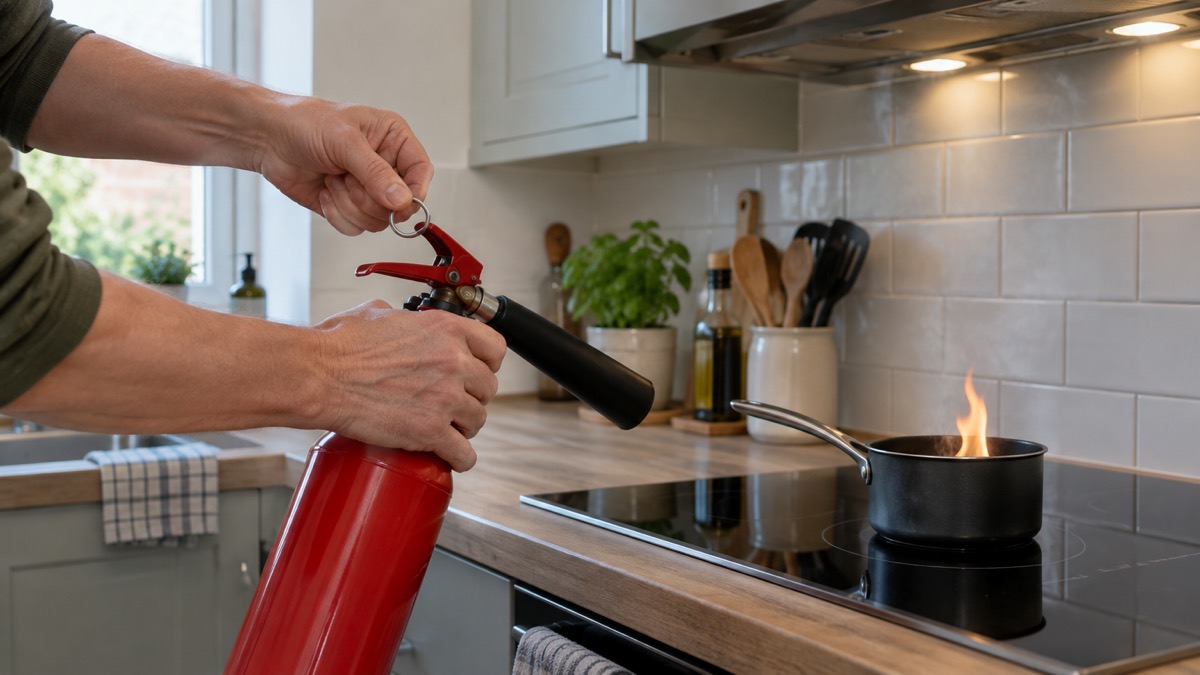
An extinguisher is for a small fire in its first moments, with your escape route behind you. Before you use any extinguisher, check the class of fire against the class on the extinguisher's label, because using the wrong type can make a fire worse: water on an electrical fire is a shock risk, and water on an oil fire is explosive3. Fireblitz's FBWC6 wet chemical extinguisher has a controlled discharge4, which means it releases its contents in a managed way rather than in one violent burst, giving you a usable burst length to sweep across the burning surface.
The basic method, which applies to Fireblitz's refillable models as to any extinguisher, is to pull out the safety pin, aim at the base of the flames rather than the smoke, squeeze the handle and sweep side to side, keeping yourself between the fire and the door. Read the instructions on your specific model before you need it, as Northern Ireland Fire and Rescue Service advises for fire blankets6, and the same habit applies to extinguishers. If you live in a flat, Manchester Fire and Rescue Service's flat safety guidance is part of the same picture: know your escape plan and keep keys accessible11.
One habit worth building is a family walk-through. Surrey's home fire action plan advice is to practise your escape plan regularly and keep door and window keys where everyone you live with can find them16, and Staffordshire Fire and Rescue Service suggests putting a reminder of what to do in a fire somewhere it will be seen regularly, like the fridge door14. Walking to the extinguisher and the blanket, and talking through who does what, takes minutes and is the difference between kit that is used and kit that is stared at.
When to leave and call 999
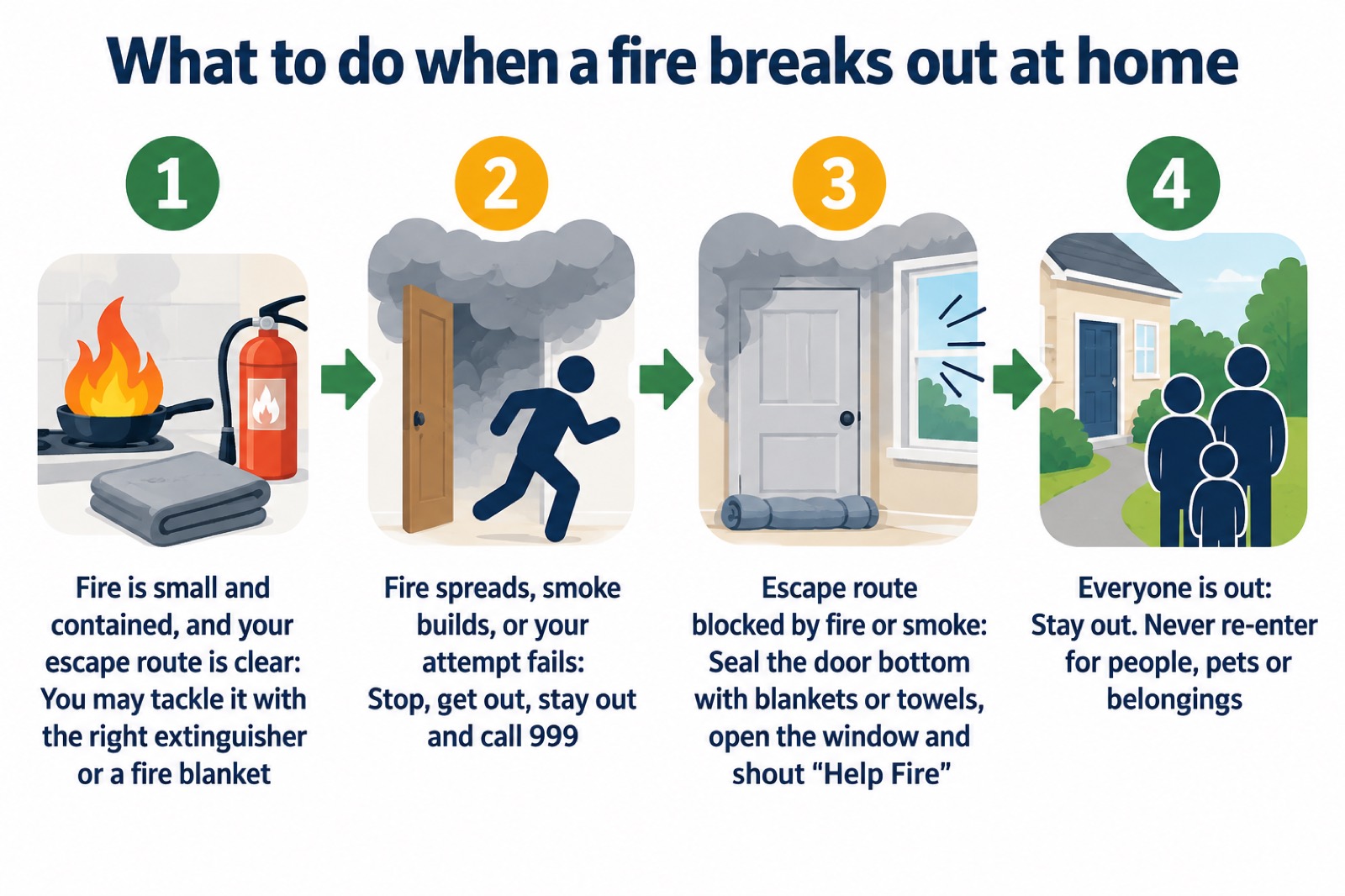
The fire and rescue services' message is short and repeated everywhere: get out, stay out and call 9992. An extinguisher or blanket is for a fire you can put out in seconds. If the fire is spreading, if the room is filling with smoke, if your escape route is compromised, or if the first attempt does not work, stop fighting the fire and leave. Never go back inside for belongings, pets or anything else once you are out.
If you cannot escape because fire or smoke blocks your route, Devon and Somerset Fire and Rescue Service's guidance for people who need more time or help is to put blankets or towels around the bottom of the door to block out the smoke, then open the window and shout "Help Fire"17. That advice is written for carers and people with hearing difficulties, but the principle of sealing a door and signalling from a window applies to anyone trapped by smoke.
Households that include someone who would need extra time or help to escape should plan for that in advance. Our extra help guide covers the arrangements for older, disabled and medically dependent households, and many fire and rescue services offer home fire safety visits that will look at exactly this with you.
Checking and looking after your kit
Fireblitz's extinguishers are refillable1, which is the key fact for maintenance: a discharged or ageing unit is meant to be refilled and serviced, not binned. The maker gives a 5-year warranty on the FBWC6 wet chemical extinguisher4, and the same model is accredited to EN3 by BSI and Kitemarked4, meaning it is independently tested against the European extinguisher standard. Follow the service instructions supplied with your own model for intervals, and keep the paperwork.
A simple routine keeps everything honest:
- Check each extinguisher is in its place, unobstructed, with the pin and tamper seal intact
- Check the pressure gauge, where your model has one, against its marked zone
- Check the fire blanket is in its holder by the kitchen door and that everyone still knows where it is7
- Note the warranty and any service dates, and set a reminder4
- Keep your first aid kit up to date so you can respond quickly and confidently if someone is burned or hurt8
The NHS's advice on first aid kits, that keeping your first aid kit up to date ensures you can respond quickly and confidently8, applies equally to fire kit: a check twice a year, at the same time as you check your smoke alarms, is enough for most households. When you register or make a claim on any piece of safety equipment, Fire and Rescue guidance on appliance registration says you will typically need the model name or number, the serial number and the purchase date18, so keep those details together with your household paperwork.
Safety notices and recalls
No Fireblitz recall or safety notice appears in the material available to this page, so there is nothing to act on here at the date of checking. That does not remove the general duty to stay informed. If a fire safety product in your home is recalled, the notice will name the model and serial numbers affected, which is why keeping those details to hand matters18. Check the maker's product pages for current notices when you service your kit.
The wider safety points around fire kit come from the fire and rescue services rather than the maker. Northern Ireland Fire and Rescue Service's summer safety advice is to ensure barbecues are fully extinguished and cold before disposing of them, and to remember that alcohol consumption increases the risk of accidents occurring19, both of which bear on when household fire kit gets used. Scottish Fire and Rescue Service's electrical safety guidance covers registering appliances so you can be contacted if a fault emerges18, and its wildfire guidance on storing flammable materials in an approved safety container, in a fire resistant building of metal or brick or a garage20, is relevant if you keep fuels or gases at home.
Fireblitz support and warranty
Fireblitz gives a 5-year warranty on its FBWC6 wet chemical extinguisher4. For warranty claims, servicing and refills, go to the retailer or fire safety service company that supplied the unit, with your proof of purchase and the model name, serial number and purchase date18. Because the extinguishers are refillable1, a service company can discharge-test, refill and re-certify a unit, which is the normal route for keeping a Fireblitz extinguisher in service beyond its first discharge.
For boat and vehicle owners, the maker states its marine range meets the recommendations of the Royal Yachting Association and the British Waterways Joint Boat Safety Scheme1, which is the certification framework your boat surveyor or insurer will ask about. The automatic fire suppression units, commonly used to protect machinery, plant and boat or vehicle engine compartments1, are fitted rather than handheld, so installation questions go to the supplier or installer.
Kit for cars, caravans and boats
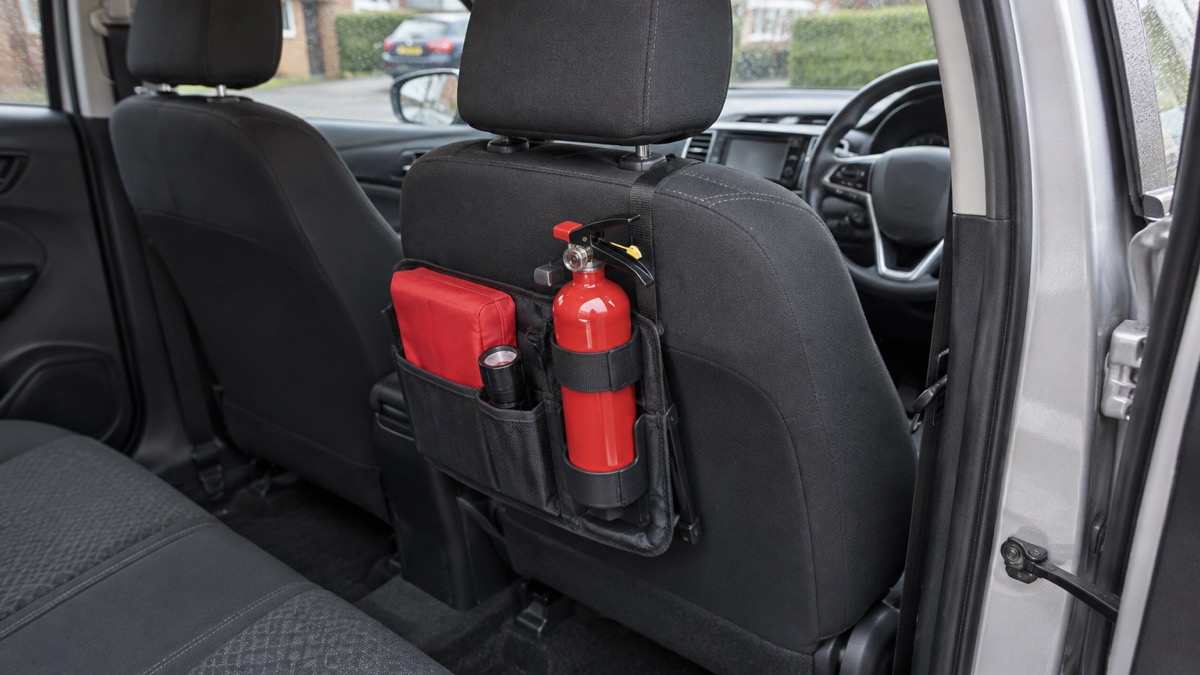
Fireblitz's marine range covers ABC dry powder, AFFF foam and water extinguishers suitable for use in the home, office, vehicles, boats and many commercial settings1, and its automatic suppression units suit engine compartments in boats and vehicles1, which includes caravan and motorhome engine bays. A small dry powder unit stored where it can be reached from the driver's seat is the usual choice for a car, and the same type suits a caravan's living space.
Fire kit belongs inside the wider car emergency kit. Ready Scotland's advice on what to keep in the car includes battery jump leads, a reflective warning sign, a map, a snow shovel, and some food and a warm drink in a flask21, and Wiltshire's emergency kit list includes spare keys for your windows, car and house10. A fire extinguisher and a foil blanket slot naturally into that bag; the NHS notes an aluminium blanket retains body heat in emergencies and is essential for first aid and survival8. Our storms and snow guide covers winter car kit in more detail.
Where this fits in your household plan
Fireblitz's products cover one part of a household's readiness: the equipment for the first seconds of a fire. Around it sit the smoke alarms that warn you, the escape plan that gets you out, and the emergency kit that carries you through whatever follows, from a power cut to a flood. The government's Be Ready checklist brings the torch, blankets and warm clothing together5, and Harborough's flood grab bag advice to keep it upstairs or near your door13 applies to any emergency that means leaving quickly.
The pages that follow from here are the practical ones: home emergencies for fire, carbon monoxide and gas, first aid for burns and casualties, emergency kit for the whole household bag, and getting started if you are beginning from nothing. Whatever kit you keep, the fire and rescue services' instruction is the one to remember above all: get out, stay out and call 9992.
Sources (21)
- Fireblitz extinguishers and fire equipment range, Fireblitz, 2022-05-26
- Fire safety, Manchester Fire and Rescue Service, 2026-10-29
- Fire safety equipment in the home, Devon and Somerset Fire and Rescue Service, 2026
- Fireblitz FBWC6 Wet Chemical Extinguisher, Fireblitz, 2020-01-28
- Be Ready Checklist, UK Government Be Ready campaign, 2026
- Student fire safety at home, Northern Ireland Fire and Rescue Service, 2026-09-15
- Thatched roof fire safety, Warwickshire County Council, 2026-10-29
- What should I keep in my first aid kit?, NHS, 2026-10-25
- Get prepared: emergency planning, Carmarthenshire County Council, 2026-10-28
- Planning for an emergency kit, Wiltshire Council, 2026-10-29
- Know your escape plan: flat safety, Manchester Fire and Rescue Service, 2026-10-29
- Escape plan, Cornwall Fire and Rescue Service, 2026-10-29
- Resident grab bags, Harborough District Council, 2026-10-29
- Plan your escape, Staffordshire Fire and Rescue Service, 2026-10-29
- Candle safety, North Yorkshire Fire and Rescue Service, 2026-03-09
- What to do if fire breaks out: action plan, Surrey County Council, 2026-08-24
- Fire safety for people with hearing difficulties, Devon and Somerset Fire and Rescue Service, 2026
- Electrical safety at home, Scottish Fire and Rescue Service, 2025-02-27
- Simple steps to stay safe this summer, Northern Ireland Fire and Rescue Service, 2025-06-23
- Wildfires: be prepared, Ready Scotland, 2026-05-12
- Emergency kit, Ready Scotland, 2026-10-29