

DeWalt is a power tool maker whose cordless kit runs on rechargeable lithium-ion batteries. For a UK household preparing for emergencies, that matters in three places: cordless tools for repairs after a storm or flood, battery work lights and torches for a power cut, and the batteries and chargers that keep both working. The same batteries that make the tools useful are also the part that needs the most care, because lithium-ion batteries can start fires if they are charged, stored or disposed of badly.
The practical answer is straightforward. Keep a charged torch or work light where you can reach it in the dark, keep spare batteries, and charge everything while you are awake and alert so you can respond if something goes wrong1. Charge on a hard, flat, heat-resistant surface, away from extreme heat, cold, direct sunlight and flammable materials2. Never put a damaged or end-of-life battery in household waste or normal recycling, because crushed or punctured batteries can cause fires in bin lorries and waste centres3. Register your tools and batteries so the manufacturer can reach you about a fault or recall3.
This page covers what DeWalt kit does for a household in an emergency, how to keep it ready, how to charge and store batteries safely, and where to get support. It does not cover prices, and it does not compare DeWalt with other makers.
What DeWalt makes for UK households
DeWalt's relevance to a household plan comes from one design idea: a shared battery platform. The same rechargeable battery pack is designed to power a range of cordless tools, lights and chargers, so a household that already owns DeWalt kit has a pool of stored energy it can move between jobs. The batteries inside cordless power tools are lithium-ion, the rechargeable type that also ranges from mobile phones, vaping devices, e-bikes and scooters, through vacuum cleaners and tablets, to ear pods5.
For emergency preparedness, that gives three broad groups of kit:
| Kit group | What it does in an emergency | Where it fits |
|---|---|---|
| Cordless tools (drills, saws, drivers) | Boarding up, temporary repairs, making safe after a storm or flood | Repairs before and after an incident |
| Work lights and torches | Light for a room, a stairwell or a repair job during a power cut | Lighting when the mains fails |
| Batteries and chargers | Store and replenish the energy the other two groups run on | Keeping everything ready |
None of this replaces the basics of an emergency kit. Official household kit lists include a charged portable power bank and charging cables, a torch and spare batteries, and spare keys for your windows, car and house6. DeWalt kit sits alongside those items: it is the heavier, more capable end of the same idea, useful when a job needs power rather than light.
The rest of this page takes each group in turn, then covers the safety rules that apply to all of them, and finally support, warranty and recalls.
Cordless tools for emergency repairs
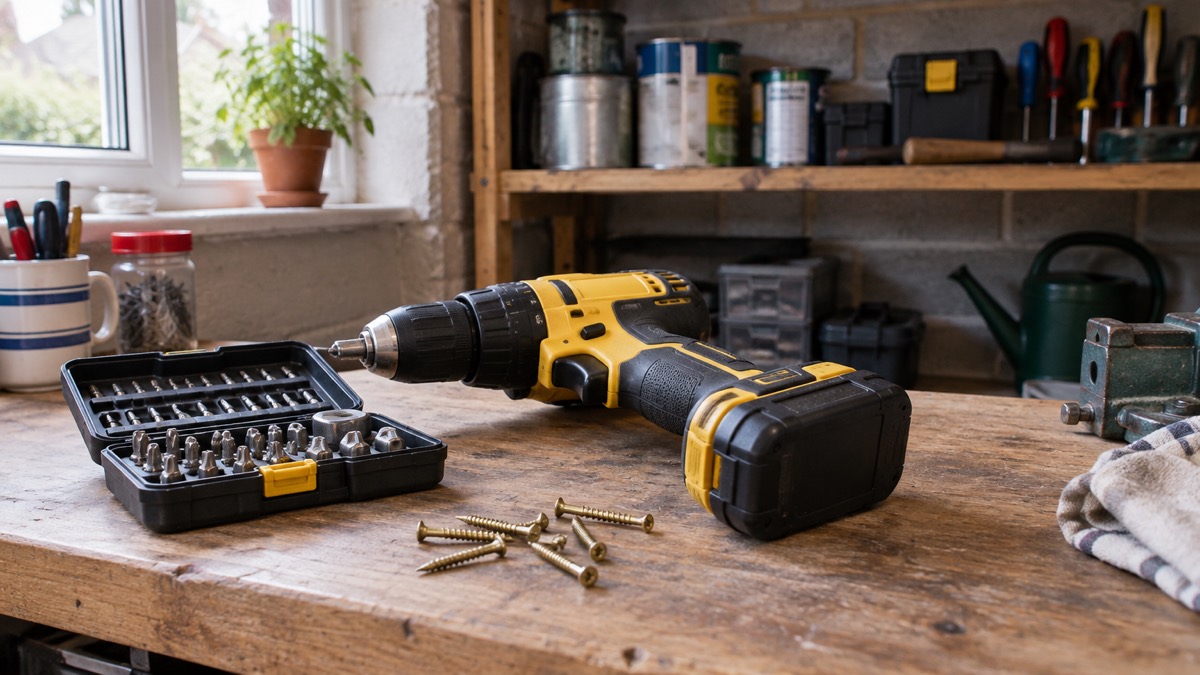
A cordless drill or driver earns its place in a household plan at the points where the mains is off, the light is poor and something needs fixing now. That is the situation after a storm or flood, when a fence panel is loose, a board needs fixing over a broken window, or a temporary repair has to hold until a tradesperson can get there. Because the tool carries its own battery, it works when the power is out and it works outdoors away from a socket.
The limits are worth being clear about. A cordless tool is only as useful as the batteries you have charged and the accessories you have to hand. A drill with a flat battery is a paperweight, and a driver with no bits will not turn a screw. Treat the tool, its batteries and its consumables as one kit: charge the batteries before winter, keep a set of bits and a few screws and fixings with the tool, and check it before the storm season rather than during it.
Official winter preparation advice for vehicles makes the same point in a different setting: make sure your battery is fully charged and replace it if it is no longer reliable9. The principle carries over to tool batteries. A battery that will not hold charge is not a spare, it is a liability, and it should be replaced rather than kept "just in case".
Cordless tools also have a role in the wider household plan. Official kit lists include spare keys for windows, car and house, and hygiene items such as toiletries, hand sanitiser and wet wipes7. A cordless driver is what lets you use a spare key or fit a temporary lock, board or fixing when the usual arrangements have failed. For the wider list, see Emergency Kit: What a UK Household Should Keep Ready.
Work lights and torches for a power cut
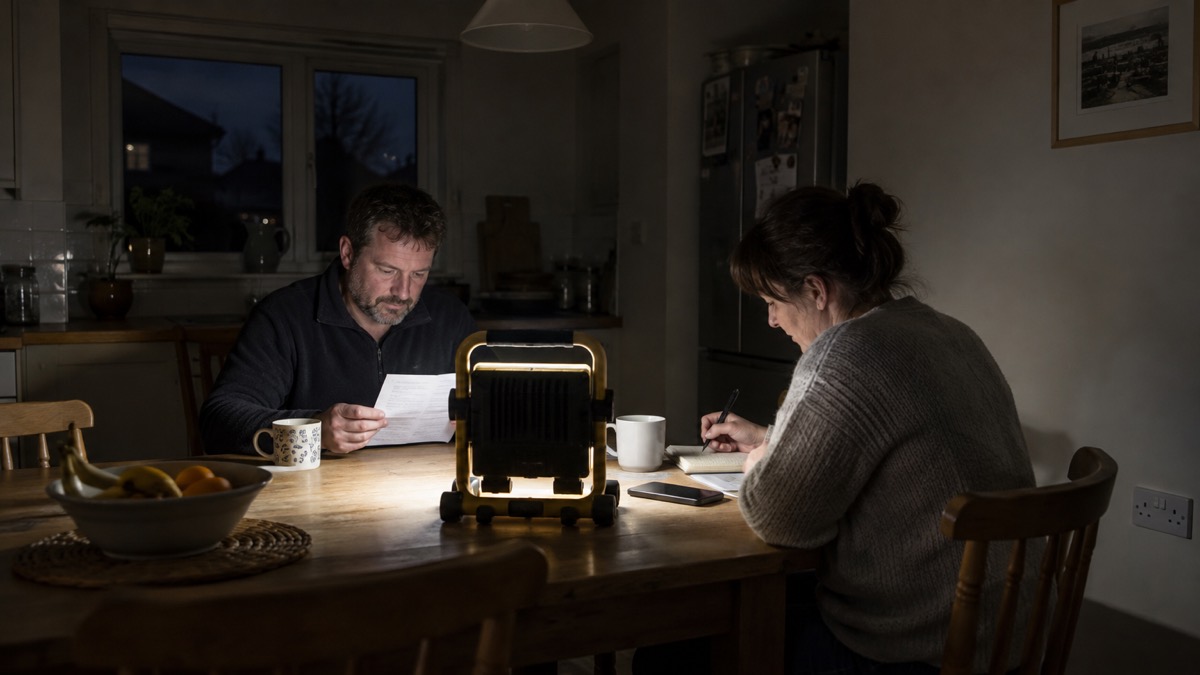
Light is the first thing a household notices when the power goes. Fire and rescue services are consistent on what to use: during a power cut, use battery-operated lights or torches as an alternative light source11. Lancashire's preparedness team advises keeping a battery operated torch, power bank and spare batteries ready12, and NHS winter advice says to have torches handy around the home and keep spare batteries somewhere convenient13. The London Fire Brigade's winter guide simply says keep a fully charged torch handy14.
A DeWalt work light or torch fits that advice directly. It runs on the same battery platform as the tools, so a household that already has batteries has a light source that can be recharged rather than thrown away. The practical points are:
- Keep one light loaded and charged. A torch with a flat battery is no better than no torch.
- Keep spare batteries charged. Official advice for people who rely on battery-powered devices is to keep a spare battery fully charged15.
- Put a light where you will find it in the dark. A power cut usually happens without warning, and a light in a drawer you cannot see is not much help.
- Think about hands-free light. For households caring for a child or an adult who needs help, chargeable lamps and headtorches are useful because they leave your hands free for care, and official advice is to get these before an outage rather than during one16.
For the wider question of what to keep and how to use it, see Emergency Lighting at Home: Torches, Lanterns and Candles and Power Cuts: A Household Guide.
Batteries and chargers: keeping the kit ready
The battery is the part of the kit that decides whether any of it works. Fire and rescue services give one instruction that covers almost everything: always follow the manufacturer's instructions for using, charging, storing and disposing of rechargeable batteries2. For DeWalt kit, that means the instructions that come with the battery and charger, not a general rule of thumb.
Keeping the kit ready comes down to a routine:
- Charge before the risk, not during it. Charge batteries ahead of storm season and winter, and top up anything you rely on for light or communications.
- Charge while you are awake and alert. Essex Fire and Rescue Service says to charge your device while you are awake and alert so if a fire should occur you can respond quickly1. Oxfordshire gives the same advice for e-bike and e-scooter batteries: charge while you're awake and at home18.
- Use the correct charger. South Wales Fire and Rescue Service lists "use the correct charger" among its battery advice19.
- Check for damage. Follow the manufacturer's charging instructions and regularly check the battery and charger for damage20.
- Keep a spare. Official advice for people who depend on battery-powered devices is to keep a spare battery fully charged15.
A charged power bank is also on the official Be Ready checklist, to charge phones or compatible medical devices21. DeWalt batteries are not a substitute for that, but the same discipline applies: charge what you rely on, and know how you will recharge it.
Battery compatibility across tools
DeWalt batteries are made for DeWalt tools on the same platform. Official guidance is to always source a battery from the same manufacturer as your power tool to ensure they are compatible, and to make sure the battery has a CE or UKCA mark22. Cheap chargers and batteries may not meet UK safety standards and can be dangerous23. Before you buy a battery for a tool, check that it is the right platform for that tool, and buy from a source you trust.
Charging from a power station
A portable power station can run a DeWalt charger, but the load matters. Electrical Safety First puts a battery charger for tools at up to 350 watts4. That is a substantial draw for a small power station, so check your charger's own rating and your power station's capacity before you plan to rely on it. For comparison, a charger for battery operated devices such as a phone draws up to 75 watts4, and a cordless vacuum cleaner draws up to 175 watts4. Plan the order you will charge things in, and put the essentials first. See Backup Power at Home: A Household Guide.
Charging in a cold garage
Official advice is to charge on a hard, flat, heat-resistant surface, away from extreme heat, cold, direct sunlight and flammable materials2. A cold garage in winter works against that. Charge indoors where you can see the battery and respond if something goes wrong, and follow the manufacturer's instructions for the temperatures your battery and charger are rated for.
Storing batteries long term
For lithium-ion batteries that will not be used for extended periods, follow the manufacturer's instructions for storage and maintenance24. Keep them out of reach of children, away from flammable materials, and check them for signs of damage before you use them again. A battery that has been sitting unused for months should be checked and charged before you rely on it in an emergency.
Safe charging and battery storage
Lithium-ion batteries are safe when they are used as intended, and dangerous when they are not. The fire and rescue service advice is consistent across England and Wales, and it is worth knowing before you charge anything.
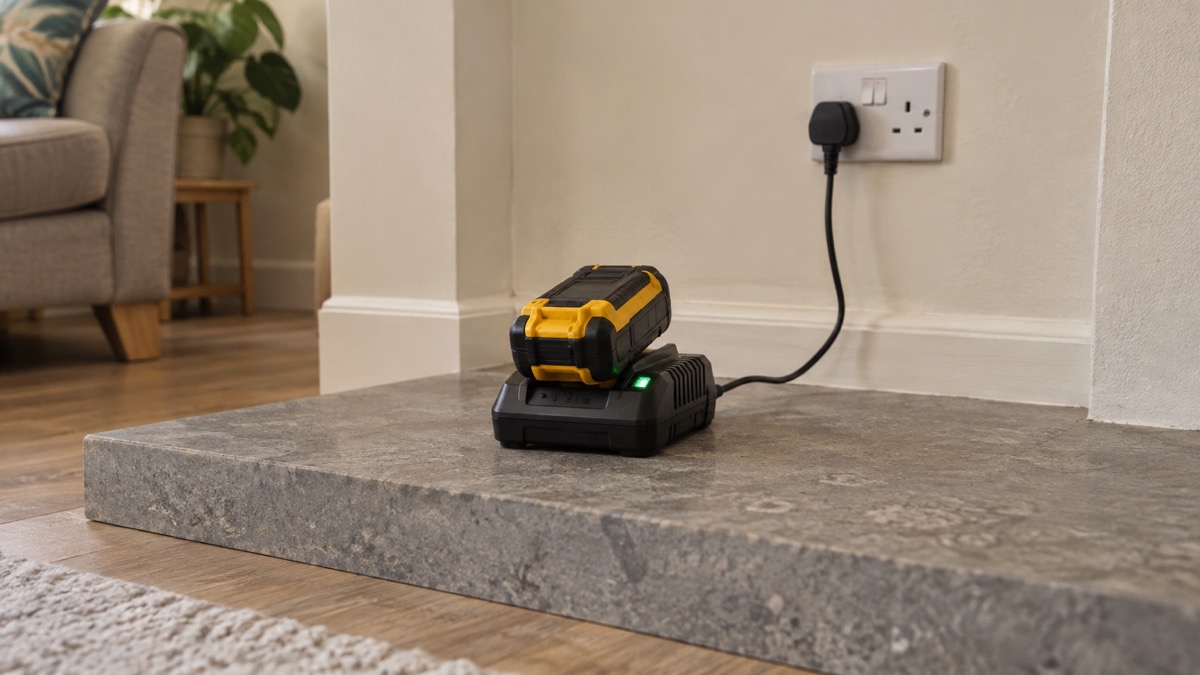
- Charge on a hard, flat, heat-resistant surface, away from extreme heat, cold, direct sunlight and flammable materials2.
- Charge in a safe, visible location. Avoid charging near flammable materials or in escape routes19.
- Do not cover devices while charging. Covering traps heat and increases fire risk, and you should not charge under pillows or blankets23.
- Do not use damaged batteries. If a battery shows signs of overheating, swelling or other forms of damage, do not use it; dispose of it appropriately and report the defect to the manufacturer20.
- Replace worn batteries promptly. Replacing damaged or worn-out batteries reduces the risk of malfunctions and fires25.
The same rules apply to every lithium-ion device in the home, not just power tools. Charge on a hard, flat, heat-resistant surface, away from extreme heat, cold, direct sunlight and flammable materials, and keep the battery in a safe, visible place where it blocks no escape route25. If you charge a tool battery, charge it the same way you would charge a phone: on a hard surface, in sight, and not overnight while you sleep.
Disposing of damaged batteries
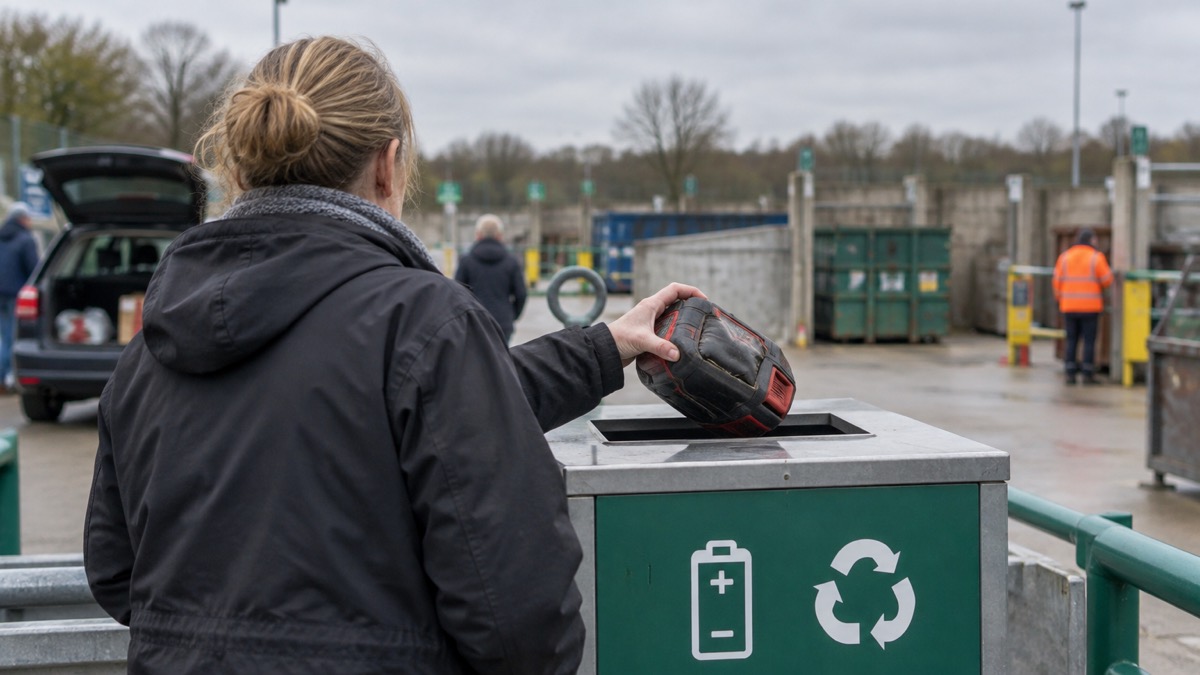
This is the rule households most often get wrong. Do not dispose of a damaged or end-of-life battery in your household waste or normal recycling; when punctured or crushed, these batteries can cause fires in bin lorries, recycling and waste centres3. The Welsh fire and rescue guidance is explicit that crushed or punctured batteries can cause fires in bin lorries and recycling and waste centres24.
What to do instead:
- Contact the manufacturer for specific advice on how to dispose of a damaged battery or device safely, and to confirm that it is safe to transport it18.
- Take it to your local household waste recycling centre (the tip) if in doubt27.
- Use the UK Government's hazardous waste disposal finder for large or damaged lithium batteries, or if you are unsure19.
- Check items for hidden batteries before recycling them25.
Using power tools safely after a storm or flood
The point at which a cordless tool is most useful is also the point at which the surroundings are most dangerous. After a flood, the London Fire Brigade's winter guide says floodwater can be hazardous and advises wearing rubber boots and gloves in and around the affected property14. A cordless tool removes one hazard, the mains lead, but it does not remove the others.
Before you start work after a storm or flood:
- Wait until it is safe to enter. Do not work in a property that has not been made safe.
- Wear rubber boots and gloves in and around a flooded property14.
- Keep the tool and battery dry. A wet battery and charger are a shock and fire risk.
- Work in good light. Use a battery work light rather than a torch in your mouth.
- Do not charge a battery in a damp or flooded space. Charge indoors, on a hard, flat, heat-resistant surface2.
For the wider picture on storms and floods, see Storms, Snow and Ice: A Household Guide and Flooding: A Household Guide.
Support and warranty in the UK
DeWalt sells through UK retailers and supports its products through the manufacturer's own warranty and service arrangements. The general rules that apply to any appliance apply here too.
- Register your product. Registering your product with the manufacturer validates any warranties, and batteries are usually included in warranties; registering also makes it easier for manufacturers to contact you with safety or recall information3.
- Keep your proof of purchase. You will need it if you claim on a warranty.
- Check for recalls before you rely on kit. Check your appliances are not subject to a product recall by checking the Office for Product Safety and Standards alerts and recalls page28.
- Use the maker's own instructions. Always follow the manufacturer's instructions when charging, storing, disposing of or replacing batteries and chargers27.
For appliances generally, registration means manufacturers can contact you about faults or recalls29, and Electrical Safety First lists recalls and safety notices29. If you are unsure whether a DeWalt product is covered, contact the manufacturer directly.
Safety notices and recalls
Product recalls are rare, but they matter more in an emergency kit than anywhere else, because the kit is what you reach for when things have already gone wrong. The checks are quick:
- Check the Office for Product Safety and Standards alerts and recalls page for product recalls28.
- Check Electrical Safety First for recalls and safety notices29.
- Register your product so the manufacturer can contact you if a safety repair is needed29.
- Stop using anything that shows signs of damage. If a battery shows signs of overheating, swelling or other damage, do not use it; dispose of it appropriately and report the defect to the manufacturer20.
For the wider context on how the UK handles product safety and emergencies, see How the UK Prepares for Emergencies: A Household Guide and Home Emergencies: Fire, Carbon Monoxide, Gas Leaks and Burst Pipes.
Sources (29)
- Batteries and charging safety, Essex County Fire and Rescue Service, 2026-10-29
- Battery safety, Greater Manchester Fire and Rescue Service, 2026-10-29
- E-bikes and e-scooters, South Wales Fire and Rescue Service, 2026-07-29
- Ratings of electrical appliances, Electrical Safety First, 2026-10-25
- Lithium-ion batteries, South Wales Fire and Rescue Service, 2026-01-13
- Be prepared for emergencies, North Devon Council, 2026-10-29
- WeatherReady winter poster, Met Office, 2026-10-28
- Planning for an emergency kit, Wiltshire Council, 2026-10-29
- Snow and ice weather warning: information and advice, nidirect, 2026-02-14
- Emergency kit, Ready Scotland, 2026-10-22
- Power cuts, Scottish Fire and Rescue Service, 2026-10-25
- How you can prepare for a power cut, Lancashire Prepared, 2026-10-29
- Keeping well in winter, NHS, 2026-10-29
- Extreme weather winter guide, London Fire Brigade, 2025-01
- Advice for disabled persons and carers, Be Ready, 2026-10-20
- Parental letter re power shortages, NHS North West Children's Operational Delivery Network, 2022-11-25
- Storm Darragh: how you can stay safe, Devon and Somerset Fire and Rescue Service, 2024-12-06
- Charging safety, Oxfordshire County Council, 2026
- Lithium battery fire safety, Mid and West Wales Fire and Rescue Service, 2026-10-26
- Battery fires, Devon and Somerset Fire and Rescue Service, 2026
- Be ready for emergencies, Be Ready, 2026-10-21
- Product safety campaigns, Peterborough City Council, 2026-10-29
- Lithium battery fire safety, North Wales Fire and Rescue Service, 2026-10-29
- Lithium battery fire safety, Mid and West Wales Fire and Rescue Service, 2026-10-29
- Be Battery Aware, Greater Manchester Fire and Rescue Service, 2026-10-29
- Electrical safety, Lincolnshire County Council, 2026-10-29
- E-bikes, e-scooters and mobility scooters, Greater Manchester Fire and Rescue Service, 2026-10-29
- Maintain appliances and recalls, Greater Manchester Fire and Rescue Service, 2026-10-29
- White goods, Cheshire Fire and Rescue Service, 2026-05-20