
Alpkit is a British maker of outdoor and camping equipment, and one item in its range has long had a place in UK household emergency kits: the Alpkit Survival Bag, a simple bag-shaped shelter that keeps a person off the wind and rain in an emergency. At the time of writing, the Survival Bag is listed as sold out on the maker's own product page. That matters if you were planning to add one to your grab bag, but it does not stop you preparing: everything else a household emergency kit needs can be assembled now, and this page sets out how.
A sold-out listing is not a discontinuation. It means the maker has no stock to sell at that moment, and no restocking date has been given. The practical response is to build the rest of your kit without delay, keep an eye on the product page, and treat the Survival Bag as one option among several for emergency shelter rather than the piece that everything else waits on.
This page also covers the parts of dealing with any maker that households ask about most: what to do when emergency kit is recalled for safety, how to return or pass on equipment you have finished with, including the maker's Continuum Project, and what the maker says about its carbon neutral status and emissions targets.
The Survival Bag is sold out: what that means for you
The Alpkit Survival Bag appears on the maker's site as sold out. Nothing in the listing indicates the product has been withdrawn permanently, and no recall or safety notice applies to it. A sold-out listing is a stock position, not a product decision, and the maker has not published a date for when new stock will arrive.
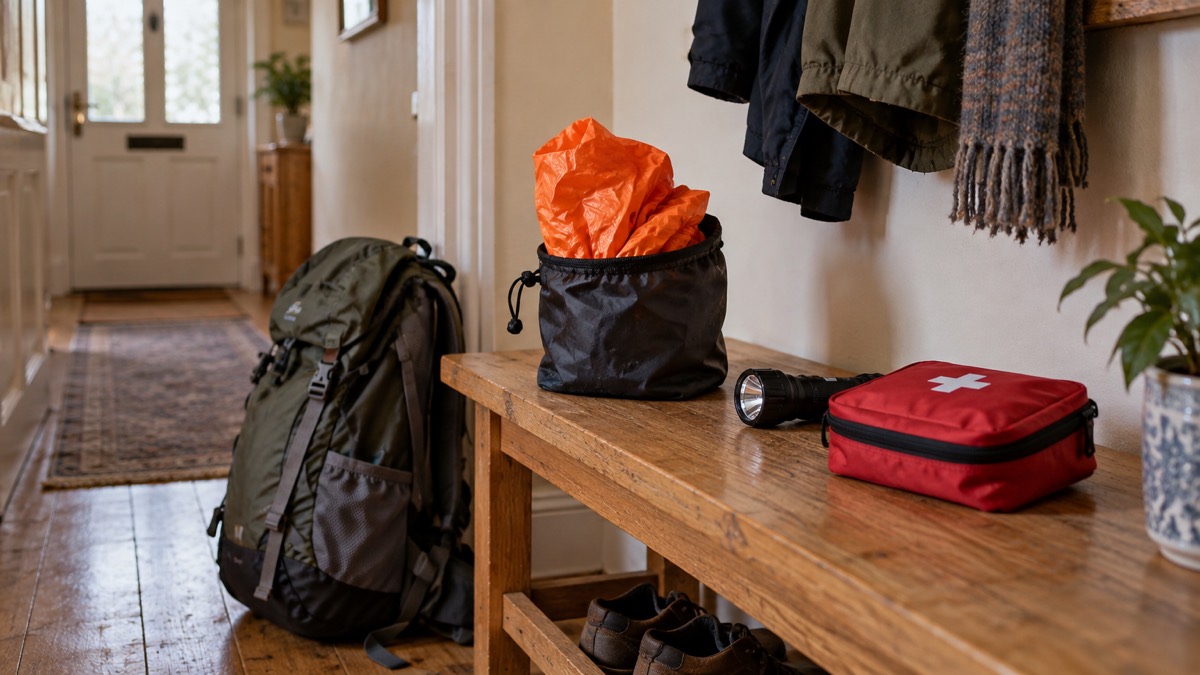
For a household building an emergency kit, the honest position is this: you cannot buy this specific item today, and you should not delay the rest of your preparations waiting for it. An emergency kit is a collection of items whose value comes from being ready before anything happens, and every UK council and government preparedness page makes the same point: assemble the kit now, check it regularly, and improve it over time. Preparedness pages across the four UK nations publish emergency kit checklists1.
If emergency shelter is what you want from a survival bag, the function to look for elsewhere is a windproof, waterproof layer that a person can get inside or under quickly, small enough to live in a rucksack or car boot. Our emergency kit guide covers what a UK household should keep ready and how to choose each item by what it does, and our storms and snow guide covers shelter and warmth when severe weather is forecast.
Building your emergency kit while it is out of stock
The items that UK official guidance actually names for a household emergency kit are unglamorous and available anywhere. Rather than waiting on one product, work through the official checklists and fill the gaps. The table below gathers what councils and government services across the four nations recommend.
| Item | Why it is recommended | Source |
|---|---|---|
| First aid kit | A core item in emergency kit advice | 1 |
| Whistle | To signal for help | 2 |
| Spare keys | Spare keys for your windows, car and house | 4 |
| Blankets | For the home kit, and a blanket for the car kit | 11 |
| Essential medicines | Named in the Northern Ireland flood kit advice | 13 |
| Water for drinking and sanitation | Named in Lincolnshire's emergency kit advice | 2 |
| Spare clothing | Named in the Hampshire wildfire grab bag advice | 14 |
| List of emergency contact numbers | Keep one at home in case of an emergency | 3 |
| Pet care items | If required, per Lincolnshire's advice | 2 |
| Jump leads | For the car emergency kit | 3 |
Two points from the official guidance are worth dwelling on. First, the kit is not just for floods or storms: Neath Port Talbot's checklist and Carmarthenshire's advice both treat it as an all-hazards kit for any emergency or disruption3. Second, the advice on what to do when something happens is consistent across nations. Carmarthenshire's emergency planning guidance puts it plainly:
If an emergency is happening right now and you are told to shelter, the principle is go in, stay in, tune in: go indoors, close windows and doors, and follow local radio, television or the internet for public information and advice from the emergency responders. Keep a battery or wind-up radio in your kit so you can still receive that advice during a power cut, and check it works before you need it.
That applies when it is not safe to go out12. Our staying informed guide covers how to keep receiving information when the usual channels fail, and our water and food guides cover the stores side of the checklist in detail. If anyone in your household depends on medical equipment or needs extra help, our extra help page explains the Priority Services Register and how to join it.
Checking kit, replacing what expires, and the Continuum Project
Alpkit runs what it calls the Continuum Project, a scheme for passing on kit you no longer need so that serviceable equipment finds a second user instead of a bin. For a prepping household, this works in both directions: it is a way to pass on outdoor kit you have upgraded or stopped using, and a reminder that emergency kit has a working life and needs checking.
The clearest official statement of why checking matters comes from the Health and Safety Executive's first aid guidance:
"Check your kit regularly. Many items, particularly sterile ones, are marked with expiry dates. Replace expired items, disposing of them safely"
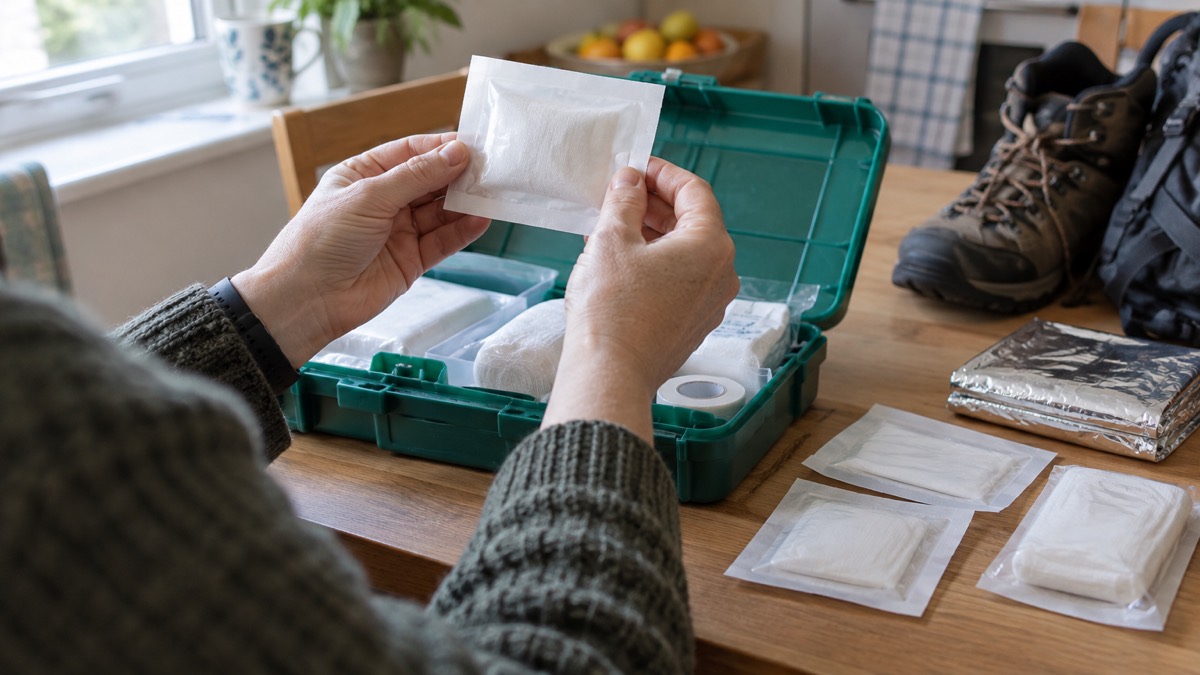
The HSE's advice is written for workplace first aid kits, but the principle is the same at home: sterile dressings and other dated items expire, and an expired item in an emergency is a gap in your kit you may not notice until you need it15. The same lesson appears in the government's COVID-19 self-test guidance, which was updated to remove information about ACON flowflex, Orient Gene and SureScreen test kits because, in the government's own words, "all test kits issued will have expired by now"16. Test kits bought or issued during the pandemic are a common item in UK households' leftover supplies, and they should be treated as expired and disposed of, not counted as part of your preparations.
A practical routine follows from this:
- Check your first aid kit regularly and replace expired sterile items, disposing of them safely15
- Pass on outdoor and camping kit you no longer use through the maker's Continuum Project rather than discarding it
- Recheck the whole household kit at least once a year, and after any emergency in which you used it
Safety notices and recalls that touch emergency kit
No recall or safety notice in the pack applies to Alpkit products. But several recent recalls apply to items that households commonly keep in or alongside an emergency kit, and knowing how recalls work protects you whichever brand you own. Bath and North East Somerset Council's guidance defines the term simply:
"A product recall is when an item or items must be returned to the manufacturer because there is a safety problem."
The table below lists recent recalls and safety notices relevant to emergency kit, with the action each one asks owners to take.
| Product | Date of notice | Action for owners |
|---|---|---|
| Anker power banks A1681, A1689 and A1647 (sold via TK Maxx) | 23 July 2025 | Stop using immediately and return to any TK Maxx store for a full refund5 |
| XO Poppy Super Power 10,000 mAh power bank (sold by TK Maxx) | 17 March 2026 | Stop using immediately and return to your nearest TK Maxx store for a full refund6 |
| Electric rechargeable hand warmer HZU003 (sold via Amazon and eBay) | 11 February 2025 | Listing removed by the online marketplace17 |
| B&Q GoodHome Saturnia electric blanket | 15 December 2025 | Stop using, unplug from the mains, return to nearest B&Q store for a full refund7 |
| Hamilton McBride single, double and king size electric blankets | 31 October 2024 | Stop using immediately and return to nearest store for a full refund18 |
| Valiant radiator fan (batches 967, 968 and 970) | 7 November 2025 | Recalled from end users; dispose of the product and email confirmation to the retailer for a full refund19 |
| Habico jars of coloured sand | 9 July 2026 | Stop using immediately and return to the retailer where specified for a full refund20 |
| Deltronic Security AB environmental alarm | 18 November 2025 | Recalled from end users; affected units were manufactured between April 2022 and 4 July 202221 |
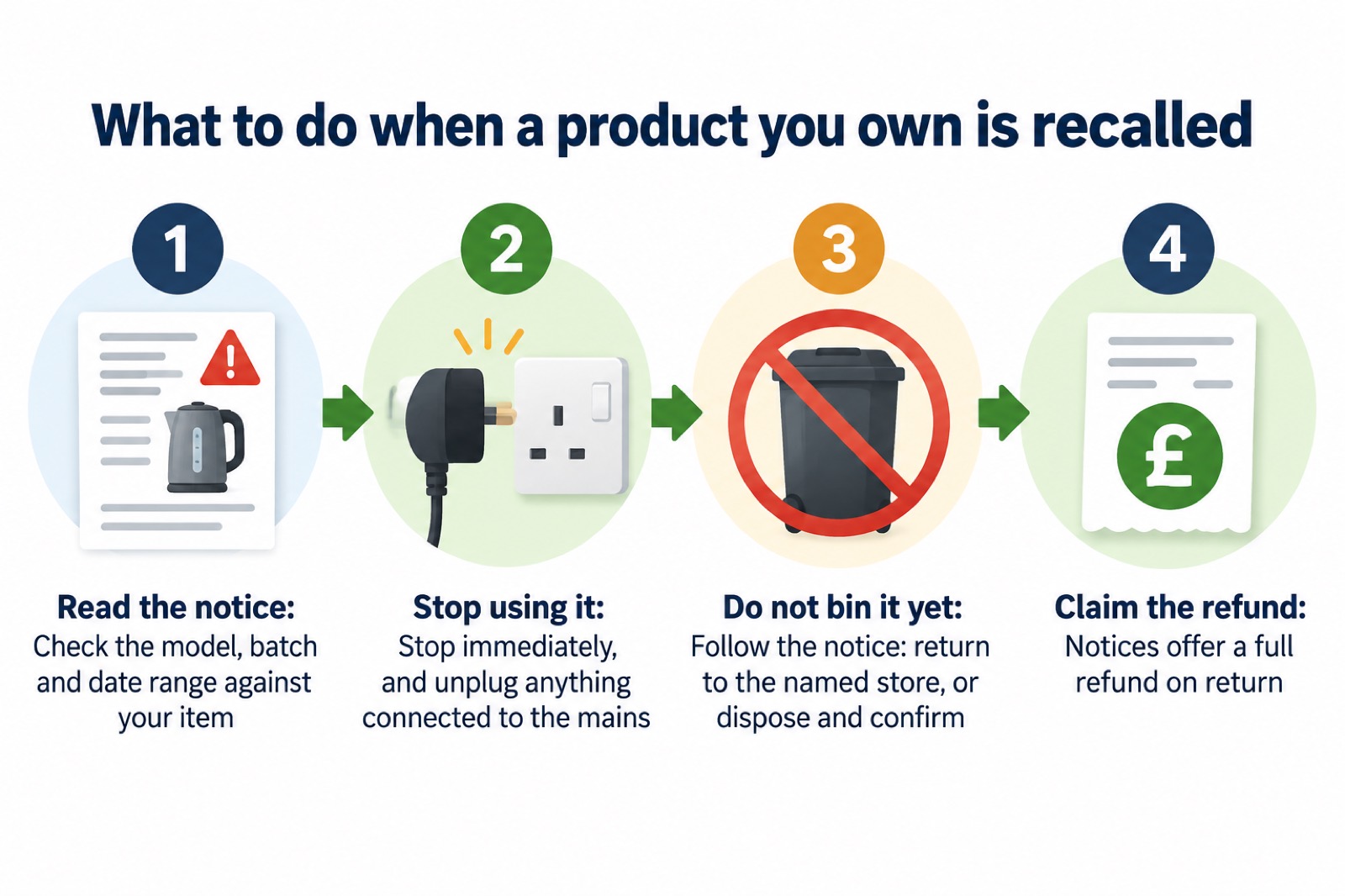
The pattern across these notices is consistent, and it is the pattern to follow for any recall, from any maker. Stop using the product. Unplug it if it is plugged in. Return it to the retailer named in the notice for a full refund, or dispose of it and confirm as instructed. London Fire Brigade's registration guidance describes what happens after an alert: the maker or retailer "may ask you to stop using the product until it has been repaired, replaced or returned"22.
Our backup power guide covers choosing and using power banks safely, and our lighting and heating and cooking guides cover the other kit types most often affected by recalls.
Returning kit you have finished with
Not everything you send back is faulty. There are three distinct routes, and using the right one matters.
Recalled products go back to the maker or retailer. As the Bath and North East Somerset definition sets out, a recall means the item must be returned to the manufacturer because there is a safety problem23. The return is to the store named in the notice, and a full refund is the standard remedy: the Anker, XO Poppy, B&Q, Hamilton McBride and Habico notices all offer one5.
Used vapes and e-cigarettes go back to any retailer that sells them. Manchester Fire and Rescue Service states the rule directly:
"Return used vapes or e-cigarettes to the retailer. Shops are legally required to offer a take-back scheme."
Vapes and e-cigarettes can be returned to any retailer, as shops are legally required to offer a take-back scheme8. This matters for battery safety as well as waste: vapes contain lithium batteries, which pose a fire risk when thrown into household waste.
Serviceable kit you no longer need can be passed on. This is where the maker's Continuum Project fits: outdoor equipment in working order finds a new user rather than a landfill. If you are replacing emergency or camping kit because you have upgraded it, not because it is faulty or expired, passing it on is the better route. If it is expired, as sterile first aid items and old test kits will be, replace and dispose of it safely instead15.
Registering your appliances closes the loop on the recall route. London Fire Brigade advises registering e-bikes and e-scooters for safety alerts and product recalls, so that when a problem is found the maker can reach you directly22. Any mains-powered item in your emergency kit, from a torch charger to an electric blanket, is worth registering with its maker.
Alpkit's carbon commitments: carbon neutral, scopes and targets
Alpkit states that it operates as a carbon neutral business under PAS 2060, the recognised standard for demonstrating carbon neutrality. The maker also publishes targets for reducing its emissions rather than only offsetting them, and its stated commitments are these:
- Halve Scope 1 and Scope 2 emissions by 2025, based on a 2018 base year
- Reduce total carbon intensity by 15% every year, to achieve what the maker calls genuine net zero by 2050
- Limit global warming to 1.5°C, in line with the Science Based Targets Initiative
The maker's own pages give these commitments in two slightly different wordings, one of which names the 1.5°C limit as part of the same target statement and one of which does not; the figures themselves, the 2025 halving date, the 2018 base year, the 15% yearly intensity reduction and the 2050 net zero date, are the same in both. The maker states all of them on its own product page, dated 25 October 2026.
What the scopes mean, in plain terms, is which emissions the targets cover. Scope 1 is what the company emits directly, from sources it owns or controls, such as fuel burned in its own vehicles or premises. Scope 2 is the emissions created in producing the energy it buys, mainly electricity. Scope 3 is everything else in the chain: materials, manufacturing, shipping and the use and disposal of products. Carbon neutrality under PAS 2060 involves measuring these emissions and offsetting what remains, while the reduction targets are the maker's stated plan to shrink the emissions themselves rather than only compensate for them.
For a household choosing kit, none of this changes what you buy or how you use it, but it answers a question people increasingly ask of the brands they buy from. The maker's own statements are the source for all of the figures above, and where its wording varies between its own pages, both readings are given here rather than one being chosen over the other.
Where to go next
If you arrived here because you were looking for a Survival Bag and found it sold out, start with our emergency kit guide and build the rest of the kit now; the official checklists above tell you exactly what belongs in it. If you already own kit, check it against the recall table, register your appliances, and set a yearly date to replace expired items. And if you have outdoor equipment you no longer need, the Continuum Project is the maker's route for passing it on.
Sources (23)
- Preparing for an emergency, Nottinghamshire County Council
- Get help and advice in an emergency, Lincolnshire County Council
- NPT Prepared: emergency kit checklist, Neath Port Talbot Council
- Planning for an emergency kit, Wiltshire Council
- Product recall: Anker power banks A1681, A1689 and A1647, UK Government, 23 July 2025
- Product recall: XO Poppy Super Power 10,000 mAh power bank sold by TK Maxx, UK Government, 17 March 2026
- Product recall: B&Q GoodHome Saturnia electric blanket, UK Government, 15 December 2025
- Be battery aware, Manchester Fire and Rescue Service
- Vaping fire safety, Manchester Fire and Rescue Service
- Prepare for emergencies, Dumfries and Galloway Council
- Emergency kit, Ready Scotland
- Get prepared, Carmarthenshire County Council
- Preparing for flood, nidirect, Northern Ireland
- Reduce the risk of wildfire damage to your property, Hampshire and Isle of Wight Fire and Rescue Service
- What to put in your first aid kit, Health and Safety Executive
- COVID-19 self-test help, UK Government, 30 April 2024
- Product safety report: electric rechargeable hand warmer sold via Amazon and eBay, UK Government, 11 February 2025
- Product recall: Hamilton McBride single, double and king size electric blankets, UK Government, 31 October 2024
- Product recall: Valiant radiator fan, UK Government, 7 November 2025
- Product recall: Habico Ltd 350g jars of coloured sand, UK Government, 9 July 2026
- Product recall: Deltronic Security AB Environmental Alarm, UK Government, 18 November 2025
- Registering your e-bike or e-scooter for safety alerts and product recalls, London Fire Brigade
- Product recalls, Bath and North East Somerset Council