
ACON is a maker of rapid test kits, and its products turn up in ordinary UK homes as part of a household's health supplies rather than as emergency equipment. If you have a box in a cupboard and are wondering how it fits a plan for a power cut, a flood or an outbreak, the short answer is that it is a small, single-use item: it does not need power, it does not keep indefinitely, and its value in an emergency depends entirely on it being in date and its instructions being to hand when you need them.
What matters for preparedness is therefore not the everyday use of the kit but three things: knowing what you hold and when it expires, keeping the instructions with it, and knowing how to check a model or batch code and who to contact if something is wrong. The same habits apply to any small electrical or medical item in a home emergency kit, and they are the ones official guidance keeps returning to.
This page covers who ACON is, what its kit means for a household getting ready for disruption, how to store and check it, and where to get help. It does not rank products or compare makers.
What ACON makes for UK households
ACON's products are rapid diagnostic test kits, the kind a household keeps for its own use rather than for treating anyone. In a preparedness context that places them in the health supplies part of a kit, alongside medicines and a first aid kit, rather than in the lighting, power or cooking boxes.
That distinction matters because the two sorts of kit fail in different ways. A torch or a power bank depends on batteries and charging, and official fire guidance treats the lithium-ion batteries in everyday devices, from mobile phones to vacuum cleaners, as something to store and charge with care1. A test kit has no battery and no charger. What it depends on is being in date, being stored somewhere dry and being used with the instructions in front of you.
A household emergency kit is built around the basics: water for drinking and sanitation1, a first aid kit kept stocked at home, in your vehicle or at work2, and a torch, batteries and a first aid kit kept handy for winter3. A test kit sits naturally with that group. It is not a substitute for any of those items, and no emergency kit list makes a test kit essential. Treat it as a useful extra that a household may already hold, not as a reason to delay building the core kit.
If you are starting from nothing, the emergency kit guide sets out what a UK household should keep ready, and the health emergencies guide covers outbreaks, pandemics and medicine supplies in more depth.
ACON kit in a home emergency supply
The practical question for a household is what happens to a test kit when the power goes, the water stops or the house floods. The answer is reassuring: the kit itself is unaffected by a power cut, because it needs no power. What changes is everything around it. You may be using it by torchlight, in a cold room, or in a house where the heating has failed.
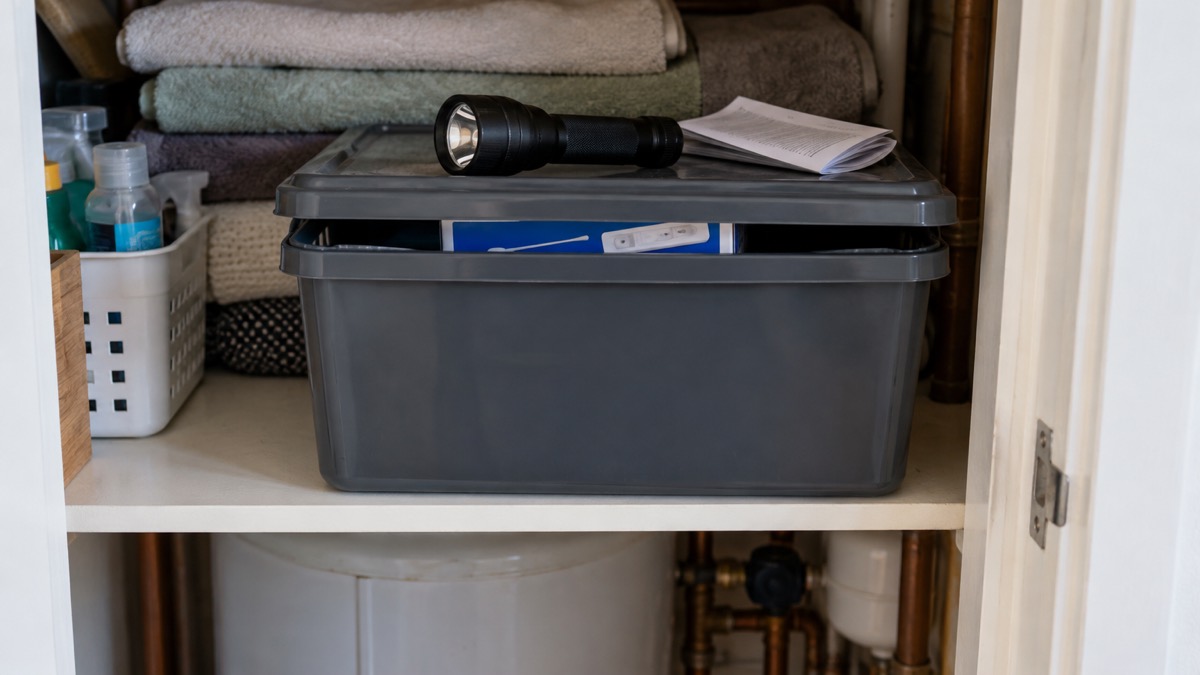
That makes two things worth doing before an emergency rather than during one. First, keep the kit somewhere you can reach without moving furniture or hunting through cupboards, and keep a torch with it. Official guidance on building a kit suggests plastic boxes or backpacks to keep supplies together, kept in a designated place that all household members know3. Second, keep the instructions with the kit. A leaflet that has drifted to the back of a drawer is no use in the dark.
A test kit also has a shelf life, and an expired kit is worse than no kit because it invites a false result. Check dates when you check the rest of your supplies, and replace what has gone out of date rather than keeping it "just in case".
| What the kit needs | Why it matters in an emergency | What to do |
|---|---|---|
| No mains power | A power cut does not stop you using it | Keep a torch and spare batteries with it |
| A dry, stable place | Damp and damage spoil single-use items | Store in a closed box in a known place |
| Instructions to hand | Steps and timings differ between products | Keep the leaflet in the box |
| An in-date kit | Expired stock gives unreliable results | Check dates at each seasonal review |
Seasonal reviews are a good habit anyway. Winter preparation advice from councils includes checking you have a torch, batteries and a first aid kit handy, and stocking up on salt or grit for paths4. Add the health supplies to that same check and the kit stays current without extra effort.
Choosing the right ACON kit for your household
There is no single right answer to which test kit a household should hold, and this page does not rank them. What can be said is how to decide what to keep and how much.
Start from who lives in the house. A household with someone who is clinically vulnerable, or who relies on medical equipment at home, has a stronger reason to keep health supplies current and to keep the paperwork with them. Official guidance for people using medical oxygen at home, for example, is to store the equipment in a well-ventilated area, kept clean, dry and away from heat sources such as gas or electric fires and cookers5. The same principle of a clean, dry, known place applies to test kits.
Then think about how you would use the kit in a disruption. If the answer is "to check symptoms during an outbreak when getting to a pharmacy is hard", keep enough for the household for the period you might be cut off, and keep the instructions. If the answer is "occasionally, for peace of mind", one box checked regularly is enough.
First aid guidance offers a useful model for splitting supplies: you may choose to have two kits, a large one that stays at home and a smaller emergency kit for when you go out6. The same split works for health supplies. Keep the main stock at home and a small, in-date amount in a grab bag, and check both on the same schedule.
- At home: the main stock, in a closed box, with instructions and a torch
- In a grab bag: a small in-date amount, plus any essential medication and medical information
- With the paperwork: model, batch reference and expiry dates, so you can check them against a recall
- For vulnerable household members: a note of who to contact, kept with the kit
Using ACON kit safely
The safety rules for a test kit are mostly about the things around it rather than the kit itself. You will often be using it in poor light, possibly with a candle or a camping stove nearby, and that is where the risk lies.
Fire and rescue services are consistent on open flame. If you use candles or a camping stove during a power cut, keep them stable and away from anything that can catch, and make sure cooking appliances are stable and cannot be knocked over easily1. A test kit needs a flat, clean, well-lit surface; a kitchen worktop cleared of clutter is better than a sofa in a dark room.
Keep the kit away from children and pets, and wash your hands after use as the leaflet directs. If a test result worries you, do not treat it as a diagnosis: call 111 for advice, and call 999 in an emergency.
Store the kit away from heat and damp. The same logic that applies to oxygen equipment, kept clean, dry and away from heat sources5, applies to any single-use medical item. A cupboard in a cold hallway is better than a shelf above a radiator or in a bathroom where steam collects.
Storing ACON kit so it is ready when needed
Storage is where most household kits quietly fail. The item is there, but the instructions are gone, the date has passed, or nobody except one person knows where it lives.
Official guidance is straightforward: use plastic boxes or backpacks to keep supplies together, and keep the kit in a designated place that all household members know3. Apply that to health supplies as well as to torches and water. Label the box, tell everyone in the house where it is, and include it in the same seasonal check as the rest of your kit.
A simple routine works:
- Put the kit in a closed, labelled box in a dry place, with the instructions inside.
- Write the expiry date on the outside of the box so it can be seen without opening it.
- Check the box at each seasonal change, alongside the torch, batteries and first aid kit1.
- Replace anything out of date, and note the model and batch reference of the new stock.
- Keep a torch and spare batteries in or beside the box, so the kit can be used in a power cut.
If you keep a larger household store, the backup power guide and the lighting guide cover the equipment that does need charging and checking, and the power cuts guide sets out what to do when the supply fails.
Safety notices and recalls
Product recalls are the one area where a household can be caught out by an item it has owned for years. Manufacturers issue recall notices if an electrical appliance could develop a fault, including a risk of electric shock or fire9. Test kits are not electrical, but the same discipline applies: check what you hold against official notices.
Official fire safety guidance says to check your appliances are not subject to a product recall by looking at the Office for Product Safety and Standards alerts and recalls page10. If an appliance is not listed as recalled it should be safe to use, and if you have concerns about its safety, contact the retailer or manufacturer9.
Recall notices show what the details look like. A recall of a fire alarm detection system, for example, was tied to a specific batch, with serial numbers running from XAB.2410.01.0001/17518/06.00 to XAB.2410.01.0528/17518/06.0011. A safety report on a caregiver pager listed the product identifiers and the Amazon ASIN, and advised buyers to stop using the product immediately and contact the seller for redress12. The lesson for any household is the same: the batch or model reference is what lets you tell whether your item is affected.
Keep a note of the model and batch reference of any test kit you hold, in the same place as your other household records. If a notice appears, you can check it in minutes rather than guessing.
Support and warranty
Support for a household product runs through the seller first and the maker second. Official fire safety guidance for a faulty electrical item is to stop using it and contact the shop where you bought it from13. For a safety concern about an appliance, official guidance is to contact the retailer or the manufacturer9.
Registration is the habit that makes support work. Registering an appliance ensures manufacturers can contact you if a safety repair is needed1. Keep the model name or number, the serial number and the purchase date with the kit, so they are to hand for a warranty claim or a recall check.
If you need to raise a problem, have these ready:
- The model name or number and the serial number
- The purchase date and proof of purchase
- The batch or lot reference from the pack
- A note of what went wrong and when
For help with an older relative or neighbour who may be relying on out-of-date supplies, local councils and charities can advise. Winter wellbeing guidance suggests contacting your local council or calling the Age UK helpline on 0800 678 1602, open 8am to 7pm every day, if you are worried about a relative or elderly neighbour14. The extra help guide covers older, disabled and medically dependent households in more detail.
Where to get help in an emergency
In a genuine emergency, the route is the same whatever kit you hold. NHS advice is to go to A&E immediately or call 99914. If you are not sure whether a situation is an emergency, call 111 for advice.
For a carbon monoxide emergency where lives are at risk, call 999 and ask for an ambulance and the Fire and Rescue Service8. For further carbon monoxide advice in Northern Ireland, the Health and Safety Executive for Northern Ireland can be reached on 0800 0320 1218.
If someone collapses and an AED is needed, staff in Emergency Operations Centres can direct 999 callers to the nearest registered AED and provide access codes for secure cabinets if required15. It is worth knowing where your nearest one is before you need it.
Other useful contacts for a household in disruption include the British Red Cross on 0844 871 1111 and the Association of British Insurers on 020 7600 3333, both listed in flood recovery guidance16. The first aid guide and the home emergencies guide set out what to do in the first minutes of a fire, a gas leak or a carbon monoxide alarm.
Sources (16)
- Lithium-ion batteries safety guidance, South Wales Fire and Rescue Service, 2026
- Household emergency kit, nidirect, 2026
- Emergency supplies kit, Denbighshire County Council, 2020
- Be winter ready, Lancashire County Council, 2026
- Home oxygen and fire safety, Greater Manchester Fire and Rescue Service, 2026
- First aid, nidirect, 2025
- Preventing exposure to carbon monoxide, NHS England Learning Hub, 2026
- Safer together: fire risk identification and management, Northern Ireland Fire and Rescue Service, 2021
- Electrical safety at home, Scottish Fire and Rescue Service, 2025
- Maintain appliances and recalls, Greater Manchester Fire and Rescue Service, 2026
- Product recall: Bull and Cygnus fire alarm detection system, Office for Product Safety and Standards, 2026
- Product safety report: ALEENFOON caregiver pager, Office for Product Safety and Standards, 2026
- Digital easy read fire safety booklet, London Fire Brigade, 2026
- Stay well this winter, NHS Cheshire and Merseyside, 2026
- AEDs and community involvement, Northern Ireland Ambulance Service, 2026
- Before, during and after a flood, Suffolk County Council, 2021